


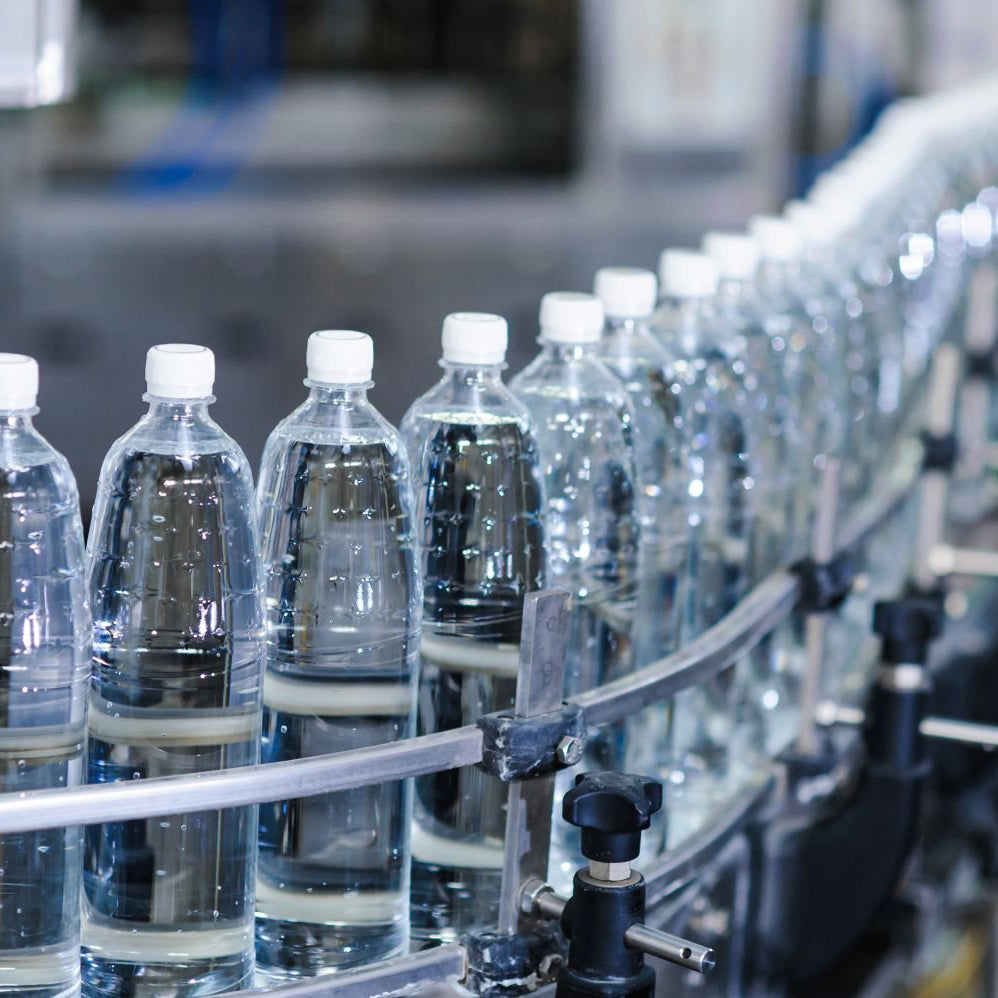
Walk into a PET bottling plant and the stretch blow molder is the machine everyone points at. It is loud, it is expensive, and it has its own compressor sitting next to it making air at pressures most shops never see.
Now ask the maintenance manager what actually stopped the line last month. Nine times out of ten it was not the 40 bar machine. It was a sticking valve on the filler, a wet line into the capper, or a rinser that failed a swab test. The glamorous half of the air system gets the attention. The other half is the one you live with every day.
That is the half this is about. Compressed air for PET bottling is really two separate systems that happen to share a building, and most of the operating pain sits on the low pressure side.
Two Pressures, Two Different Machines
A PET line needs air at two levels and they are not interchangeable.
The high pressure side is the blow air itself. Published figures put it at roughly 30 to 40 bar, which is about 435 to 580 psi. Plain still water bottles usually sit near the bottom of that band, around 30 to 35 bar. Carbonated bottles and large format containers want 35 to 40 bar because the base has to form fully, and some specialty shapes go higher still. That air comes from a dedicated high pressure booster or a multi stage piston machine built for the job.
The low pressure side is everything else, and it runs at ordinary plant pressure, roughly 7 to 8 bar or 100 to 115 psi. This is the air that moves preforms, cools the oven chain, actuates several hundred valves across the blower, filler, capper, labeler and case packer, rinses bottles, blows water off them before coding, and feeds caps down the track.
The mistake that shows up over and over is trying to serve both from one machine. Regulating 40 bar air down to 8 bar for valve actuation is one of the most expensive things you can do in a plant. You paid to compress it four or five times further than you needed and then threw the work away across an orifice. If your line was built that way, splitting it is usually the largest single energy project on the floor.
What We Sell and What We Do Not
Straight answer, because this is the kind of vertical where overclaiming wastes everyone's week. We do not sell 40 bar PET boosters. That is specialist machinery, it usually comes through the blow molder OEM or a high pressure house, and anyone telling you a standard rotary screw gets you there is selling you something that will not work.
What we do sell is the entire low pressure side and the treatment train on both sides: rotary screws and oil free packages, refrigerated and desiccant dryers, filtration, receivers, drains, and the piping that ties it together. And here is the part people miss. The booster does not make clean air. It takes whatever your plant air system hands it and compresses that further. Every contaminant you leave upstream ends up inside the bottle at 500 psi. The quality of your blow air is decided by the treatment train in your compressor room, not by the booster.
The Air Quality Number Your Auditor Will Ask About
This is where PET bottling stops being a generic plant air problem. Blow air goes inside the container. Rinse air goes inside the container. That is direct product contact by any reasonable reading, and it gets held to a standard.
The reference most food and beverage auditors work from is the BCAS Food and Beverage Grade Compressed Air best practice guideline, and it sets two targets against ISO 8573-1:
| Contact type | Target class | What that means in equipment |
|---|---|---|
| Direct product contact (blow air, rinse air, air inside the bottle) | ISO 8573-1 [2:2:1] or better | Water class 2 is a minus 40 pressure dew point. That is a desiccant dryer, not a refrigerated one. Oil class 1 means coalescing plus activated carbon, or an oil free machine. |
| Indirect contact (valve actuation, conveying, blow-off on closed containers) | ISO 8573-1 [2:4:2] | Water class 4 is a plus 3 C dew point, which a properly sized refrigerated dryer delivers. Ordinary coalescing filtration covers the oil class. |
Read that table again, because it contains the most useful fact in this article. The jump from indirect to direct contact is the jump from a refrigerated dryer to a desiccant dryer. It is a step change in equipment, in capital cost, and in operating cost, and it applies only to the air that actually touches product.
Which is why the right architecture for most plants is not one giant desiccant dryer on the whole plant. It is a refrigerated dryer carrying the bulk of the load, with a smaller desiccant dryer and a carbon filter dedicated to the direct contact branch. You buy the expensive treatment once, for the air that needs it. Our breakdown of refrigerated versus desiccant dryers covers how the two families differ and what the purge loss really costs.
Where the Low Pressure Air Actually Goes
| Use | Demand character | Quality needed |
|---|---|---|
| Preform feeding, hopper and air rails | Continuous while running | Indirect. Dry enough not to rust the rail. |
| Oven chain and mandrel cooling on the blower | Continuous, often the biggest single low pressure load | Indirect, but it is inside the machine, so keep it clean. |
| Valve actuation across blower, filler, capper, labeler | Cyclic, high count, small each | Indirect. Dry air here is what stops nuisance faults. |
| Bottle rinsing, air or ionized air rinse | Continuous at line speed | Direct contact. Full treatment. |
| Air conveyor for empty bottles | Continuous, large if fed from compressed air | Direct contact, since it blows across the neck finish. |
| Blow-off and air knives before coder and labeler | Continuous | Direct if the container is open, indirect if capped. |
| Cap feeding, sorting tracks and chutes | Continuous | Direct contact. Caps touch the beverage. |
| Case packing, palletizing, end of line | Intermittent | General plant quality. |
| CIP and process valve actuation | Low volume, must never fail | Indirect, but this is the branch to back up. |
Two things fall out of that list.
First, the direct contact users are mostly small. Rinse air, cap track air and open container blow-off are not where your CFM goes. The oven cooling and the conveying are. So splitting the treatment is cheap, and running the whole plant at the direct contact spec is money you did not need to spend.
Second, if your empty bottle conveyor runs on plant compressed air, go look at it this week. Air conveying of empty PET at 100 psi is one of the most wasteful things done with compressed air anywhere in manufacturing, and the modern answer is a low pressure blower feeding the air channel. Reported savings when plants make that change run around 30 percent of the conveyor's energy, and the compressed air you free up often means you do not need the next compressor at all. If you are not sure how much that conveyor is costing you, it is one of the first things a proper compressed air audit will put a number on.
Sizing, Honestly
Published figures for the blow machines themselves span a very wide range, from a couple of hundred CFM on a small machine up to several thousand CFM on a high output multi cavity line. That is the high pressure side and your blow molder OEM gives you that number on the machine data sheet. Use theirs, not a rule of thumb.
For the low pressure side, the only number worth building on is a measured one. Every OEM on your line, the filler, the capper, the labeler, the case packer, publishes an air schedule in its manual. Add those up, add the oven cooling, add the conveyor if it is on compressed air, then put a flow meter on the header for two weeks before you buy anything. Bottling plants are the classic case where measured demand lands well under the sum of the nameplates, because the air schedules assume everything peaks together and it never does.
What does deserve a rule of thumb is storage. A PET line has a nasty demand profile: steady base load with hard transients every time a mold opens, a case packer fires, or a changeover happens. Wet storage ahead of the dryer plus dry storage after it keeps the compressor from short cycling and keeps pressure flat at the filler. If pressure sags at the end of the header during a transient, the fix is almost never a bigger compressor. Getting that stored air to actually come out when the mold blows is a job of its own, and we covered it in pressure flow controllers for PET blow molding.
What PET Plants Get Wrong
- Regulating high pressure air down for plant use. Expensive, and surprisingly common on older lines.
- Treating the booster as a source of clean air. It is a multiplier of whatever you feed it. Treat upstream.
- Putting the whole plant on desiccant. Only the direct contact branch needs minus 40. Split it.
- Running the empty bottle conveyor on compressed air. Worth auditing before you buy another compressor.
- Nobody owns the air quality test. If an auditor asks for your last ISO 8573-1 result and the answer is a brochure, you have a finding waiting.
- No dryer redundancy on the direct contact branch. One desiccant dryer down on a Friday and you are either running out of spec or not running.
- Condensate going straight to the drain. Compressor condensate is oily water and it is on your discharge permit in most jurisdictions.
Frequently Asked Questions
What pressure does PET bottle blowing need?
The blow air itself is typically 30 to 40 bar, roughly 435 to 580 psi. Still water bottles sit nearer 30 to 35 bar, carbonated and large format nearer 35 to 40 bar. The rest of the line, which is most of the pneumatics in the plant, runs at ordinary plant pressure around 7 to 8 bar or 100 to 115 psi.
Can one compressor supply both the blow air and the plant air?
Technically yes, by regulating down, and it is a bad idea. You pay to compress the air to 500 psi and then throw most of that work away across a regulator. The standard arrangement is a low pressure rotary screw for plant air plus a dedicated high pressure booster for blow air, with shared treatment upstream.
What ISO 8573-1 class does bottling air need?
The commonly referenced targets are [2:2:1] for direct product contact and [2:4:2] for indirect contact. The practical difference is the water class. Direct contact calls for a minus 40 pressure dew point, which means a desiccant dryer, while indirect contact is satisfied by a refrigerated dryer at a plus 3 C dew point.
Do we need oil free compressors for a bottling plant?
Not necessarily. An oil lubricated compressor with correctly sized coalescing filtration and an activated carbon stage can meet oil class 1 on the direct contact branch. Oil free removes a failure mode and simplifies the audit conversation, which is why a lot of plants choose it, but a well maintained lubricated machine with a proper treatment train and documented testing is a legitimate answer.
Why does our capper keep faulting intermittently?
Start with water and pressure, in that order. Moisture reaching a cap track or a small pilot valve produces exactly the kind of random fault that will not repeat on the bench. After that, check whether header pressure is sagging during line transients, which points at storage rather than compressor size.
Where to Start
Find out two things. What is the measured dew point on the branch feeding your rinser and cap track, and is your empty bottle conveyor running on compressed air. Those two answers tell you whether your next spend should go into treatment or into taking a load off the system entirely.
Browse air dryers, or the filtration and rotary screw compressors that go with them. Send us your line OEM air schedules and which drops touch product, and we will spec the split system with you.


