


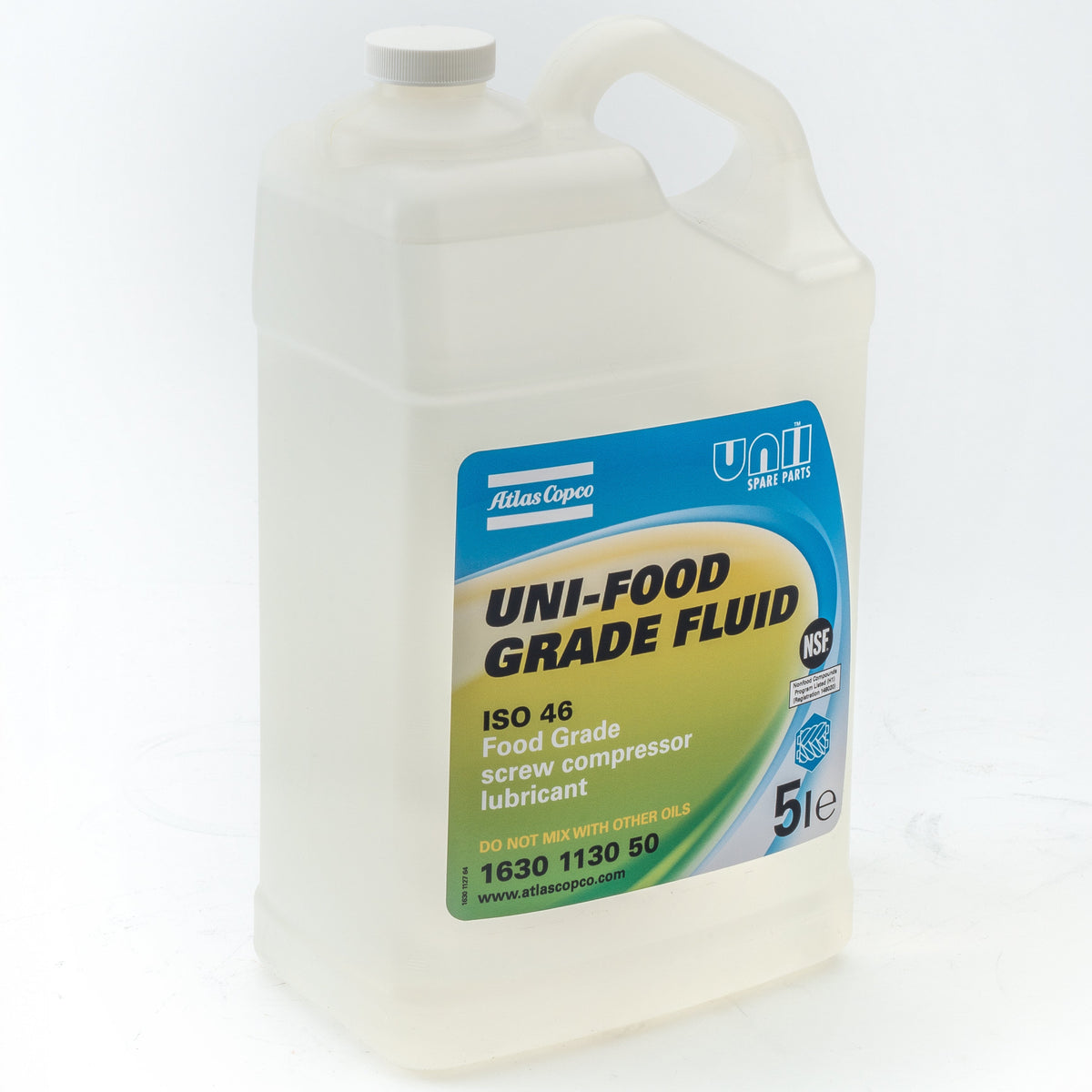
The auditor is standing in the compressor room with a clipboard. She points at the sight glass and asks one question: "Is that H1?" The maintenance lead says he thinks so. She asks for the registration number. Nobody has it. That turns into a corrective action, and now somebody is spending a week building a lubricant register for a plant that was running fine yesterday.
That scene plays out in food plants every year, and it is almost always avoidable. Food grade compressor oil is not complicated, but the rules around it are specific, and "we buy the good synthetic" is not an answer that survives an audit.
This one goes deeper on lubricants. For the whole air system picture, start with Compressed Air for Food and Beverage Processing.
What NSF H1 actually means
H1 is a registration category for lubricants that may have incidental contact with food. Not intended contact. Incidental, meaning the lubricant is not supposed to touch product, but the equipment is built and located such that a trace could get there anyway.
To earn H1, a lubricant has to be formulated only from ingredients listed in 21 CFR 178.3570, the FDA regulation that names the base stocks and additives allowed for lubricants with incidental food contact. The finished product also has to be odorless, colorless and tasteless. There is a 10 parts per million limit on base oil present in food if incidental contact does occur.
For rotary screw compressor lubricants specifically, 21 CFR 178.3570 permits polyalkylene glycols of medium and high viscosity with molecular weight above 1500. That is why so many H1 compressor coolants are PAG-based, and it matters enormously when you go to switch over. More on that below.
What H1 does not mean: it is not a performance rating. An H1 oil is not automatically better, longer-lasting or cooler running than the mineral oil you are replacing. It means the chemistry is on an approved list. Check the OEM viscosity and service interval separately.
H1, H2, 3H: know which one you are holding
| Category | What it is for | Where you see it |
|---|---|---|
| H1 | Incidental food contact possible | Compressor coolant, gearboxes, chains and bearings above the line, hydraulic fluid on packaging equipment |
| H2 | No possibility of contact | Equipment in non-production areas, floor-level drives with no path to product |
| H3 | Soluble oils, mostly corrosion prevention | Hooks, trolleys, and equipment cleaned before use |
| 3H | Direct contact release agents | Griddle and pan release, dough divider oils |
Auditors care about H1 and H2 living in separate places with separate dispensing gear. If the same transfer pump touches both, expect a finding. Keep dedicated pumps, dedicated funnels and dedicated grease guns, color coded, and label them so a temp cannot get it wrong at 2 a.m.
ISO 21469 is the bigger stamp
NSF H1 is a formulation review. ISO 21469 goes further and certifies the hygiene of how the lubricant is manufactured, packaged, transported and stored, with site audits and annual product testing. A lubricant certified to ISO 21469 automatically satisfies the requirements of H1.
Practically: if you are running an SQF or BRCGS site and you have a choice between two equivalent products at a similar price, take the ISO 21469 one. It closes a conversation with the auditor that H1 alone sometimes opens.
Where food grade oil actually belongs in a food plant
Here is the part that catches people out. Buying an oil-free compressor does not remove the need for food grade compressor oil in the building. It removes it from one machine.
Walk the plant and you will find lubricated equipment everywhere that sits above or beside open product:
- Conveyor gearboxes and chain drives over the line
- Filler and capper hydraulics
- Case packer and palletizer drives
- Vacuum pumps on pick-and-place heads
- Air compressors that are not oil-free, including the small piston unit that feeds the maintenance shop and somehow ended up teed into the plant header
That last one is common enough to be worth a walk-down this week. Plants buy a proper oil-free machine for product-contact air, then leave the old lubricated piston compressor connected as backup. The day it runs, it feeds oil-carrying air into a header that nobody expects it in.
If your compressor is oil-flooded and its air touches product or product-contact surfaces, it needs H1 coolant and it needs a filtration train behind it. If it is oil-flooded and its air only runs cylinders and valves in a non-contact area, H1 on that machine is good practice but not always required. Talk it through with whoever owns your HACCP plan rather than guessing.
Switching over is not a drain and fill
This is where plants get hurt. Most H1 compressor coolants are PAG-based. Most of what is in your compressor right now is mineral oil, PAO or a diester. PAG and PAO are different chemistries, and mixing them is not a minor sin. You can get separation, sludge, seal problems and varnish that plugs the separator.
The right sequence looks like this:
- Confirm the OEM allows it. Some airends and seal materials are not rated for PAG. Call before you buy the drum, not after.
- Run a flush fluid. Ester-based compressor flush fluids exist for exactly this conversion, and some are rated to run as the working lubricant for a few hundred hours while they clean the system. Follow the flush product's own instructions on hours and change-out.
- Change the separator and the oil filter. Both of them hold old chemistry. Reusing them puts what you just flushed out right back in. Grab the right air oil separator and oil filter at the same time you order the coolant.
- Change the hoses if they are old. Rubber that has lived in mineral oil for eight years can swell or harden in PAG.
- Pull an oil sample at 250 hours. You want to confirm the conversion is clean before you settle into a normal interval. Our guide to reading an oil analysis report covers what to watch.
- Log it. Date, product, registration number, quantity, who did it. That log is what the auditor actually wants to see.
What your auditor asks for
Across SQF, BRCGS and FSSC schemes the questions land in the same four places:
| What they ask | What you should have ready |
|---|---|
| Is this lubricant food grade? | The NSF registration number, and the current listing, not a printout from three years ago |
| Show me the lubricant register | Every lubricant in the building, its category, where it is used, and the current spec sheet |
| How do you prevent H2 getting used on an H1 point? | Segregated storage, dedicated and labeled dispensing equipment, a written procedure |
| Who is trained on this? | Training records for anyone who touches a grease gun or an oil fill |
None of that is expensive. All of it takes about a day to set up and five minutes a month to maintain. The plants that fail this are the ones treating it as paperwork instead of as a real contamination control.
A note on cost
H1 compressor coolant runs meaningfully more per gallon than a standard synthetic. People look at that number and flinch. Run it against the real denominator instead: a typical 50 hp screw compressor holds somewhere in the range of 4 to 8 gallons, changed once or twice a year. Against one product recall, or one failed audit that stops a shipment, the annual delta is noise.
Where it does get expensive is a plant that standardizes H1 across every lubrication point in the building without asking which points need it. Categorize honestly, buy H1 where there is a contact path, and buy the right conventional product everywhere else.
Frequently Asked Questions
Does an oil-free compressor mean I do not need food grade compressor oil?
Not for the building. An oil-free compressor removes the risk from that one machine, and it is the right call for product-contact air. You still have gearboxes, chain drives, hydraulics and vacuum pumps sitting over the line, and those need H1. Check whether an older lubricated compressor is still teed into the plant header as a backup, because that is the one people forget.
Can I top off mineral oil with H1 oil?
No. Most H1 compressor coolants are PAG-based and PAG does not mix with mineral oil or PAO. Mixing can cause separation, sludge and varnish that plugs the air oil separator. Converting means a flush, a separator change and an oil filter change, not a top-off.
What is the difference between NSF H1 and ISO 21469?
H1 is a review of the formulation against 21 CFR 178.3570 and the incidental contact requirements. ISO 21469 adds hygiene requirements for how the lubricant is manufactured, packaged, transported and stored, with site audits and annual testing. A product certified to ISO 21469 meets H1 as well, so it is the stronger claim of the two.
How often should I change H1 compressor coolant?
Follow the coolant manufacturer's interval and adjust with oil analysis, same as any synthetic. Do not assume the H1 version matches the interval of the product it replaced, because the base chemistry is often different. Sample at 250 hours after a conversion, then settle into a schedule once you have two clean results.
Do I need H1 oil in the compressor if the air never touches product?
Often no, but the answer belongs to your food safety plan, not to a blog. The test is whether a contamination path exists. If the compressor sits in a separate room, feeds only cylinders and valves in a non-contact area, and its condensate is captured, many plants run standard coolant there and document why. Write the reasoning down so the auditor sees a decision instead of an oversight.
The short version
Buy food grade compressor oil that carries an NSF H1 registration you can produce on demand, or better, one certified to ISO 21469. Convert properly with a flush and fresh separator and filter instead of a drain and fill. Segregate H1 from H2 in storage and in dispensing gear. Keep a lubricant register that is actually current. And walk the plant once to find the lubricated equipment nobody thought about, because it is almost never the compressor that gets you.
Related reading: Food Grade Compressed Air: What Your Auditor Is Actually Looking For and Air Compressor Oil: Which Type to Use and How Often to Change It.


