


Quiet Air Compressor Buying Guide: How to Cut the Noise Without Losing Air
Anybody who has run a pancake compressor in a two-car garage knows the drill. You pull the trigger on a brad nailer, the pump kicks on, and suddenly you cannot hear yourself think. The dog bolts, the kids upstairs start yelling, and your neighbor gives you a look next time you see him. If that sounds familiar, a quiet air compressor is one of the best upgrades you can make to a home shop.
We get asked about noise almost every week, usually from woodworkers, hobbyists, dental and medical folks, and guys finishing basements who cannot run a screaming compressor at 7 a.m. The good news is that quiet units have come a long way. The trick is knowing what the decibel numbers actually mean and what you give up, if anything, to get the quiet.
Why air compressors are so loud in the first place
Most of the racket comes from the pump. A standard oil-lubricated or oil-free piston pump slams a piston up and down thousands of times a minute, and the motor spins fast to drive it. Universal (direct-drive) motors on cheap pancake and hot-dog compressors are the worst offenders. They howl. Add a thin steel tank that rings like a bell and vibration through the feet, and you get the 80 to 90 decibel wall of sound most people picture when they hear the word compressor.
A quiet compressor attacks the noise at the source. It uses a low-RPM induction motor instead of a screaming universal motor, a pump designed to run slower, and rubber isolation feet so the tank does not transmit buzz into the floor. Slower pump speed also tends to mean longer pump life, which is a nice bonus.
Reading decibel ratings without getting fooled
Decibels are not linear, and that trips people up. The scale is logarithmic, so every 10 dB increase is roughly a doubling of perceived loudness. A 70 dBA compressor is not "a little louder" than a 60 dBA one. It sounds about twice as loud to your ear. That is why the jump from a typical 80 dB shop compressor down to a 60 dB quiet unit feels like night and day.
Here is a rough guide to where things land:
| Noise level | What it compares to | Typical source |
|---|---|---|
| 56 to 60 dBA | Normal conversation | Ultra-quiet oil-free units (small tanks) |
| 60 to 70 dBA | Conversation to a dishwasher | Most quiet compressors under load |
| 75 to 85 dBA | Vacuum cleaner to city traffic | Standard oil-lube shop compressors |
| 85 to 95 dBA | Loud, hearing protection territory | Cheap pancake and hot-dog units |
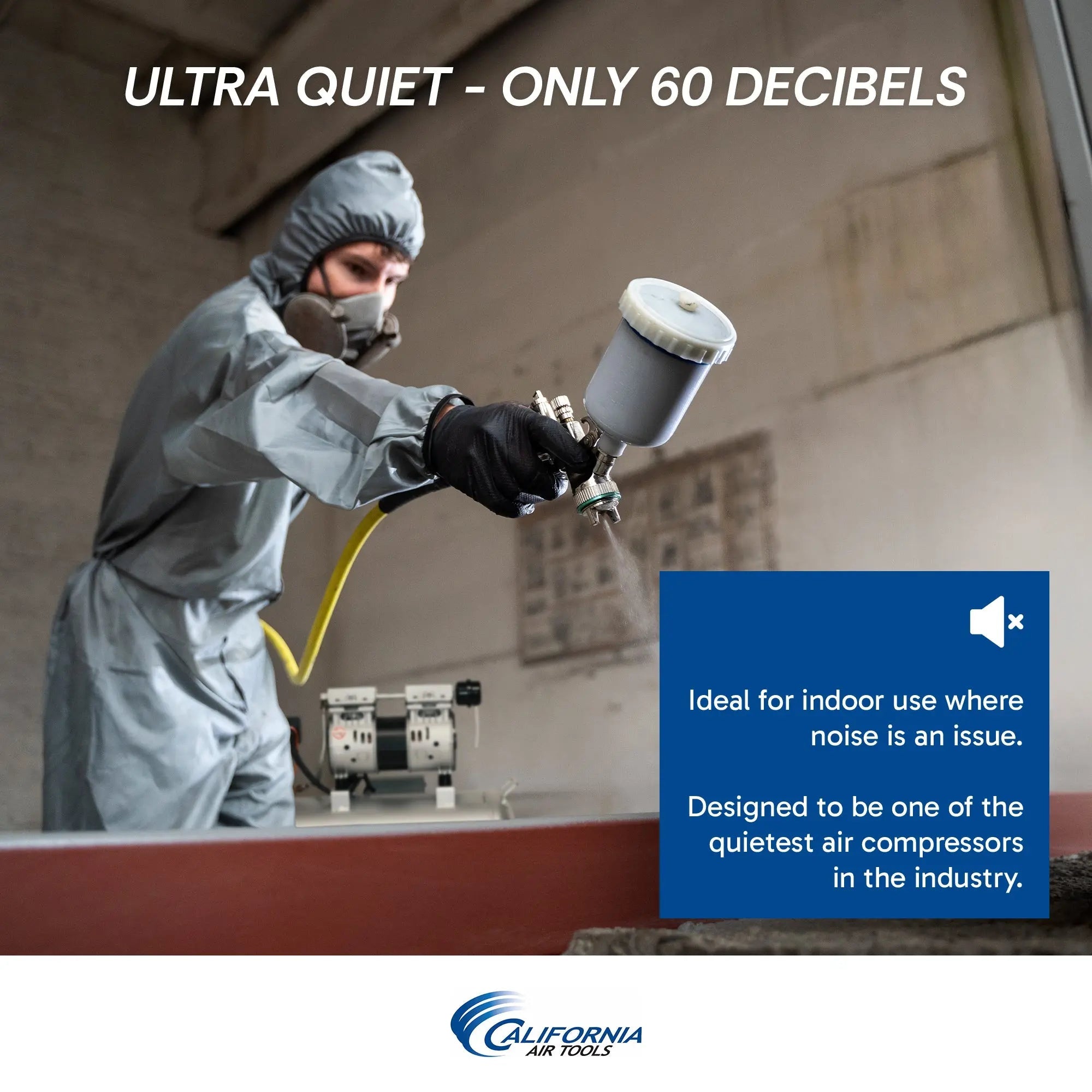
One honest caution on the numbers. Manufacturers measure decibels at a set distance under specific conditions, and real-world readings can come in higher or lower depending on your room and where you stand. Leading ultra-quiet models from brands like California Air Tools are rated around 56 to 70 dBA depending on size, and independent testing has shown some of them run even quieter than the sticker claims. Treat the rating as a strong relative guide between models rather than a promise of the exact number you will read on a meter.
What you give up (and what you do not)
The most common worry we hear is that a quiet air compressor must be underpowered. That is not really true anymore, but there are real trade-offs to understand.
Air delivery still comes down to CFM and tank size
Quiet has nothing to do with how much air a unit makes. A quiet 2 HP unit puts out about the same CFM as a loud 2 HP unit of similar design. If you need to run a die grinder or a DA sander continuously, you still need the CFM to back it, quiet or not. Match the compressor to your tools first, then chase the quiet within that group. If you are not sure how much air your tools pull, our air tools pages list consumption, and it is worth checking before you buy.
Most quiet units are oil-free, and that is a mixed bag
A lot of ultra-quiet compressors use oil-free pumps. Oil-free means no oil changes and cleaner air out of the box, which is great for finish work, airbrushing, and anywhere oil carryover is a problem. The downside is that oil-free pumps generally have a shorter service life than a good oil-lubricated pump run in a shop. For a home user putting a few hours a week on it, that is a fine trade. For someone running it hard all day, a quieter oil-lubricated unit may last longer. If clean air is the whole point for you, look at dedicated oil-free air compressors too.
Rotary screw is the quiet option nobody mentions
If you are running a real shop and noise still matters, do not forget rotary screw. A rotary screw compressor runs far smoother and quieter than a piston unit at the same output, and it is built for continuous duty. It costs more up front, but for a busy shop that runs air all day, it solves the noise problem and the duty-cycle problem at once. We cover the trade-offs in our rotary screw versus piston write-up, and you can browse units on our air compressors page.
How to pick the right quiet air compressor for your space
Work through these in order and you will not overbuy or underbuy.
Start with your loudest tool and its CFM at 90 PSI. Add a little headroom, usually 30 percent or so, so the pump is not running nonstop. Next, pick a tank size that fits how you work. Short bursts of air, like brad nailing or airing up tires, do fine on a small 1 to 8 gallon tank. Longer runs on grinders or sanders want a bigger tank so the pump cycles less. Then, and only then, sort your remaining choices by decibel rating and pick the quietest one that still hits your air numbers. Finally, think about placement. Rubber feet, a rubber mat under the unit, and a few inches of clearance from walls all shave real-world noise.
Where a quiet compressor is worth every penny
Some jobs practically demand quiet. Finish carpentry and cabinet shops where people talk and take measurements all day. Dental and medical offices where a patient is sitting right there. Home garages in neighborhoods with early hours or thin walls. Podcast and photography studios that cannot have a pump kicking on mid-take. And any basement or attached shop where the noise travels straight into the living space. In all of these, the extra cost of a quiet unit pays for itself in sanity.
Frequently Asked Questions
How many decibels is considered a quiet air compressor?
Anything at or below about 70 dBA is generally marketed as quiet, and the truly ultra-quiet models land around 56 to 60 dBA. For reference, normal conversation is roughly 60 dB, while a standard shop compressor runs 80 dB or more. Because decibels are logarithmic, dropping from 80 to 60 dB cuts the perceived loudness by about three quarters.
Are quiet air compressors less powerful?
No. Noise level and air output are separate things. A quiet unit makes about the same CFM as a loud unit of the same horsepower and design. Pick your compressor based on the CFM your tools need first, then choose the quietest model in that group.
Why are quiet compressors usually oil-free?
Many quiet models use low-RPM oil-free pumps because they run smoothly and need no oil changes, which also keeps the air cleaner. The trade-off is that oil-free pumps tend to wear out sooner than a good oil-lubricated pump under heavy daily use. For light home use the difference rarely matters.
Can I make my existing compressor quieter?
You can help. Set it on a rubber anti-vibration mat, add an inline intake silencer or extend the intake with a filter, move it into a closet or another room and run a hose to your work area, and keep it a few inches off the wall. None of these turns a pancake unit into an ultra-quiet one, but together they can shave several perceived decibels.
Is a rotary screw compressor quieter than a piston?
Generally yes. At the same air output a rotary screw runs smoother and quieter than a reciprocating piston compressor, and it is built to run continuously. It costs more, so it makes the most sense for shops that use air all day rather than occasional home users.
Bottom line, a quiet air compressor is no longer a compromise. Nail down the CFM and tank size your work actually needs, then buy the quietest unit that clears that bar. Your ears, your family, and your neighbors will all thank you. When you are ready to shop the quiet models, start with the collection below.


