


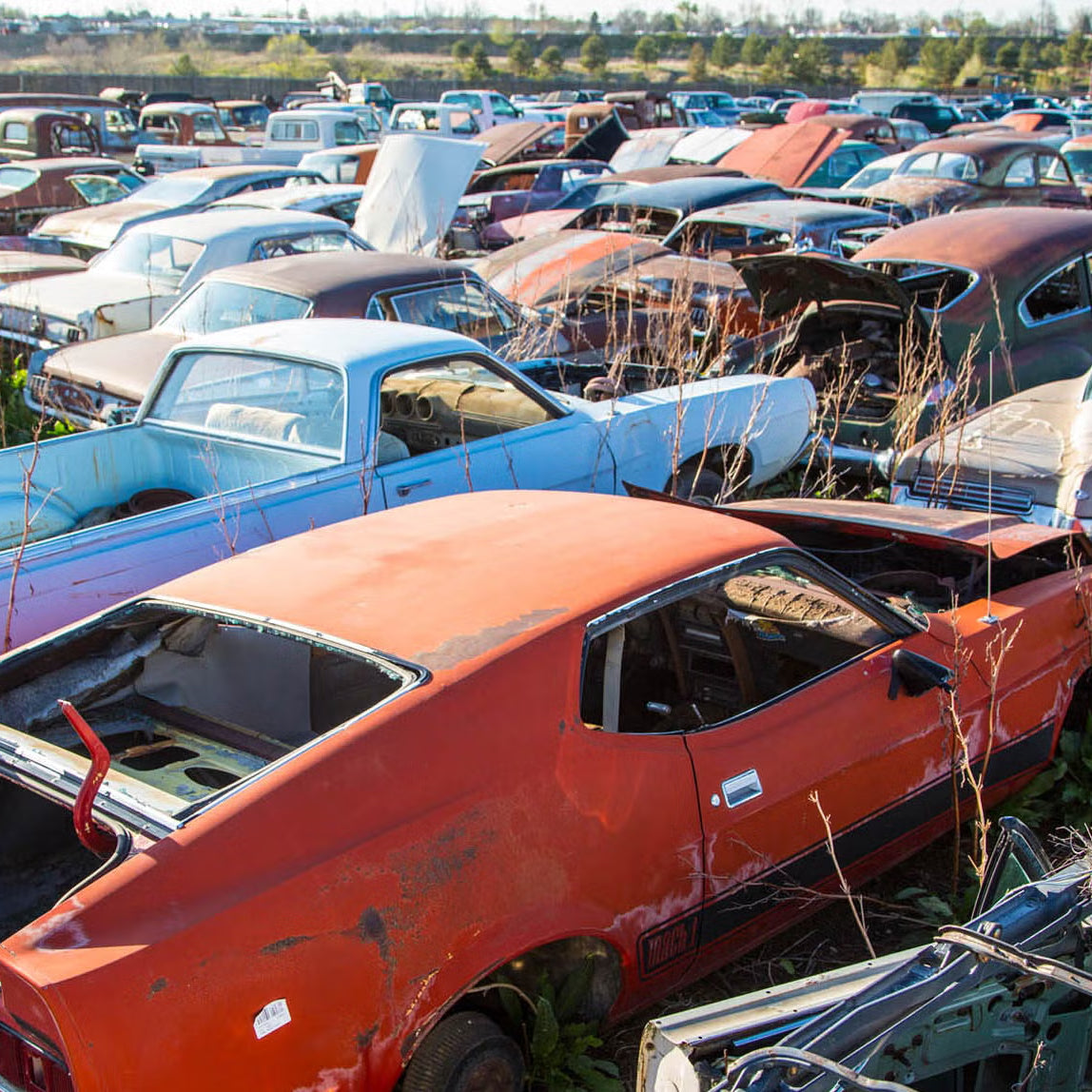
A SEDA DrainTower wants 8.5 bar at the inlet. That's about 123 psi, and it wants more than 1,350 liters a minute of it, which works out to roughly 48 cfm. Plenty of yards try to feed that from a 60 or 80 gallon piston compressor in the corner of the dismantling building, then wonder why the drain station crawls by the third car of the morning.
That gap between what the depollution equipment needs and what the yard actually has is where most of the trouble starts. So this piece is about compressed air for auto salvage yards: the drain rack, the dismantling tools, the yard winter, and the paperwork that comes with every gallon of fluid you pull.
Why a recycler's air system is different from a repair shop's
A repair shop runs impact guns in bursts. A busy recycler does that too, but it also runs depollution equipment that pulls air steadily for seven to eleven minutes per vehicle, car after car, and that equipment runs explosion-proof diaphragm pumps that move fuel. That changes three things.
First, duty cycle. SEDA's datasheet puts air use at around 12,550 liters per vehicle, which is about 443 cubic feet every time a car rolls onto the rack. A piston compressor rated for 50 to 60 percent duty will try to keep up and cook itself in the process.
Second, pressure. The drain station spec is measured at the equipment, not at the tank gauge. If your compressor cuts in at 125 psi and you lose 8 or 10 psi through an undersized line, a couple of quick couplers and a clogged filter, the station never sees 123.
Third, the environment. Salvage yards are cold, wet, dusty and spread out. Air lines run to outbuildings and hose reels hang outside. Condensate that would sit harmlessly in a heated shop freezes in a yard.
What the drain station really draws
The Automotive Recyclers Association says its members and the wider industry recycle more than 4 million vehicles a year across the US and Canada, from over 9,000 US locations. ARA also puts the fluids recovered each year at about 8 million gallons of fuel, 24 million gallons of motor oil, 8 million gallons of coolant and 5 million gallons of washer fluid. Most of that comes out through air-powered equipment.
Here's what the published specs say for the gear we see most often.
| Equipment | Published air requirement | Notes |
|---|---|---|
| SEDA DrainTower | 8.5 bar (about 123 psi), more than 1,350 l/min (about 48 cfm) | About 12,550 liters of air per vehicle, 7 to 11 minutes per car. Fuel at 10 l/min, oil and coolant at 3 l/min, washer fluid at 5 l/min. |
| SEDA single station | 8.5 bar, 1,350 l/min | ATEX-certified tank drilling machine, air pumps for each fluid |
| JohnDow JDI-6EV / JDI-20EV fluid evacuators | 110 to 115 psi | Venturi vacuum, no cfm figure published |
A 2008 piece in ISRI's Scrap magazine walked through the drainage systems on the market then. SEDA used explosion-proof double-diaphragm air pumps and suction plus air pressure instead of gravity. Iron Ax built its tank drill fully air-powered so there's no spark-producing motor anywhere near the fuel. Crow Environmental ran air-operated diaphragm pumps too. One maker, Auto Tap, went with a hydraulic brass probe specifically because compressors can freeze in Midwest winters. Keep that last one in mind. A competitor's entire design pitch was that your air system will fail in January.
Why air at all? Because you're pumping gasoline. An air motor or air-operated diaphragm pump has no brushes and no ignition source, which is why EPA's end-of-life vehicle guide tells processors to use a purpose-built suction system for fuel, warns against plastic hand pumps because they build static, and says plainly not to just puncture a tank to drain it.
The dismantling tools
Once the fluids are out, the car becomes a parts job. That means impact wrenches on wheels and subframes, an air hammer on seized hardware, a cut-off tool and a reciprocating air saw. Here's what a few representative tools draw, with the basis each maker publishes. Some list average consumption and some list consumption at load, and those are not the same number, so don't add them up blindly.
| Tool | Air use (maker's basis) | Other specs |
|---|---|---|
| Chicago Pneumatic CP7748, 1/2 in. impact | About 25 cfm (listed as maximum) | 960 ft-lb reverse, 3/8 in. hose |
| Ingersoll Rand 2135QXPA, 1/2 in. impact | 5 cfm (average) | 1,100 ft-lb max, 90 psi |
| Chicago Pneumatic CP7769, 3/4 in. impact | 31 cfm (at load) | 1,440 ft-lb reverse, 90 psi, 1/2 in. hose |
| Chicago Pneumatic CP7111 air hammer | 25 cfm (at load) | 3,000 blows per minute, 90 psi |
| Ingersoll Rand 429G reciprocating saw | 8 cfm (average) | 10,000 strokes per minute |
| Ingersoll Rand 426, 3 in. cut-off tool | 26 cfm (dealer listing) | 20,000 rpm, 90 psi |
The pattern here: at load, a real dismantling tool pulls 25 to 30 cfm. Two guys on 3/4 in. impacts plus the drain rack running is well past 100 cfm for those minutes. Average figures make that look smaller than it feels. Our air tool CFM chart goes deeper on why the "average" number misleads.
Sizing the compressor for a yard
Start with the drain station, because it's the load that runs steady and has the tightest pressure requirement. Then add the tools people are realistically using at the same time, not every tool you own.
A worked example. One SEDA-style station at 48 cfm, two dismantlers on 1/2 in. impacts, one on an air hammer for part of each hour, and a cut-off tool now and then. If you treat the station as constant and assume the dismantlers are on the trigger about a third of the time at the at-load figures, you're looking at somewhere around 70 to 80 cfm average with peaks well above 100. That's rotary screw territory. A common rule of thumb is roughly 4 cfm per horsepower at 100 to 125 psi, which points at a 20 to 25 hp screw, but check the actual CAGI data sheet before you buy. Here's how to read one.
Pressure matters as much as flow. If the station needs 123 psi at its inlet, you want a compressor rated 150 psi, not 125. A 125 psi machine leaves zero room for pressure drop, and you will have pressure drop.
Then add storage. A good-sized receiver near the dismantling bays covers the impact gun spikes, so the compressor isn't chasing every trigger pull. If the drain station is in a separate building, a second receiver right next to it is cheap insurance.
Rotary screw or piston?
For a yard pulling a few cars a week, a two-stage piston with a big tank can do it if you're honest about duty cycle. For a yard running the rack all day, a rotary screw compressor is the right tool. It's built for 100 percent duty, it runs cooler and it doesn't care that the drain station never stops.
Winter, water and the yard
This is where yards lose more productivity than anywhere else. Hot, saturated air leaves the compressor, cools in pipe that runs through an unheated building or underground to an outbuilding, and the water drops out. In October that's a wet tool. In January it's an ice plug in the line to the drain rack.
The fixes aren't exotic. Put a refrigerated air dryer on the compressor discharge. If any line runs outdoors or through a building that drops below freezing, a refrigerated dryer's dew point isn't low enough, and that run needs a desiccant dryer or the pipe needs to stay in heated space. Install drip legs with drains at the low points. Slope the pipe back toward the drains. We wrote up winterizing a compressor separately, and it all applies here.
Wet air also hurts the drain station. Diaphragm pumps and air motors don't love water, and a pneumatic control panel with water in it does strange things.
The rules that touch your air system
Most of what regulators care about in a salvage yard is fluids. Your compressor is part of that whether you think of it that way or not.
Stormwater
Auto salvage (SIC 5015) falls under Sector M of EPA's Multi-Sector General Permit for stormwater. EPA's sector fact sheet tells yards to drain fluids when vehicles arrive and to be certain all fluids are drained before crushing. It lists oil-water separators among treatment practices and names mercury from switches, glycol, oils and battery acid as pollutants of concern.
Used oil and mixed fluids
Under 40 CFR 279.22, used oil containers have to be in good condition, not leaking and labeled "Used Oil", and releases have to be stopped, contained and cleaned up. Massachusetts' crushing best practices go further and say mixed fluids must be treated as a hazardous waste. That's a direct argument for a drain system that keeps fluids separate, one pump per fluid.
Refrigerant and mercury
Under 40 CFR 82.155, the final processor in the disposal chain has to recover refrigerant or get a signed statement that it was recovered, and keep that record for three years. EPA's own end-of-life guide lists the order: battery first, then refrigerant, then fuel, then the other fluids. Mercury switch programs vary by state. North Carolina, for example, pays $5 a switch and reports more than half a million switches recovered since 2007.
Compressor condensate
Here's the one people forget. Condensate from an oil-flooded compressor is oily water, and it belongs in the same compliance conversation as everything else coming off the yard. One trade article puts a 150 hp compressor at about 500 gallons of oily condensate a week. Your machine is smaller, but the water is the same kind of dirty. New York's auto recycler manual notes that sewer authorities may require oil-water separators that get checked monthly. Running compressor drains to an oil-water separator instead of the yard is cheap and easy to explain to an inspector. More on that in our piece on condensate disposal rules.
What we sell and what we don't
We don't sell drain racks, tank drills, refrigerant recovery machines or crushers. Talk to SEDA or the other depollution makers about those. What we do sell is everything behind them: the compressor, the dryer, filters, receivers, oil-water separators, hose reels and the air tools on the dismantling bench. If you tell us which drain system you have and how many cars you run a day, we'll size the air side around it.
Mistakes we see in yards
Running the drain station off the same 1/2 in. hose that feeds the impact guns. Setting the compressor at 125 psi when the station needs 123 at the inlet. Putting a refrigerated dryer on a line that runs to an unheated outbuilding and then blaming the dryer when it freezes. Dumping compressor condensate on the ground next to the building. And buying a bigger piston compressor when the real answer was a screw that can run all day.
Frequently Asked Questions
Can I run a drain station off my existing shop compressor?
Maybe, if it can hold the station's pressure at the inlet and deliver the flow without exceeding its duty cycle. A SEDA DrainTower calls for about 123 psi and 48 cfm. Most 5 hp and 7.5 hp piston units can't hold that for a full shift.
Why does my drain rack slow down in the afternoon?
Usually because the compressor is losing ground. Tank pressure sags, the station sees less than its rated pressure and the pumps slow. A heat-soaked piston compressor also delivers less as the day goes on. Check the gauge at the station, not just the tank.
Do I need a dryer if my compressor is indoors?
If the air stays in heated space, a refrigerated dryer handles it. If any pipe or hose runs outside or to an unheated building, you need a lower dew point than a refrigerated dryer gives, or that line will freeze when it gets cold.
Pulling fluids is the job a yard gets judged on. Give the drain station the air it was designed for, keep that air dry, and the rest of the dismantling floor gets easier too.


