


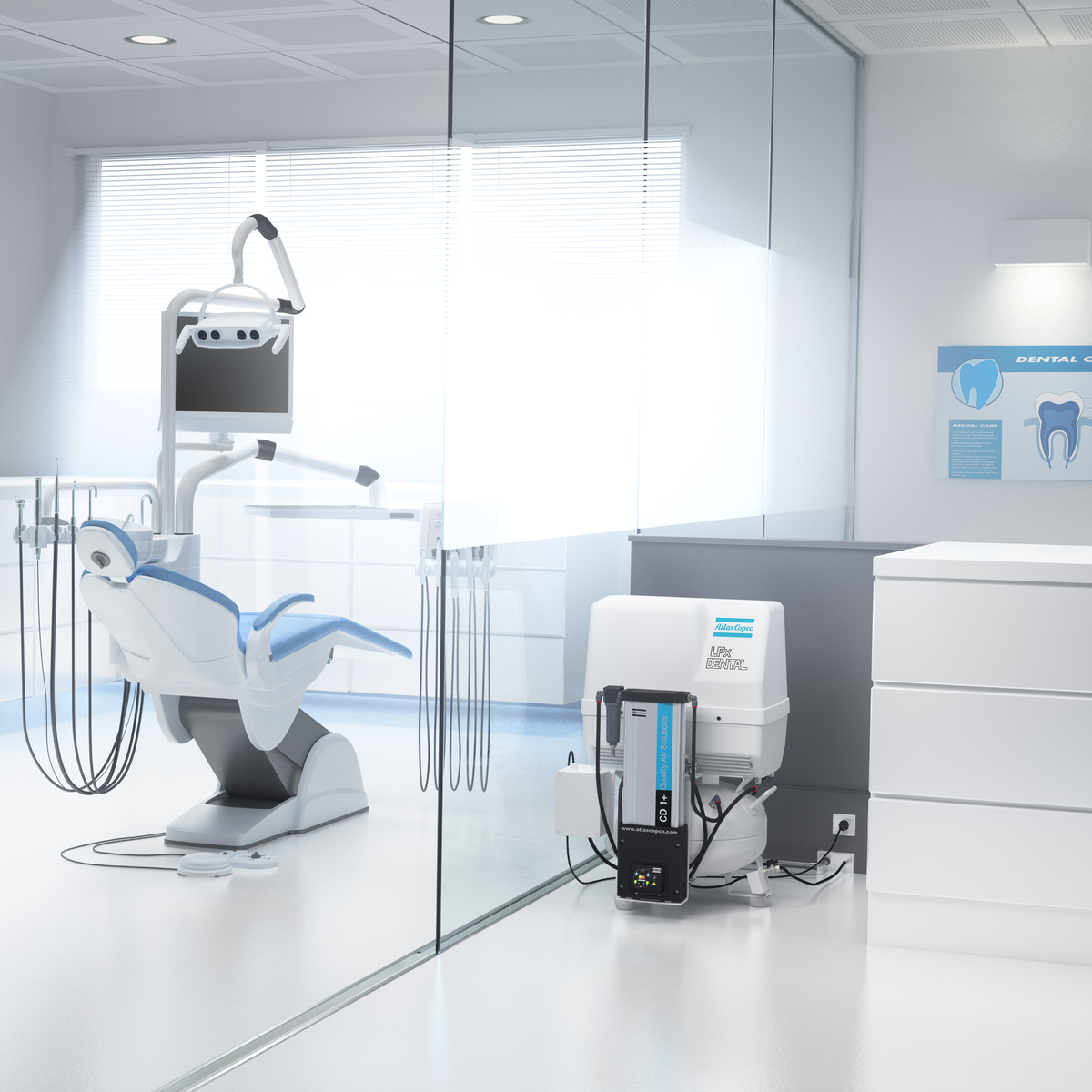
A dentist called us after his second handpiece rebuild in a year. The rebuild shop kept telling him the turbines were failing from contamination. He assumed that meant something in the water lines. It was the air. His compressor was a lubricated shop unit somebody had installed in the mechanical room years earlier, and it had been quietly misting oil into thirty thousand dollars worth of handpieces the whole time.
That is the short version of why a dental air compressor is a different animal from the one in a garage. The pressure and the flow are modest. The air quality is not negotiable.
Oil-free is the whole point
Dental air touches three things that make oil unacceptable.
It drives the handpiece, where the turbine spins fast enough that oil contamination and bearing wear go hand in hand. It runs through the air-water syringe and out into a patient's mouth. And it feeds air-driven scalers and drying steps in restorative work, where an oil film on a prepped tooth is the difference between a bond that holds and one that fails.
So dental compressors are built oil-free from the start. Not low-oil, not "oil-less pump with a lubricated bearing housing." Genuinely oil-free, which in practice means either a scroll compressor or an oil-free reciprocating pump with PTFE-lined cylinders and sealed bearings. In ISO 8573-1 terms you are aiming for Class 0 on the oil axis, which is the class that says no oil at all rather than a permitted trace amount. If that classification system is new to you, our breakdown of the ISO 8573-1 air quality classes walks through what the three numbers mean.
Scroll is the quiet, clean end of the market. Two spiral elements, one fixed and one orbiting, compress air continuously with no reciprocating mass and no rings. Fewer wear parts, less vibration, and a noise level people can tolerate in a building where patients are already nervous. Oil-free piston units cost less up front and are perfectly good for smaller practices, with the tradeoff that the piston rings and cylinder coatings are consumables on a schedule. If you are down to choosing between those two designs, or a vendor is using the word oil-less in a way you are not sure about, our deep dive on oil-free dental compressors and Class 0 air compares the two head to head and covers duplex sizing.
Dry matters as much as oil-free
The part people miss is water. Compressing room air condenses most of the moisture out of it, and if you do not remove that water it lands in the lines, the handpiece, and eventually the patient's mouth. It also feeds biofilm inside the tubing, which is the thing your infection control protocol is trying to prevent everywhere else in the operatory.
Purpose-built dental compressors handle this with an integrated desiccant dryer, usually a twin-tower design that alternates between drying and regenerating. Manufacturers commonly quote a pressure dew point in the range of -40 F on those units. That is far below anything the air will encounter in the building, which means no liquid water anywhere downstream, ever.
If you are assembling a system rather than buying a packaged dental unit, the drying step is not optional and a simple water separator is not enough. A separator catches liquid that has already condensed. It does nothing about the vapor still in the air, which will condense later, somewhere less convenient. Our explainer on compressed air dew point covers why that distinction matters, and the air dryers collection covers the equipment.
Sizing: count the chairs running, not the chairs installed
This is where practices overspend or, more often, underspend.
A six-operatory office almost never has six operatories pulling air at the same instant. Handpiece use is intermittent by nature. A hygienist doing a cleaning barely touches the compressor. A restorative appointment hits it hard for thirty seconds at a time. So the number that matters is peak simultaneous demand, not chair count.
Published figures per chair vary a lot depending on what is in the room, from roughly 2 CFM for a chair running basic air-driven handpiece work up to 7 CFM or more for an operatory with several air-driven devices going. Rather than trusting one number, do it this way:
| Step | What to do |
|---|---|
| 1 | Count how many chairs realistically run air at the same time during your busiest hour. In most practices this is half the installed chairs or fewer. |
| 2 | Pull the CFM figure off the actual equipment in those rooms, not a generic per-chair average. Handpieces, scalers, and any air-driven lab equipment all publish it. |
| 3 | Add anything that runs continuously rather than in bursts, at full value. |
| 4 | Add 25 to 30 percent on top for aging equipment and the operatory you have not built yet. |
Dental compressor manufacturers usually rate their machines by "number of users" rather than CFM, which is convenient but hides the assumptions. Ask what duty cycle and what per-user flow that rating is based on before you take it at face value. A three-user machine sized around light hygiene work is not a three-user machine in a practice doing heavy restorative days.
Pressure is the easy part. Dental systems typically sit around 80 to 100 psi at the compressor and get regulated down at the chair, with handpieces running much lower at the head. You are not chasing pressure. You are chasing clean, dry, steady flow.
Where it goes and what it needs around it
A few things that come up on every install:
- Noise. A mechanical room shared with a wall to an operatory will telegraph every start. Scroll units and cabinet-enclosed oil-free piston units exist specifically for this. Do not solve it by putting the compressor in a closet with no ventilation.
- Heat and airflow. Oil-free pumps run hot because there is no oil carrying heat away. They need real air movement around them. A sealed closet will shorten the pump's life more than anything else you could do to it.
- Intake air. The compressor breathes whatever is in the room. Do not put the intake where it will pull in sterilizer exhaust, floor dust during construction, or fumes from a lab bench. The intake and line filtration is your last defense, not your first.
- Redundancy. A practice that cannot run without air should think hard about a duplex unit with two pumps on one tank, or a second machine. A compressor failure on a Tuesday morning is a full day of cancellations.
- Drainage. Even with a dryer, the tank collects condensate. An automatic drain removes the one maintenance task everyone forgets.
Regulation, plainly stated
Dental air in a private practice is not governed by one single federal rule the way piped medical gas in a hospital is. What you get instead is a stack of expectations that all point the same direction. Equipment manufacturers specify oil-free dry air and will lean on that in a warranty conversation. Infection control guidance assumes the air reaching a patient is not carrying oil or moisture. And if your practice sits inside a larger healthcare facility with a piped medical gas system, NFPA 99 governs that system and brings its own requirements with it.
The practical version: buy oil-free, dry it properly, document your maintenance, and none of this is ever a conversation.
What to keep on a schedule
| Item | Typical interval | Why |
|---|---|---|
| Intake filter element | Annually or per manual | Everything the pump breathes goes to the patient |
| Desiccant | Per manufacturer, often 2 to 5 years | Spent desiccant stops drying long before it looks different |
| Tank drain | Daily if manual, verify monthly if automatic | Standing water rusts tanks from the inside |
| Piston rings and cylinder kit (oil-free piston units) | By running hours, per manual | Coating wear shows up as falling output before it shows up as failure |
| Safety relief valve | Test annually | It is the only thing between a stuck switch and a pressure vessel |
None of that is expensive. All of it is cheaper than a handpiece rebuild, and much cheaper than a day of cancelled chairs.
If you are specifying a new office or replacing a unit that was never right for the job, start with the oil-free air compressors and tell us how many chairs run at once. That one number does most of the work.
Frequently Asked Questions
Can I use a regular shop air compressor in a dental office?
No. A standard lubricated compressor puts an oil aerosol into the air stream, which contaminates handpiece turbines, interferes with bonding, and reaches the patient through the air-water syringe. Dental air needs to be oil-free at the source, not filtered after the fact.
What size dental air compressor do I need for four operatories?
Size to how many of those four actually run air at the same time, which is usually two or three. Total the published CFM of the equipment in those rooms, add anything that runs continuously, then add 25 to 30 percent for headroom. Chair count alone will lead you to buy more machine than you need or, if your rooms are equipment-heavy, less.
Do I need a dryer if the compressor is already oil-free?
Yes. Oil-free solves oil. It does nothing about water, and compressing room air always produces condensate. Most purpose-built dental compressors include a desiccant dryer for exactly this reason.
Scroll or oil-free piston for a dental practice?
Scroll runs quieter, vibrates less, and has fewer wear parts, which suits a practice where the compressor sits near occupied rooms. Oil-free piston costs less up front and works well for smaller offices, with rings and cylinder coatings as scheduled consumables. Both are genuinely oil-free.
How long does a dental air compressor last?
With correct sizing, real ventilation, and maintenance on schedule, a well-built unit runs for many years. What kills them early is almost always the same short list: an undersized machine running near continuous duty, a closet with no airflow, or a skipped intake filter.


