


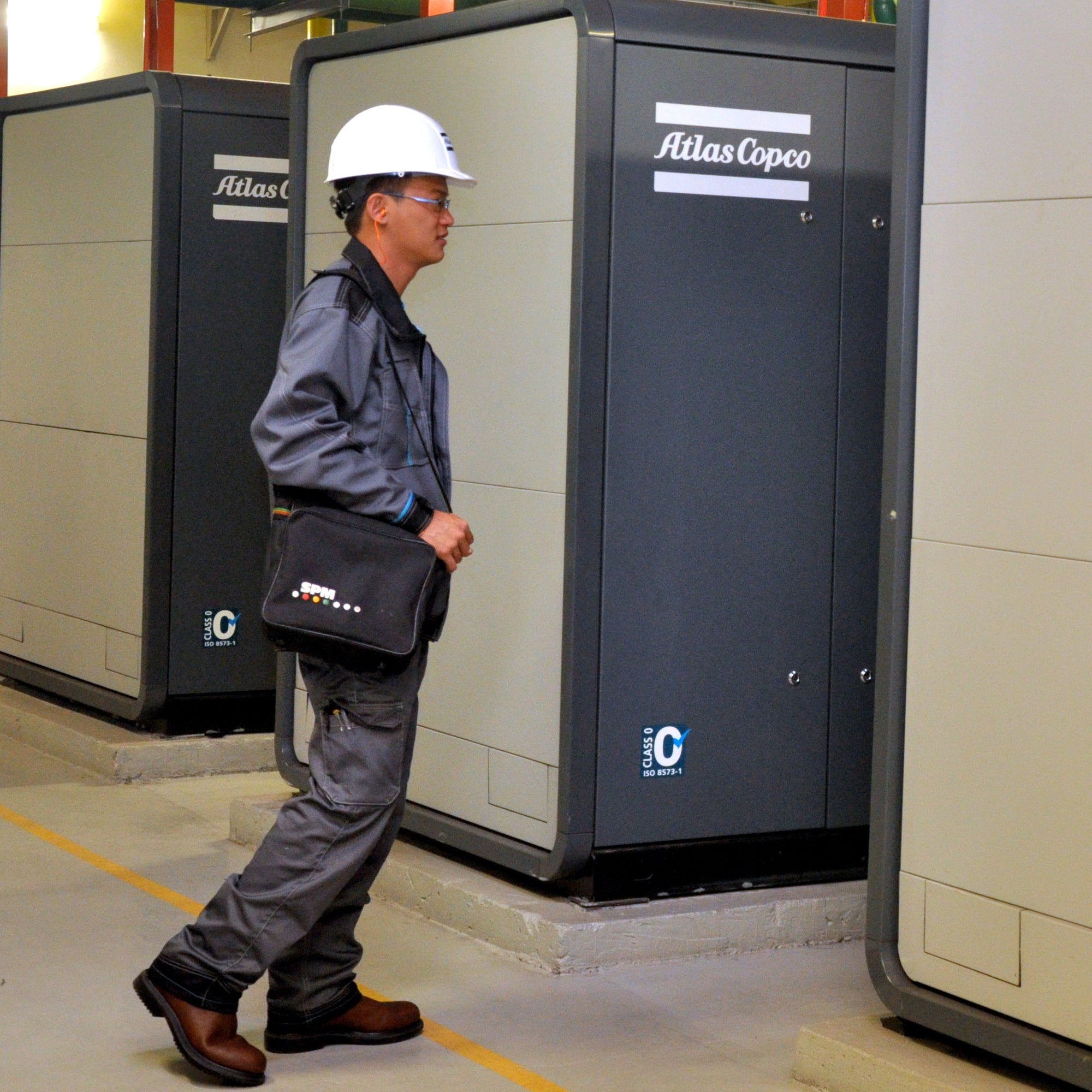
A customer called us last August about a nearly new 30 HP rotary screw that kept shutting down on high discharge temperature every afternoon. Nothing was wrong with the machine. It was sitting in a block closet with one 12 inch louver and a door that stayed shut, and by two o'clock that room was well past 120 degrees. The compressor was breathing its own exhaust.
We get that call a lot. Somebody spends thirty or forty thousand dollars on a good compressor and then puts it somewhere that guarantees it runs hot and dies early. The air compressor room requirements that actually matter are not complicated, but they are unforgiving. Get the heat out. Give it cool, clean air to breathe. Leave enough room to service it. Give the water somewhere to go. Miss any one of those and you will pay for it, either in electricity or in an airend.
Start with heat, because heat is the whole problem
Here is the number that drives every other decision in the room: nearly all of the electrical power you feed a compressor comes back out as heat. Not most of it. Nearly all of it. A 25 HP machine pulling about 20 kW off the line is dumping roughly 87,000 BTU per hour into whatever space it occupies. That is two residential furnaces running flat out, all day, every day.
For planning purposes, figure about 3,500 BTU per hour per compressor horsepower. Then size your ventilation to carry that heat away without letting the room climb too far above outdoor temperature:
Ventilation CFM = (3,500 x HP) / (1.08 x allowable temperature rise in degrees F)
The allowable rise is your choice, and it is a tradeoff. A 10 degree rise means a big fan and big openings. A 20 degree rise means smaller everything, but on a 95 degree summer day your room hits 115 and you are back in trouble. Most shops land on 15 degrees.
| Compressor | Heat rejected (BTU/hr) | Vent air, 10°F rise | Vent air, 15°F rise | Vent air, 20°F rise |
|---|---|---|---|---|
| 10 HP | 35,000 | 3,240 CFM | 2,160 CFM | 1,620 CFM |
| 25 HP | 87,500 | 8,100 CFM | 5,400 CFM | 4,050 CFM |
| 50 HP | 175,000 | 16,200 CFM | 10,800 CFM | 8,100 CFM |
| 75 HP | 262,500 | 24,300 CFM | 16,200 CFM | 12,150 CFM |
| 100 HP | 350,000 | 32,400 CFM | 21,600 CFM | 16,200 CFM |
Those numbers surprise people. A 50 HP compressor in a dedicated room needs a fan moving more air than most whole-shop exhaust systems. If the number looks impossible for your building, you have three other options, and all of them are legitimate:
- Duct the cooler discharge straight outside. Most packaged rotary screws have a flanged cooler outlet made for this. You are then only ventilating radiant heat off the cabinet, which is a fraction of the total. Watch the static pressure limit on the package fan, usually somewhere around 0.2 to 0.5 inches of water column, and use a short duct run with a smooth transition.
- Go water cooled. If you already have a cooling loop or a tower, a water cooled package moves the heat out through pipe instead of air. Adds plumbing, removes the ventilation headache.
- Recover the heat. Ducting compressor discharge into the shop in winter is free heat, and it is real money. Just put a damper in it so you can send it outside in July.
Where the openings go
Two openings, low and high, on opposite ends of the room. Cool air comes in low near the compressor intake, hot air leaves high on the far wall or through the roof. If both openings are on the same wall, you get a short circuit: the fan pulls in the hot air it just pushed out and the room never cools.
Size the free area of the inlet louver for roughly 500 to 700 feet per minute face velocity, and remember that a louver with a bird screen and a filter has maybe 50 to 60 percent free area. A 24 by 24 inch louver is not four square feet of opening. Get the free area figure from the louver manufacturer, not from the outside dimensions.
Put the exhaust fan on a thermostat so it is not running in February and freezing your condensate lines.
Temperature limits, high and low
Most industrial rotary screws spec a maximum ambient of 104 to 110 degrees F, with some packages rated to 122 degrees at derated output. Do not design to the limit. Design so the room stays under 100 degrees on your worst day, and you will keep the high temperature shutdowns and the accelerated oil breakdown away.
The low end matters too, and people forget it. Below about 40 degrees F, condensate in traps and drain lines can freeze, the oil is thick enough to spike startup load, and the automatic drains stop working. An unheated outbuilding in Minnesota is a bad home for a compressor unless you heat it or use trace heat on the drains.
Cool intake air is also denser air, so the same machine on the same kilowatt gives you a little more usable flow. It is not a huge effect, but it points the same direction as everything else in this article: cooler is better.
Space and clearance
You need enough room to open the doors, pull an element, and get a drum of oil next to the machine. Here is what we tell people to leave:
| Location | Minimum clearance | Why |
|---|---|---|
| Service side (door side) | 36 inches | Filter and separator changes, belt access, oil fill |
| Remaining sides | 24 inches | Panel removal, cooler cleaning, airflow |
| Above the package | 36 inches | Vertical cooler discharge, lifting eye access |
| Cooler discharge face | 36 inches to any wall | Prevents recirculation of hot discharge air |
Then add footprint for the rest of the system, because the compressor is never alone. A refrigerated or desiccant dryer, a filter bank, an oil water separator, and a receiver tank all need to live in the same room with their own service access. Draw it on paper before you pour a pad.
What the compressor breathes
The intake is the one thing in the room you can ruin with good intentions. Every contaminant that goes in the inlet ends up in the oil, the separator, the cooler, or your product.
Keep the compressor room away from, or at least upstream of, these:
- Paint booths and solvent storage. Overspray and solvent vapor destroy oil and coat coolers.
- Grinding, sanding, and cutting operations. Abrasive dust is exactly what you do not want in a screw element.
- Loading docks and anywhere forklifts or trucks idle. Diesel exhaust is acidic and it will show up in your oil analysis.
- Roof exhaust stacks. People duct fresh air intakes ten feet from a kitchen or process stack all the time.
If the room air is questionable, duct the intake to a clean outside location and keep the inlet and downstream filtration on a real schedule. A dirty intake filter is cheap. The airend it protects is not.
Condensate, drains, and the floor
A compressor is also a dehumidifier, and a good one. A 100 CFM machine in a warm, humid shop can pull tens of gallons of water out of the air in a day. That water has to go somewhere, and it comes out of the tank drain, the aftercooler, the dryer, and the filter bowls.
Plan for it:
- A floor drain or a sloped trough, not a bucket somebody forgets about.
- Automatic zero-loss drains instead of timer drains, so you are not blowing compressed air down the drain every cycle.
- An oil water separator before anything goes to the sanitary sewer. Condensate off a lubricated compressor carries oil, and in most jurisdictions dumping it is a violation. This is not a gray area worth testing.
- A level concrete pad. Most packages do not need isolation pads or anchors, but they do need to sit flat so the oil sight glass reads true and the drains actually drain.
Power
Get an electrician, but know what to ask for. A dedicated circuit sized to the motor full load amps with the code required margin, a fused disconnect within sight of the machine, and correct wire gauge for the run length. Long runs on undersized wire cause voltage drop, and voltage drop causes hard starting, nuisance overload trips, and cooked windings.
Above about 10 to 15 HP, three phase is the right answer if you have it. Single phase motors that size draw enormous starting current and stress everything upstream. If all you have is single phase, talk to us before you buy, because it changes which machines are realistic.
Noise
A bare piston pump can run 90 dBA or more at three feet, which is loud enough to matter for hearing conservation if people work nearby. A packaged rotary screw in an enclosure is usually in the mid 60s to mid 70s. Putting the compressor in its own room solves most of this on its own, which is one more argument for a dedicated space rather than a corner of the shop. Just do not solve the noise problem by sealing the room, because now you are back to the heat problem at the top of this article.
The mistakes we see most
- One louver and no fan. Passive ventilation almost never moves the air a compressor needs.
- Inlet and exhaust on the same wall, so hot air recirculates.
- The cooler discharge blowing at a wall two feet away.
- Compressor pushed into a corner with 8 inches of clearance, so nobody ever changes the separator.
- Condensate running to a floor drain with no oil water separator.
- A room sized for today's compressor with no room for the dryer, filters, and tank that come next year.
Frequently Asked Questions
How much ventilation does a 25 HP air compressor need?
Roughly 5,400 CFM if you want to hold the room within 15 degrees F of outdoor temperature, based on about 87,500 BTU per hour of rejected heat. You can cut that number substantially by ducting the cooler discharge directly outside instead of ventilating the whole room.
Can I put my air compressor outside?
Only in an enclosure built for it. Weather, sun on the cabinet, freezing condensate, and rodents in the electrical panel all cause failures. Most manufacturers void warranty coverage on outdoor installation of an indoor rated package. A small insulated and ventilated lean-to is a far better answer than a tarp.
What is the maximum room temperature for a rotary screw compressor?
Check the nameplate, but most are rated for a maximum ambient of 104 to 110 degrees F, and some go to 122 degrees with derated capacity. Aim to stay under 100 degrees on the hottest day of the year so you have margin left.
Do I need a floor drain in the compressor room?
You need a plan for water, and a floor drain is the easiest one. Between the tank, the aftercooler, the dryer, and the filters, a working system produces a steady stream of condensate. Route it through an oil water separator before it enters the sewer.
Does the compressor room need to be a separate room at all?
No, and plenty of small shops run a compressor in the corner successfully. But a dedicated space makes the heat, noise, air quality, and drainage problems much easier to solve at once, and it keeps grinding dust and paint overspray out of the intake.
Getting it right the first time
Every item on this list is cheaper to handle before the compressor lands than after. Move the heat, feed it clean air, leave clearance, catch the water, and size the power correctly, and the same machine that would have died in five years will run twenty. If you are laying out a new space or trying to fix one that runs hot, tell us the horsepower, the room dimensions, and what else is in the building, and we will help you work through the air compressor room requirements for your specific setup before you spend money on the wrong fix.


