


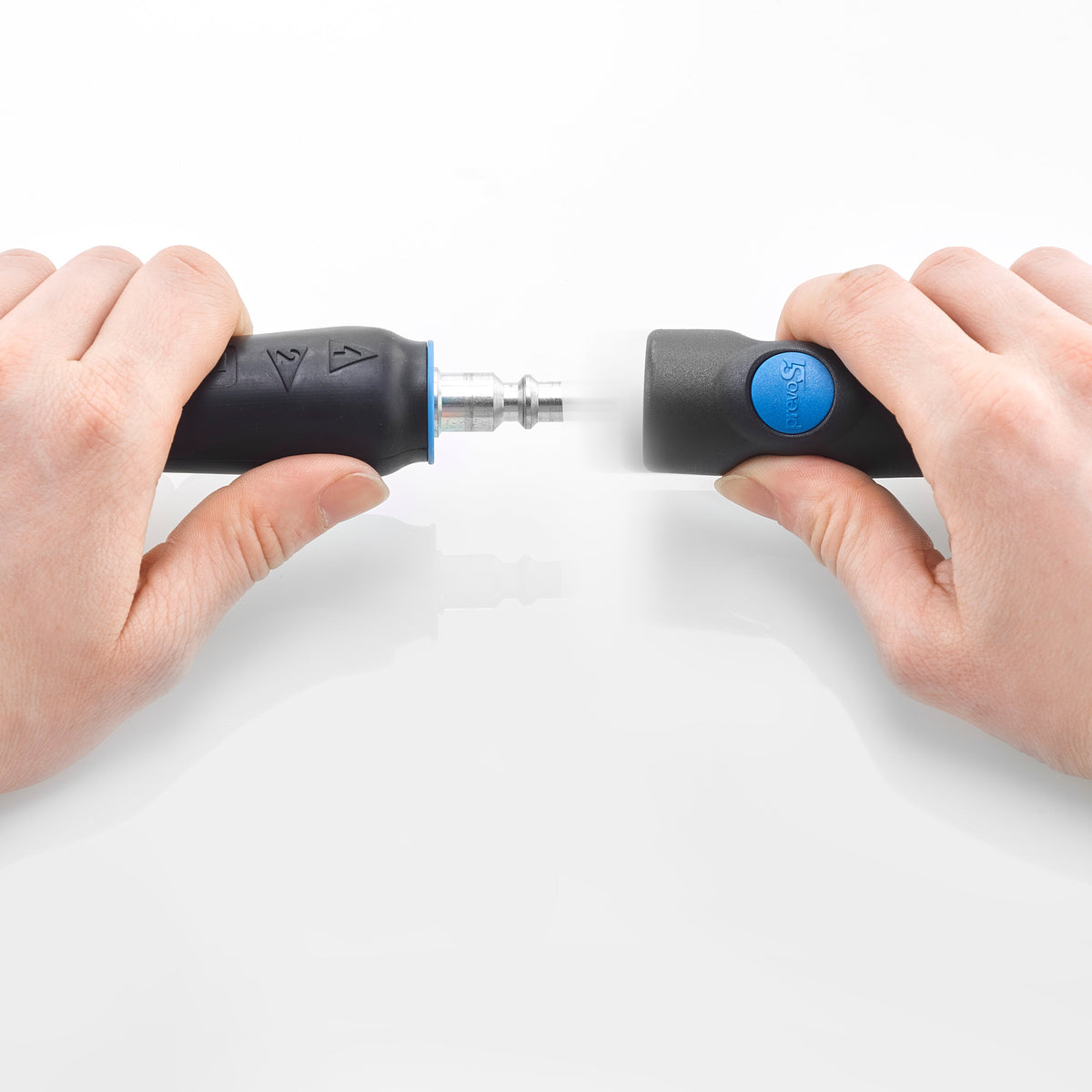
Somebody once ran an entire shop air system in quarter inch push-to-connect because the fittings were quick and the tubing came on a roll. It worked for about four months. Then a line let go behind a cabinet at two in the morning, the compressor ran all night, and the Monday conversation was about why the electric bill looked like that.
That is not an argument against push to connect fittings. It is an argument against using them for a job they were never built for. They are excellent at what they do, and they are the wrong answer for a main. Here is where the line is.
How they work, and why that matters
Inside the fitting is a collet with stainless teeth and an O-ring. Push the tube in, the teeth bite, line pressure pushes the tube against the seal and the connection gets tighter the harder you push on it. Press the release collar and the teeth let go.
Two things follow from that design and they explain nearly every failure you will see.
First, the seal depends on the tube's outside diameter being round, consistent, and the right size. Not the inside diameter. If the tube is oval from being coiled, scored from a dull cutter, or the wrong OD tolerance, the O-ring will not seal and no amount of pushing fixes it.
Second, the grip depends on the tube wall resisting the collet teeth. A wall too soft lets the teeth crush and deform the end, which is why cheap soft tubing works loose over time while semi-rigid nylon stays put.
Pressure and temperature, which is where people get surprised
Ratings vary a lot by manufacturer and body material, so read the spec sheet for what you are buying rather than assuming. The general shape of it:
| Typical range | Watch out for | |
|---|---|---|
| Composite and standard brass push-to-connect | Often rated around 150 psi for air | Plenty for 125 psi shop air, thin margin above it |
| Premium brass and stainless bodies | Up to roughly 290 psi with plastic tubing, higher with metal tube | The tubing usually becomes the limit, not the fitting |
| Temperature range | Roughly minus 40 to 200 degrees F depending on body and O-ring | Working pressure falls as temperature rises, sometimes sharply |
| Nylon tubing | Much higher burst than the fittings, good to around 200 degrees F | The system rating is the lowest component, which is the fitting |
The temperature derating is the one that catches people. A fitting rated 150 psi at room temperature is not rated 150 psi at 180 degrees, and a drop installed close to an un-aftercooled compressor discharge can easily see that. If you are putting push-to-connect anywhere warm, find the manufacturer's derating curve before you commit.
Where they belong
Push-to-connect earns its keep anywhere the runs are short, the pressure is modest, and the layout changes.
- Machine and panel pneumatics. Cylinders, valve manifolds, actuators. This is what the technology was designed for and it is excellent there.
- Point-of-use drops and whips. The last few feet from a hard-piped drop to a tool, an FRL, or a fixture.
- Control and instrument tubing. Small bore signal lines where flow is tiny and access matters.
- Temporary and prototype layouts. If you will move it next quarter, do not weld it.
- Tight or awkward spots where you cannot swing a wrench but can push a tube.
Our push to connect fittings and pneumatic tubing cover these cases.
Where they do not
Main headers and trunk lines. Use aluminum air pipe or hard pipe. A main carries your whole plant's flow, it runs for decades, and a push-to-connect joint overhead in a plenum is a leak you will not find for a year. Modular aluminum systems give you the same speed of assembly with a joint built for permanent service.
Anywhere with real vibration. Reciprocating compressors, mounted hydraulic power units, anything that shakes. The collet grip is good; it is not designed for a few million cycles of movement at the joint.
Hot lines. See the derating note above. Compressor discharge before the aftercooler is not the place.
Anywhere abrasion or impact is likely. Floor level in a forklift aisle, behind a weld cell, anywhere sparks land. Plastic tubing is not armor.
Breathing air. Supplied-air respirator lines have their own requirements and their own fittings, deliberately non-interchangeable so nobody plugs a respirator into shop air. Do not improvise there. See what Grade D breathing air requires.
One thing worth stating since it comes up in the same conversation: none of this is the PVC problem. PVC for compressed air is a different and much worse hazard, because it shatters. Properly specified pneumatic tubing fails by blowing off a fitting, which is loud and annoying rather than dangerous. Do not read "plastic" and lump them together.
Installing them so they do not leak
Nearly every push-to-connect leak traces back to one of five things, and all five are avoidable in the thirty seconds before you push the tube in.
- Cut square. Use a tube cutter, not side cutters and not a knife. An angled or pinched end will not seal, full stop.
- Deburr and check for scores. A scratch running lengthwise along the tube is a leak path straight past the O-ring.
- Push all the way in. There is a hard stop. Push to it, then tug back to set the teeth. A tube that is in far enough to grip but not far enough to seat on the O-ring will hold air at first and weep later.
- Match the tube OD and material to the fitting. Metric and imperial sizes are close enough to seem interchangeable and are not. 6 mm and 1/4 inch are a classic bad pairing.
- Support the tube. The fitting is a connection, not a bracket. Hanging a long unsupported run off a fitting puts side load on the collet and works it loose.
Use nylon rather than the softest polyethylene where you want the connection to last, since the harder wall works better with the collet and gives a broader chemical and temperature range. Soft tubing is fine for short, cool, low-vibration runs.
A sensible way to lay out a shop
The system that works in practice is mixed, and nobody should feel bad about that.
Run the mains and the drops in aluminum pipe or hard pipe, sized properly, taking drops off the top of the header. Hard-pipe down to a drop with a shutoff, a filter, and a regulator. Then use push-to-connect for the last stretch into the machine, the panel, and the fixtures, where you want to be able to change things without a torch. For a small shop or a home garage, a tubing kit like MaxLine covers the whole job in one system and is a reasonable exception to the main header rule at that scale.
That layout gives you a permanent backbone that does not leak and a flexible last few feet that you can reconfigure on a Tuesday. Most leak audits we see find that the trouble is almost never in the hard pipe and almost always at the joints somebody added in a hurry. Spending an hour with a leak survey usually confirms it.
Frequently Asked Questions
Can I use push to connect fittings for my whole shop air system?
You can, and we would not. They are rated for the pressure, but a main header is a permanent, high-flow, long-life run, and every fitting is a potential leak point you have to find later. Hard pipe or aluminum for mains and drops, push-to-connect for the last few feet, is the layout that holds up.
What pressure are push to connect fittings rated for?
It varies by manufacturer and body material. Many common composite and brass fittings are rated around 150 psi for air, and premium brass or stainless versions run considerably higher. Always check the specific product's rating, and remember that the rating falls as temperature rises.
Why does my push to connect fitting keep leaking?
In order of likelihood: the tube was not cut square, it was not pushed fully to the stop, the tube OD is wrong for the fitting, the tube is scored or oval, or the run is unsupported and side-loading the collet. Pull the tube, cut a fresh square end, and reseat it before you replace the fitting.
Can I reuse a push to connect fitting after removing the tube?
Usually yes, a few times. Cut off the gripped section of tube rather than reinserting it, because the collet teeth leave marks that become leak paths. If the release collar feels gritty or the fitting has been cycled many times, replace it; it costs less than finding the leak later.
Nylon or polyethylene tubing?
Nylon for anything that matters. The harder wall grips better in the collet, the pressure rating is higher, and the temperature and chemical range is broader. Polyethylene is fine for short, cool, low-vibration runs where cost and flexibility win.
Used where they belong, push to connect fittings are one of the genuinely good developments in shop air. Used as a substitute for a properly piped system, they turn into a slow leak you pay for every hour the compressor runs. Hard pipe the backbone, push-to-connect the last few feet, and you get the best of both.


