


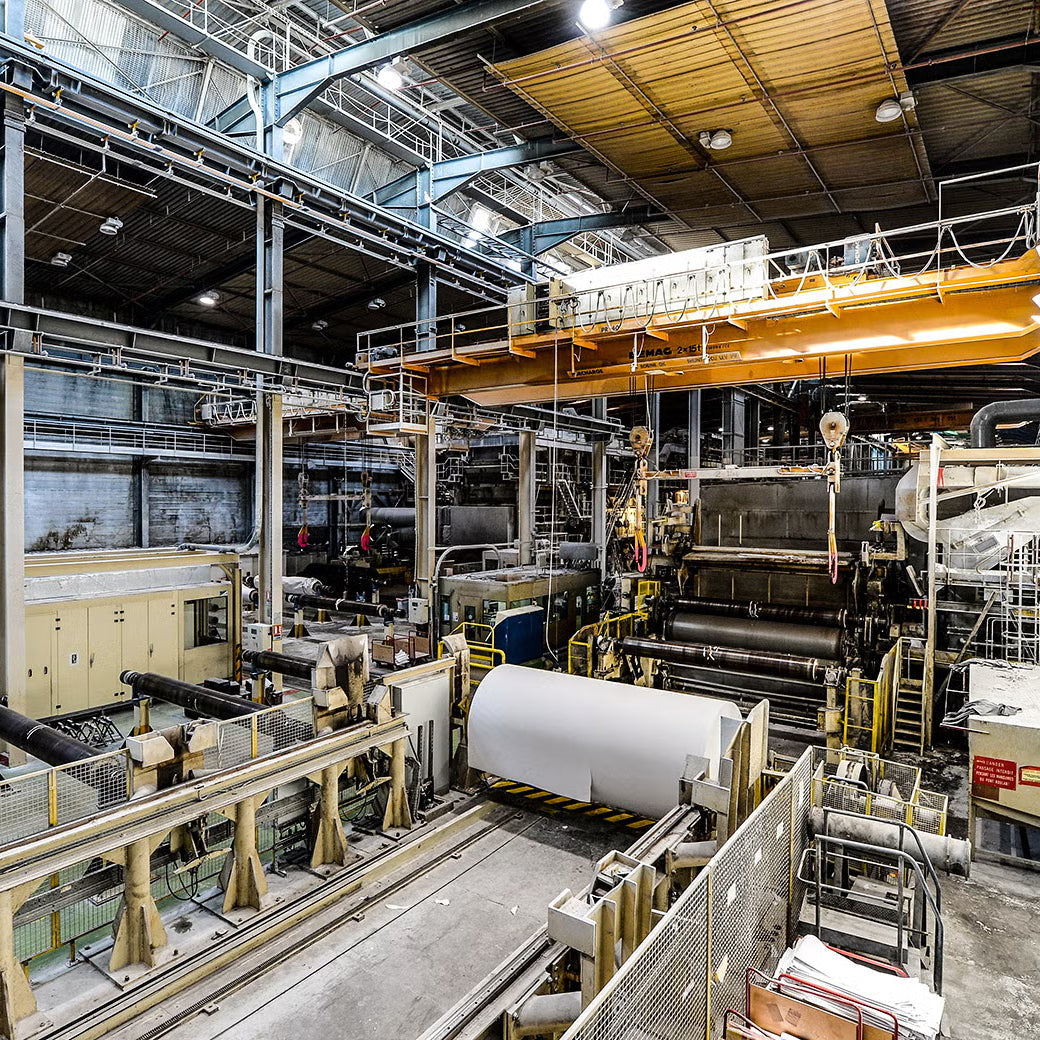
Every mill we talk to has an opinion about where the air goes. The operators say the machine. Maintenance says the bleach plant. Engineering says leaks. Then somebody puts a meter on the main header and on four branches, and within a month it turns out the biggest single consumer is a bank of open blow-off tubes in the dryer section that nobody had on any list.
That is the case for metering. Not because the number is interesting, but because a mill runs on so much air that everyone's intuition about it is wrong, and compressed air flow meters for paper mills convert an argument into a measurement.
This builds on our broader guide to compressed air for pulp and paper mills, which covers the whole system. Here we are only on measurement.
Why a mill in particular
Three reasons metering pays back faster here than almost anywhere else.
The system is enormous and distributed. Fiberline, bleach plant, machine, finishing, utilities. Each area has its own culture and its own habits, and a single main header reading tells you nothing about which one is the problem.
It runs continuously. A waste that costs a shop money during one shift costs a mill money 8,760 hours a year. Small percentages become real numbers fast.
Nobody can shut it down to investigate. You cannot walk a mill during a quiet Sunday the way you can walk a machine shop, because there is no quiet Sunday. Metering is how you see the system without stopping it.
Where the meters go
Do not start by metering everything. Start with a structure that answers questions.
- The main header, at the air house discharge. This is your total. Without it nothing else can be put in context.
- One meter per area or building. Fiberline, bleach plant, paper machine, finishing, utilities. Five meters here will tell you more than twenty scattered anywhere else.
- Dust collection and any pulse jet cleaning, separately. It is peaky, it is large, and it behaves completely differently from everything else, so mixing it into an area total hides both.
- Any branch you suspect. Once the area meters point somewhere, add a meter downstream to close in.
- The instrument air leg, if it is separate. Small volume, and worth watching because a rising trend there usually means a leak in a place that matters.
A mill that meters the main plus five areas has enough to find almost anything. A mill that meters only the main knows its bill and nothing else.
What you are buying
For compressed air, thermal mass flow meters are the normal choice. They read mass flow directly, which is what you actually want, so you are not doing pressure and temperature corrections in your head. Insertion style meters go into a hot tap on an existing pipe, which matters enormously in a mill where taking a header down is a scheduled outage item rather than an afternoon.
Two things to get right at install:
Straight pipe run. The meter needs undisturbed flow to read correctly. Manufacturers typically ask for something on the order of 10 to 15 pipe diameters of straight run upstream and about 5 downstream, but the number varies by meter and by what is upstream, so use the figure in the manual rather than a rule of thumb. Putting a meter right after an elbow is the most common way to get a number that is confidently wrong.
Insertion depth and orientation. An insertion probe has to sit at the right depth in the pipe and face the right way. This is a five minute detail that determines whether the readings mean anything.
Browse compressed air flow meters by pipe size, and see our general flow meter guide for how the technologies compare.
What to do with the data
This is where most metering projects stall. The meters go in, somebody builds a trend screen, and nothing changes. Four things to actually do:
1. Find the leak load
A mill has no true downtime, but it does have partial outages. During a machine down day, when production in an area is genuinely stopped, whatever that area is still consuming is leaks plus whatever somebody left open. Log it. That number is your leak baseline for that area, and it is usually the most persuasive number you will ever put in front of a capital committee.
Track it after a leak repair campaign too. A leak program with no measurement drifts back within a year and nobody notices. A leak program with a metered baseline stays honest.
2. Calculate specific power
Divide the electrical input to the air house by the flow you are producing, and express it as kW per 100 cfm. That single ratio tells you how efficiently you are making air, lets you compare your machines against their CAGI data sheets, and shows you immediately when something has degraded. We cover reading those sheets in how to read a CAGI data sheet.
3. Correlate air to production
Plot cfm against tons per day for a month. In a well run system the line is reasonably straight and goes through something close to your leak load at zero production. If the intercept is high, you have a large constant load that does not care whether you are making paper. That is leaks and open blowing, and it is money.
4. Catch artificial demand
If an area's consumption jumps when header pressure rises, that area has unregulated open uses. Every psi of extra header pressure makes them consume more for no benefit. Metering makes that visible in a way that no walkthrough will, and it is the argument for a pressure flow controller and proper point of use regulation.
What a mill will get wrong
- Metering the main only. You now know what you spend and nothing about where.
- Installing after an elbow. Bad data is worse than no data, because people act on it.
- No owner. A meter without somebody whose job includes looking at it is a gauge nobody reads. Assign it.
- Treating the baseline as permanent. Re-establish the leak baseline after every outage. Outages create leaks.
- Skipping dust collection. Pulse cleaning is peaky enough to distort an area total and hide everything else in it.
A reasonable first project
If you are starting from nothing, the first phase is one meter at the air house discharge and one per major area. Run it for a month. Take a leak-load reading during the next scheduled area down. Compute specific power. Bring those three numbers to whoever approves capital.
In most mills, that first month of data pays for the meters several times over, and it usually kills at least one project that was about to be approved for the wrong reason.
Frequently Asked Questions
How many flow meters does a paper mill need?
Start with one at the air house discharge for the total, one per major area such as fiberline, bleach plant, machine and finishing, and a separate one on dust collection because pulse cleaning is peaky enough to hide everything else in an area total. That is usually six or seven meters, and it answers most questions. Add branch meters later once the area meters point somewhere.
What kind of flow meter works for compressed air?
Thermal mass flow meters are the normal choice, because they read mass flow directly rather than volumetric flow that you then have to correct for pressure and temperature. Insertion style units install through a hot tap on existing pipe, which matters in a mill where shutting a header down is an outage item.
How much straight pipe does a flow meter need?
Manufacturers commonly ask for roughly 10 to 15 pipe diameters of straight run upstream and about 5 downstream, but the requirement varies by meter and by what is upstream of it. Use the number in your meter's manual. Installing immediately after an elbow is the most common cause of readings that are wrong in a way nobody catches.
How do I measure my leak load if the mill never stops?
Use partial outages. When one area is genuinely down, whatever that area's meter still shows is leaks plus anything somebody left open. Log it per area over several outages and you build a leak baseline without ever stopping the mill. Re-take it after every outage, because outages create leaks.
What is a good specific power number?
Express it as kW per 100 cfm and compare your own system against the CAGI data sheets for the machines you actually own, rather than against a published industry average. The value of the number is the trend: a rising kW per 100 cfm at constant flow means something has degraded, and it will show up there long before it shows up anywhere else.
The short version
Meter the total, meter each area, pull dust collection out on its own, and give the data an owner. Then use partial outages to find the leak load and track specific power over time. That turns compressed air flow meters for paper mills from instrumentation into an argument you can actually win.


