


Three compressors, one header, and a pressure gauge that never sits still. One machine is loaded, one is unloaded but still turning, and the third comes on for ninety seconds every time somebody opens a blow gun. Meanwhile the plant is running at 118 psi because that is where the last guy set the highest band, and the machines only actually need 95.
That room is not short on capacity. It is short on coordination. Lead lag control is the fix, and on a multi-compressor system it is usually the cheapest energy project available to you, because you already own all the hardware.
What Lead Lag Control Means
Lead lag is simple in concept. One machine is designated the lead, or base, unit and carries the steady part of the load. The others are lag units, sometimes called trim, and they only come in when demand climbs past what the lead can supply. When demand falls off, the lag units drop out first and the lead keeps running.
The point is that a rotary screw compressor is most efficient fully loaded. A machine running loaded at 100 percent delivers the most air per kilowatt it is ever going to. A machine idling in unload still burns 20 to 35 percent of its full-load power while producing nothing. So the strategy that wins is: keep as few machines as possible, fully loaded, and let exactly one machine do the modulating.
Lead lag also means rotating which machine is the lead. Left alone, one airend accumulates all the hours while another sits and gathers rust in its cooler. Rotating the lead on a schedule evens out wear and keeps every machine exercised.
The Cascade Problem
Most multi-compressor rooms were never designed. They grew. Somebody added a second compressor, set its pressure switch a little lower than the first so it would only come on when needed, and called it a day. Add a third and you get this.
| Machine | Pressure band | What actually happens |
|---|---|---|
| Compressor 1 | 110-120 psi | Runs first, holds the plant at the top of its band |
| Compressor 2 | 105-115 psi | Comes on when 1 cannot hold 105 |
| Compressor 3 | 100-110 psi | Last resort, rarely loaded efficiently |
| System result | 100-120 psi swing | Plant runs near 120 because that is the top band |
This is called a cascading or overlapping pressure band, and it has three problems.
It forces the plant to run high. To give each machine its own band you need a wide total band, and the plant ends up living near the top of it. Every 2 psi of extra system pressure costs roughly 1 percent more energy on the compressors, and it also increases flow through every leak and every open blow-off in the building.
It hunts. Bands that overlap mean two machines can both decide it is their turn. You get compressors cycling on and off, short cycling, and a pressure trace that looks like a saw blade. Downstream, anything with a tight pressure tolerance sees the swing.
It never rotates. The machine with the highest band is always the lead, forever, until it dies first.
What a Master Controller Does Instead
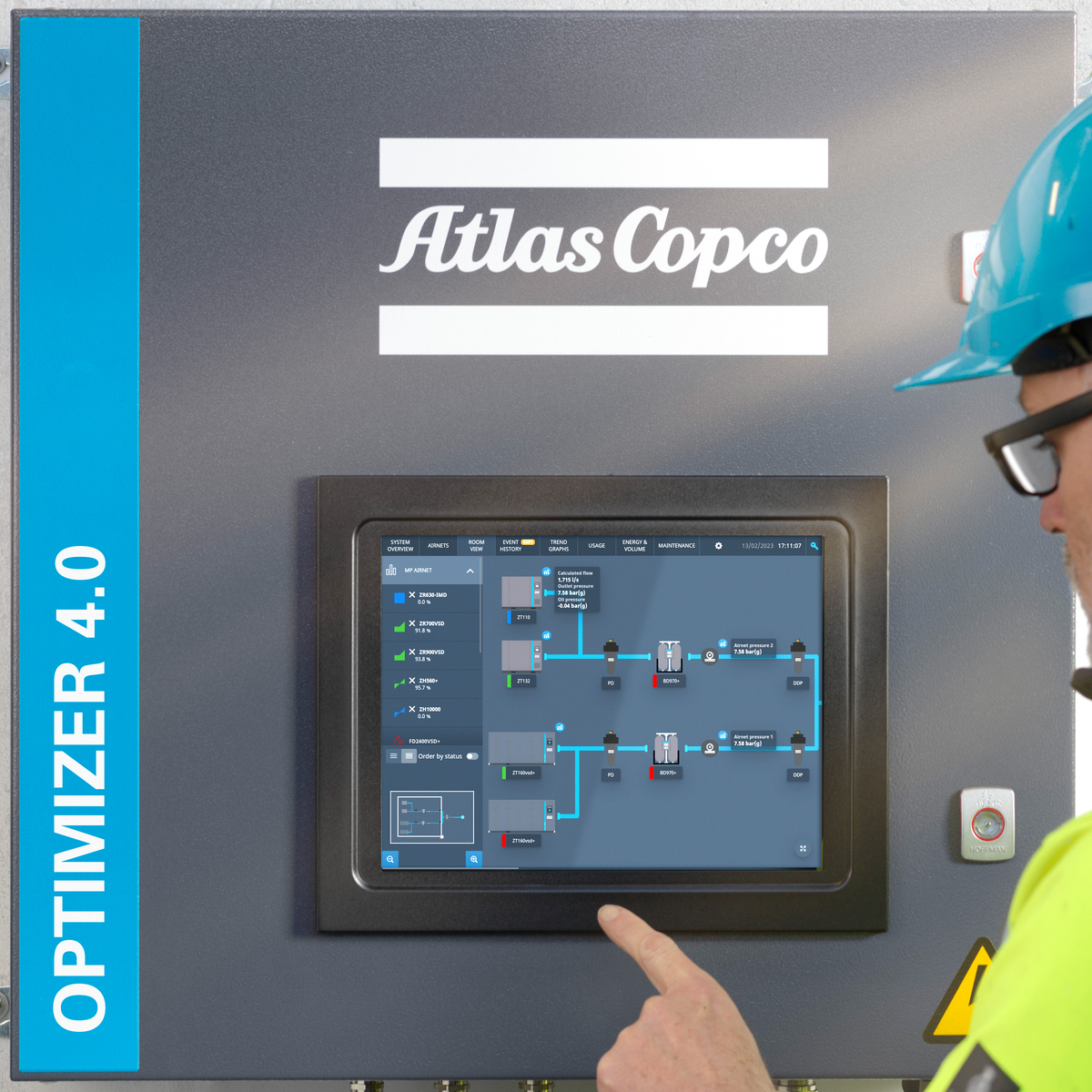
A master sequencer takes over from the individual pressure switches. Instead of three bands, the system gets one, and it can be tight: something like 98 to 102 psi across the whole room.
The controller reads system pressure at a single point, decides how many machines are needed, brings them on fully loaded, and hands the modulating job to exactly one unit. It also handles the housekeeping that nobody does manually: rotating the lead, equalizing run hours, keeping a machine out of the rotation when it is down for service, and preventing two machines from starting into the same demand spike.
The energy case comes from two places. First, the plant runs at a lower average pressure because you no longer need a wide band to separate machines. Dropping from an effective 115 psi to 100 psi is about a 7 percent cut to compressor energy, plus lower leak flow. Second, fewer machines run part-loaded. Published assessments of optimization-based sequencing against conventional automated control report system power reductions in the neighborhood of 12 percent.
You can browse the master and machine controllers we stock, including pressure flow controllers for holding a flat downstream pressure.
When You Need a Sequencer and When You Do Not
Two compressors of similar size with a plant that runs at a steady load? You can often get away with a simple lead lag relay or an alternating scheme, set both machines to the same band, and rotate weekly. That is real lead lag control and it costs almost nothing.
Three or more machines, mixed sizes, or a load that swings hard between shifts? You want a master controller. The decision logic gets past what a human can set with pressure switches, especially once machine sizes differ and the right answer depends on which combination covers the current demand most efficiently.
Mixed fixed-speed and variable-speed room? You definitely want a controller, and you want it configured so the variable-speed machine is the trim unit and the fixed-speed machines are the base. Get that backwards and you run a VSD at full speed, which is where it is least efficient, while a fixed-speed machine sits unloading.
Storage Makes Any Control Scheme Work Better
Control cannot outrun physics. If a plant has 1,000 CFM of demand and 240 gallons of storage, every demand event hits the compressors instantly and no control strategy will stop the swing.
The rule of thumb most of the industry uses is somewhere around 2 to 4 gallons of receiver per CFM of compressor capacity, more if your load is spiky. Added receiver capacity buys the controller time to make a decision instead of reacting, and it lets you narrow the pressure band without the compressors chattering. It is also the cheapest thing in the room.
If you are sizing storage from scratch, the math is in our guide to air receiver tanks.
Setting It Up Without Making It Worse
Find your real minimum pressure first. Walk the plant and find the machine with the highest genuine requirement, then add back the pressure drop through your dryer, filters and piping. That is your target, not the number on the gauge today. Most plants discover they have been running 15 to 20 psi higher than anything needs.
Measure before and after. A flow meter and a pressure logger on the header for a week before you change anything is what turns this from a guess into a number you can put in front of your CFO.
Fix the leaks first or you will oversize the room. A plant leaking 25 percent needs a machine it should not need. Find them before you decide how many compressors the sequencer has to manage.
Do not narrow the band before you add storage. A tight band with no receiver capacity produces short cycling, and short cycling kills motors and contactors. Storage first, then the band.
Watch the trim machine's sizing. The trim unit has to be able to cover the gap between base steps. If your base machines come on in 400 CFM chunks and your trim machine only covers 200 CFM, there is a 200 CFM window where the system has no good answer and it will cascade anyway.
Frequently Asked Questions
What is the difference between lead lag and a sequencer?
Lead lag is the strategy: one machine carries the base load, the others trim. A sequencer or master controller is the hardware that executes it across three or more machines, reading one pressure signal, deciding which units run, and rotating the lead. With two compressors you can do lead lag with a simple alternating relay and no sequencer at all.
How much energy does a master controller actually save?
Most of the saving comes from lowering average system pressure and from running fewer machines part-loaded. Roughly 1 percent per 2 psi of pressure reduction, plus the part-load recovery. Published comparisons of optimization-based sequencing against conventional automated control report around 12 percent system power reduction. Your number depends entirely on how badly the room is coordinated today.
Should the variable-speed compressor be the lead or the lag?
The lag, or trim. A VSD machine is most valuable when it is modulating to hold pressure, and least efficient at full speed. Fixed-speed machines should carry the flat baseline fully loaded, with the VSD following the swing on top.
Can I mix different brands of compressor under one controller?
Usually yes. Many master controllers work from simple run and load signals rather than a proprietary bus, so mixed-brand rooms are common. What you need to confirm is the interface available on each machine's own controller, which varies by model and vintage.
Do I still need pressure switches on each machine?
Keep them, set wide, as a backstop. If the sequencer loses communication or goes down, you want each compressor to fall back to a local band that will keep the plant running rather than leave you with no air at all.
Start With the Gauge
Before you price anything, watch your header pressure for ten minutes during a busy shift and write down the high and the low. If the spread is more than about 10 psi, or if your plant is running more than 15 psi above what any machine in the building actually needs, you have a coordination problem and not a capacity problem. Proper lead lag control and a bit more storage will get you further than another compressor, for a fraction of the money.


