


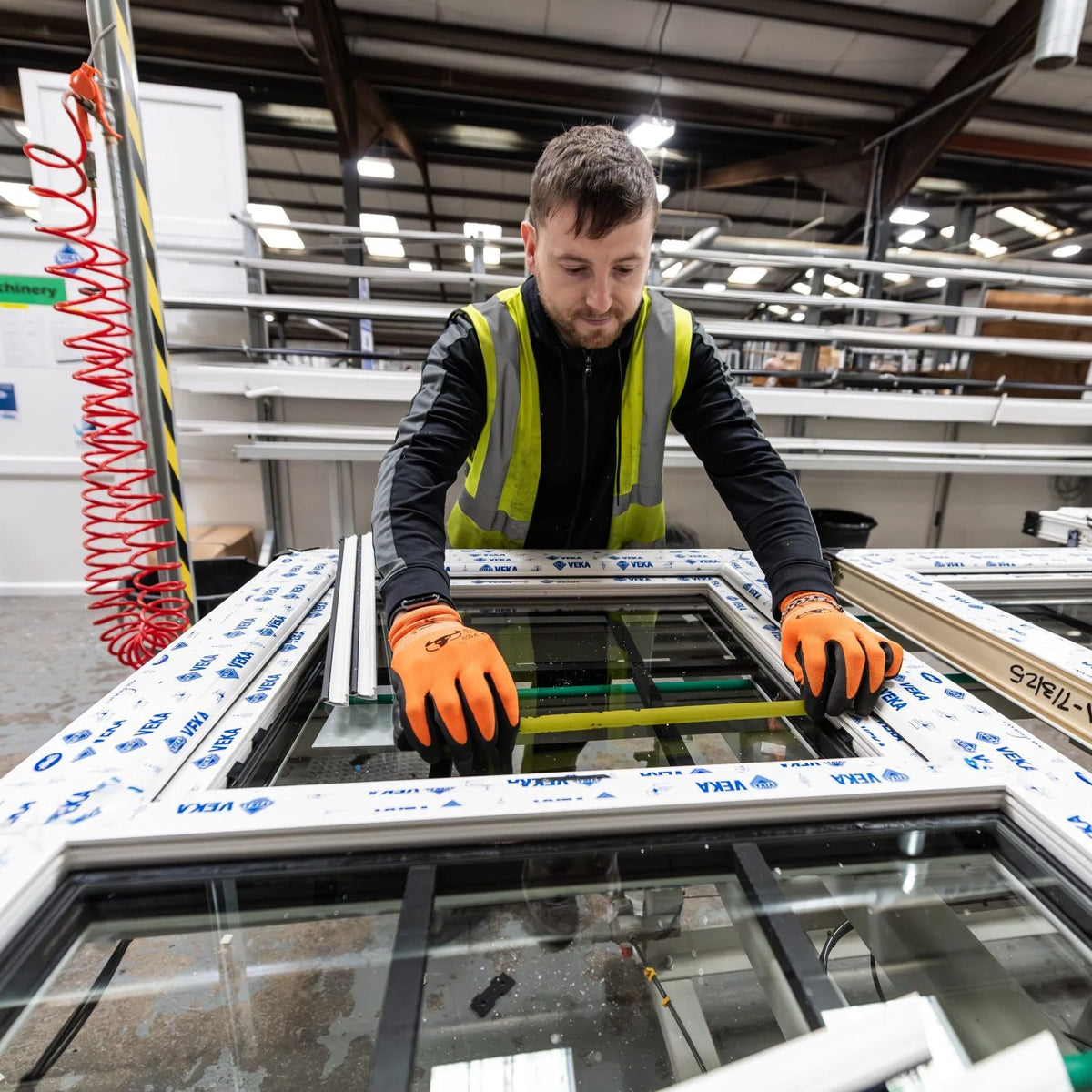
The warranty claims arrive about three years late, which is what makes them so hard to trace.
A window plant starts seeing fogging between the panes on units built in a particular stretch. Not many, maybe one in a few hundred. The sealant supplier gets called, the spacer supplier gets called, somebody reviews the press settings, and nobody finds anything because by the time the complaint arrives the evidence is two years in the past.
Wet compressed air on an insulated glass line is one of the few causes that produces exactly that pattern, and it is the reason compressed air for window and door manufacturing is worth more thought than a plant full of clamps and saws would suggest.
Why the IG Line Sets the Spec
An insulated glass unit is a sealed cavity with a desiccant filled spacer around the perimeter. That desiccant has a finite capacity, and its job is to absorb the small amount of residual moisture trapped in the cavity at assembly, then keep absorbing whatever slowly permeates the seal over the unit's life.
Every bit of moisture you seal in at the factory is capacity you have already spent. Build the unit with wet air blowing across the glass or into the cavity and you ship a unit whose desiccant is partly loaded on day one. It passes every test you run. It fogs in year three.
The same logic applies to the sealant bead. Moisture or oil on a glass surface or a spacer face before the sealant goes down is an adhesion problem, and a seal that fails early is the same warranty claim by a different route.
So the rule for a window plant is simple. Anything that blows on glass, on a spacer, or into a cavity before sealing needs to be dry and clean, and that requirement sets the specification for the plant whether or not the rest of the building cares.
- A refrigerated dryer holding roughly a 38 to 45 F pressure dew point is the baseline for an indoor heated plant.
- Coalescing filtration at the IG line itself, not just at the compressor room three hundred feet away.
- Activated carbon if the machine is lubricated and the IG air shares a header with everything else.
- A desiccant dryer if any part of the run goes through an unheated bay, which in a northern plant is worth checking rather than assuming.
That second bullet is the one plants skip, and it is worth its own page, because the three hundred feet of pipe between the dryer and the glass adds back rust, scale and condensate that your treatment already removed. We go through the filter stack, where to mount it and how to prove it works in point of use air treatment for an insulating glass line.
Our coalescing filter guide covers the stages and refrigerated vs desiccant walks the dryer decision.
Where the Air Goes in a Window Plant
| Operation | Demand character | What it needs |
|---|---|---|
| Vinyl welders, pneumatic platens and clamps | Cyclic, moderate, many of them | Dry general plant air |
| CNC corner cleaners | Cyclic clamping plus chip blow-off | Dry, and a safety nozzle on the blow-off |
| Saws, punches, crimpers on aluminum | Clamping and feed, intermittent | General plant air |
| IG washer, press and spacer application | Continuous while running | Clean and dry. The quality critical load |
| Sealant pumps, two part and hot melt | Air driven, continuous, often the largest single draw | Dry, and sized properly |
| Glass handling vacuum lifters | Can be enormous if venturi driven | Check whether yours are air or electric |
| Glazing, hardware, screw guns, staplers on wood | Intermittent, many tools | General plant air |
| Blow-off at the washer and before sealing | Small but critical | Dry and oil free. This is the one that fogs units |
Two rows in that table are where the money is, and neither is the one people think about.
Sealant Pumps Are Probably Your Biggest Load
Two part polysulfide and polyurethane sealant gets moved by air operated ram or piston pumps, and hot melt butyl by heated air driven units. These run continuously while the line runs, and they are frequently the largest single air consumer in a window plant.
Two things worth checking:
- Nobody counted them in the original sizing. Plants size on welders and clamps, which are intermittent, and then wonder why the header sags whenever the IG line runs.
- Air motors on pumps are inefficient by nature. That is a fair trade for the simplicity and the stall behaviour, but it means the pump is a real continuous load and not a rounding error. Our piece on air motors covers why.
Glass Vacuum Lifters, and the Same Expensive Question
Glass handling runs on vacuum, and vacuum comes two ways. An electric vacuum pump, or a compressed air venturi generator.
The venturi version is simpler, cheaper to buy and has no motor on the arm. It is also an enormous air consumer. A single generator can pull on the order of 20 SCFM while generating, and for the same job an electric vacuum pump will typically do it on something in the range of one quarter to one tenth of the energy.
So, from a company that would rather sell you more compressor:
- Occasional lifting, a few cycles an hour? Venturi is fine. Size the compressor to cover it.
- Lifters running most of the day on a glass line? Price the electric pump. It will usually pay the difference and remove a large block of load from your compressor at the same time.
- Already running venturis? Check whether they keep generating while holding vacuum. A vacuum switch that cycles them only on demand is a cheap retrofit that stops you paying for air while a lite sits still.
We made the same argument for stone shops in compressed air for stone fabrication, and it holds here for the same reason. The full comparison is in venturi vacuum generators versus electric vacuum pumps.
The Intake, PVC Chips and Glass Dust
A window plant generates a specific mix of debris. PVC chips and shavings from the cleaners and saws, aluminum swarf, glass dust from cutting and seaming, and sealant overspray near the IG line.
A compressor is an efficient dust collector, so put the intake somewhere that is not downwind of any of it. Outside air, away from the cleaner exhaust and away from the glass cutting table, with a restriction indicator so you change the element on condition rather than on a date. More in the intake filter guide.
Sizing
| Plant | Typical demand | Common setup |
|---|---|---|
| Small fabricator, one weld and clean line, buys IG in | 40 to 80 CFM | 20 to 25 HP rotary screw, refrigerated dryer, 240 to 400 gal |
| Mid size plant with an IG line in house | 100 to 250 CFM | Two screws in lead/lag, dryer plus filtration at the IG line, 400 to 660 gal |
| High volume multi line plant | 250 CFM and up | Multiple machines, consider variable speed as the trim unit, distributed storage |
Build your own number from the equipment list rather than the table. The method that actually works here:
- Get published consumption for the welders, cleaners and IG line from the machine builders.
- Add the sealant pumps at continuous draw. This is the step people skip.
- Find out whether your glass lifters are venturi or electric, and if venturi, add them honestly.
- Apply a diversity factor to the hand tools only, not to the line equipment.
- Add 15 to 25 percent for leaks unless you have surveyed.
If you run one shift, zone the plant and shut it down at night. A window plant has a lot of quick disconnects and a lot of hours with nobody using air. We covered that in compressed air zoning.
What Window Plants Get Wrong
- Sizing on welders and clamps and forgetting the sealant pumps. The intermittent loads are visible, the continuous one is not.
- IG line air on the general header with no local treatment. Then chasing fogging claims through the sealant supplier.
- No dryer at all, which works until the first humid summer and then produces units that fail three years out.
- Venturi glass lifters nobody priced against electric. Often the single largest avoidable load in the building.
- Unregulated blow-off at the cleaners. The 30 psi cleaning limit applies, and a proper safety nozzle costs very little. See compressed air safety.
- Compressor breathing PVC chips and glass dust. Cheap to fix, expensive to ignore.
- Running the plant at 120 psi because one welder seemed happier. Every psi is roughly half a percent in energy, continuously.
Frequently Asked Questions
Can wet compressed air cause insulated glass units to fog?
It can contribute, and it produces exactly the delayed pattern that makes fogging claims hard to diagnose. The spacer desiccant has finite capacity and its job is to absorb residual cavity moisture plus whatever permeates over the unit's life. Moisture sealed in at assembly is capacity already spent, so the unit passes every factory test and fails years later.
How much compressed air does a window manufacturing plant need?
A small fabricator running one weld and clean line and buying IG in is usually 40 to 80 CFM. A plant with an IG line in house commonly runs 100 to 250. The variable that moves it most is not the welders, it is the sealant pumps and the glass vacuum lifters, both of which are continuous loads that get left off the list.
Do we need a dryer for a window plant?
Yes if you assemble insulated glass. A refrigerated dryer at roughly a 38 to 45 F pressure dew point is the baseline for an indoor heated plant, with coalescing filtration at the IG line itself rather than only at the compressor. Go to desiccant if any part of the run passes through an unheated bay.
Should glass vacuum lifters be air driven or electric?
Venturi generators are cheaper and simpler and fine for occasional lifting. For lifters running most of the day, an electric vacuum pump typically does the same work on roughly one quarter to one tenth of the energy, which usually makes it the better buy and removes a large load from the compressor. If you already run venturis, check whether they keep generating while holding.
Why does our header pressure drop when the IG line starts?
Most often because the sealant pumps were never counted. They are air driven and run continuously while the line runs, unlike the welders and clamps that dominate everyone's mental model of the plant. Add them at full continuous draw, and if the drop is at one end of a long building check for an undersized or dead end main.
Where to Start
Two checks. Find out what the air blowing on glass before sealing is actually treated with, and find out whether your glass lifters are venturi or electric. The first one decides whether you are building warranty claims into units today, and the second usually decides how big your next compressor needs to be.
Browse rotary screw air compressors, or the refrigerated air dryers and filtration the IG line needs. Send us your line equipment list and whether you seal in house and we will size it with you.


