


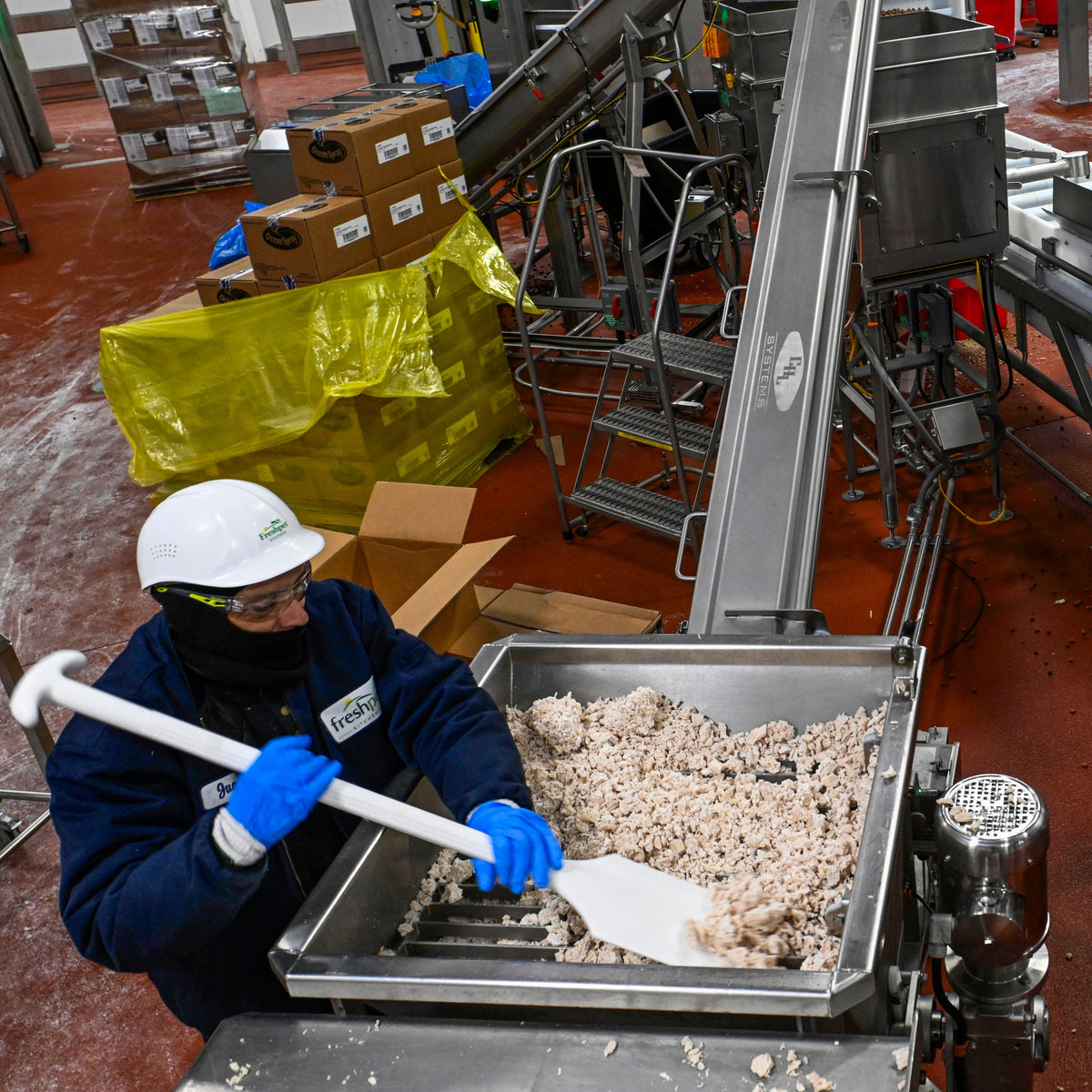
Stand next to the extruder in a kibble plant and you can hear where the air goes. Every few seconds the baghouse fires a row of pulses, sharp and loud, and the header pressure dips. Down the line the vacuum coater cycles, the checkweigher rejects a bag, and the bagger pulls a shot to open the next one. None of that is glamorous. All of it stops the line when the air stops.
Most plants size their system around the extruder and are then surprised by what the dust collection costs them. Compressed air for pet food manufacturing is really two systems sharing one header: a very large, very spiky utility load driven by baghouses and conveying, and a small clean load that touches product and answers to FDA.
The rule you actually answer to
Pet food plants fall under 21 CFR Part 507, the FSMA preventive controls rule for food for animals. People assume it is softer than the human food rule. On compressed air it is not vague at all. The regulation requires that compressed air or other gases mechanically introduced into animal food, or used to clean animal food-contact surfaces or equipment, be used in a way that protects against contamination.
Read that again, because it covers more than people think. It is not just air that blows onto kibble. It includes the air you use to blow down a conveyor between runs, the air that opens and shuts a bag, and the air inside a vacuum coater. If it touches product or a product-contact surface, it is in scope and it belongs in your food safety plan as a preventive control or a prerequisite program.
What the rule does not do is hand you a number. Like the human food rules, it tells you to control the hazard and leaves the specification to you. In practice that means two things:
- Your hazard analysis has to name compressed air and say how you control it, usually filtration at point of use plus a test schedule.
- Your audit scheme supplies the number. If you are certified to Safe Feed/Safe Food, SQF, or a customer standard, expect them to want an ISO 8573-1 class and a test report, not a shrug.
A reasonable, defensible target for the product-contact branch is particulate and oil at ISO 8573-1 Class 1 or 2, with a dew point class matched to your coldest line temperature. We broke the classes down in ISO 8573-1 air quality classes, decoded.
Where the air actually goes
Here is the load picture in a typical extruded dry pet food plant. Numbers are ranges to argue from, not a substitute for your equipment sheets.
| Load | Typical demand | Character |
|---|---|---|
| Pulse-jet baghouse cleaning | 20 to 150+ CFM per collector | Short, violent pulses at 90 to 100 psig. Usually the largest single load in the plant. |
| Dilute phase pneumatic conveying | Blower driven, not compressor | Worth knowing so nobody charges it to your compressor budget. |
| Extruder die face cutter and knife adjust | 2 to 10 CFM | Small, continuous, zero tolerance for interruption. |
| Vacuum coater and fat applicator valves | 5 to 25 CFM | Product contact. This is your clean branch. |
| Diverter and slide gates | 2 to 15 CFM per bank | Pulsing, storage-sensitive. |
| Bagging, sealing, checkweigher reject | 10 to 40 CFM per line | Product contact at the fill head. |
| Blow-off and sanitation cleanup | 10 to 30 CFM | Capped at 30 psi at the nozzle by OSHA. |
The pattern that matters: the biggest load is also the spikiest. A pulse-jet collector fires a roughly tenth of a second burst through a venturi over a row of bags, then the next row, cycling continuously. That is a demand profile almost perfectly designed to make an undersized system look like a capacity problem when it is a storage problem.
Fix the baghouse before you buy a bigger compressor
We get this call every few months. Plant adds a line, the collector pulses weaker, bags blind, differential pressure climbs, and somebody quotes another 50 hp. Check these first.
Put a dedicated receiver at the collector. Not back in the compressor room. At the manifold. Short pulses need volume within a few feet, and a local receiver converts your existing compressor into enough compressor. Our air receiver tanks cover the sizes that matter here.
Check that the pulse is actually reaching the bag. A diaphragm valve that is slow to reseat looks like low pressure. So does a plugged venturi.
Dry the air feeding the collector. This is the one people skip because it is "just dust collection." Moisture plus pet food dust equals a paste that blinds media and gums diaphragm valves. In a plant running fat and protein fines, wet pulse air is a maintenance problem on a schedule.
Then look at pulse timing. Many collectors are set to pulse on a fixed timer when they could pulse on differential pressure, which can cut pulse air consumption substantially without hurting cleaning.
If you want the full energy framing, measuring what you actually use will settle the argument faster than any spec sheet.
Combustible dust changes the conversation
Pet food dust is combustible. Grain-based fines, protein meals, and fat-coated fines all are, and NFPA 652 applies to facilities that manufacture, process, convey, or handle combustible particulate solids. More than half of recorded dust explosions happen inside the dust collector itself.
This affects your air system in a few concrete ways. Your collector needs deflagration venting or suppression, explosion isolation, and a rotary airlock, and none of that is optional because the collector is outdoors. Static control matters on your air lines near the collector. And if you are in a classified area, the usual answer is to move electrical actuation out and use pneumatic actuation instead, which adds air load.
Be clear about the division of labor here: we can supply the compressor, the receiver, the dryer, the filtration, and the piping feeding your collector. The explosion protection hardware on the collector itself is your dust collection vendor's scope, and you want them involved early rather than after you have set the compressor.
Oil-free, or treated lubricated air?
Same answer as every food plant, with a pet food wrinkle. Most of your air is utility air driving baghouses, gates, and conveying aids. That does not need oil-free. A standard rotary screw compressor with a good separator and proper downstream treatment is the economical choice for the bulk of your flow.
The product-contact branch is different. Air going into a vacuum coater, blowing across kibble, or entering a bag at the fill head should be on a treated branch with coalescing filtration and carbon, or fed by an oil-free compressor. Plants that split the header this way spend less and have an easier time at audit than plants that go oil-free across the board and then cannot justify the cost, or that run everything lubricated and cannot defend the product-contact points.
One honest caveat. If you make wet or canned pet food with a retort, your sterile and clean-in-place requirements go up a level and start to look like human food canning. We can treat the air; the retort validation is not ours.
Dew point, and the one place plants get burned
A dry kibble plant is warm and the product is hygroscopic. Water in the air shows up as caking in the coater, inconsistent fat pickup, and bags that will not seal cleanly.
Refrigerated drying to a roughly plus 38 degree F pressure dew point is adequate for most of the plant. Go to desiccant and minus 40 only where you have a specific reason: lines that run outdoors or through an unheated section in winter, instrument air on a critical control loop, or a customer specification that names it. Buying desiccant for the whole plant when a refrigerated dryer would do is a common and expensive overcorrection.
Then actually drain the system. Pet food plants generate a lot of condensate and the drains get ignored. Zero-loss condensate drains stop the twin problems of wasted air and missed slugs.
Frequently Asked Questions
Does 21 CFR 507 require me to test my compressed air?
The regulation requires you to use compressed air in a way that protects against contamination, and to document that control in your food safety plan. It does not name a test method or frequency. Your audit scheme usually does, and twice a year at the point of use nearest product is the common expectation. Testing is the easiest way to prove the control you wrote down.
Is the baghouse really my biggest air load?
In most extruded dry pet food plants, yes. Pulse-jet cleaning at 90 to 100 psig across multiple collectors routinely outweighs everything on the process side. If you have never metered it, that is the first measurement worth making.
Do I need oil-free air throughout the plant?
Almost never. Split the header. Run lubricated machines with full treatment for baghouses, gates, and conveying, and put a treated or oil-free branch on anything that touches product or a product-contact surface. That is cheaper and easier to defend than a blanket answer in either direction.
Why do my pulse valve diaphragms keep failing?
Usually wet air, sometimes dirty air. Moisture and fine product dust make a paste that holds the diaphragm off its seat, and the valve then leaks continuously instead of pulsing. Dry the air feeding the collector and the failure rate usually drops hard.
Can I use the same compressor for a new line, or do I need another machine?
Meter first. The majority of complaints we see in this industry turn out to be a transient problem, fixed by local storage at the collectors and better pulse control, rather than a true capacity shortfall. Add storage, fix the drains and the leaks, then re-evaluate. If you still come up short after that, size the new machine against measured data rather than nameplate math.
Build it as two systems on one header and compressed air for pet food manufacturing gets a lot simpler. Big, well-stored, well-dried utility air for the baghouses and the gates. A small, clean, tested branch for everything that touches the food. Size the first one off measurement and document the second one, and both the line and the auditor leave you alone.


