


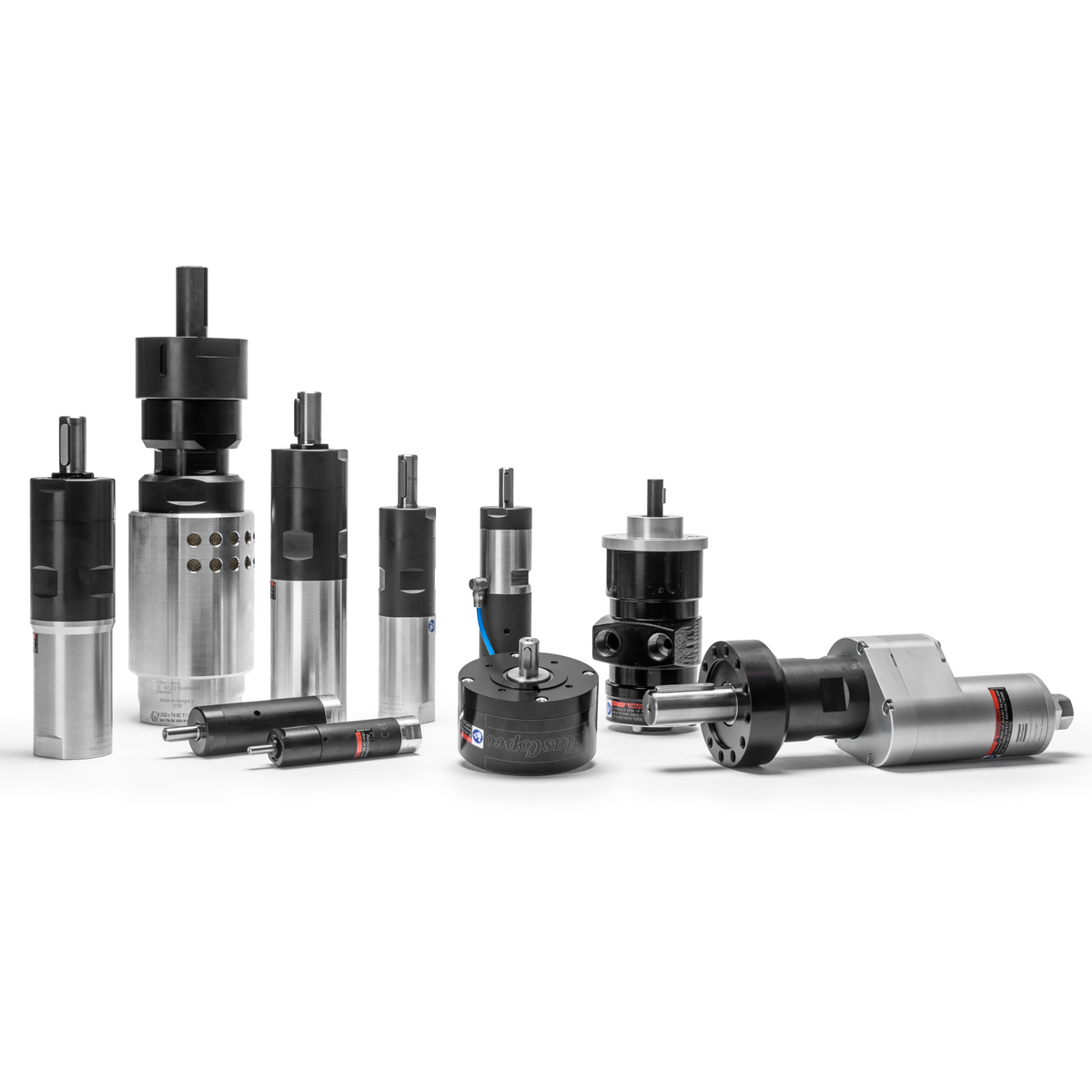
Start with the uncomfortable part, because everybody who sells air motors skips it.
An air motor is a poor way to convert electricity into rotation. You pay to compress air, you lose most of that energy as heat at the compressor, you lose more in the pipe, and then the motor itself is not especially efficient at turning that air back into torque. Compared to running an electric motor of the same output, you are spending several times the energy for the same work.
So why does anybody use them? Because in five specific situations, the things an air motor does are things an electric motor simply cannot do at any price. If you are in one of those situations, the energy penalty is not the deciding factor. If you are not, you are burning money.
The Five Cases Where Air Wins
1. It can stall all day and not care
This is the big one and it is the reason air hoists exist. Overload an electric hoist and you trip a breaker, burn a winding, or rely on a clutch to save you. Overload an air hoist and it simply stops turning. No heat, no damage, no drama. Take the load off and it goes again.
For a hoist, a winch, a capstan, or any drive that can meet a hard stop as part of normal operation, that behavior is worth a great deal. It also means an air motor can be used as its own torque limiter: set the regulator and the motor physically cannot exceed that torque.
2. Classified and hazardous areas
No electricity at the motor means no ignition source, no explosion-proof enclosure, no conduit, no seal-offs, no inspection. In a paint booth, a solvent room, a grain elevator, a refinery or anywhere with a combustible dust or vapor classification, an air motor and a hose replace a very expensive electrical installation.
Run the numbers on the whole install, not just the motor. An explosion-proof electric drive plus the conduit, the seals and the electrical inspection often costs more up front than the air motor and its lifetime energy penalty combined. We covered the broader version of this argument in compressed air for oil and gas.
3. Wet, washdown and submerged
Air motors do not mind water. There is no winding to short and the positive internal pressure keeps water out. In a food plant washdown area, a car wash, a dairy, or anything that gets hosed down daily, that removes an entire category of failure. Some designs will run submerged.
4. Continuous duty at 100 percent, in any ambient
An electric motor has a duty cycle and a thermal limit. An air motor is cooled by the air passing through it, so it runs continuously without heating up, and it does not care whether the room is 20 F or 140 F. For a mixer that runs an eight hour batch, or a conveyor drive next to a furnace, that matters.
5. Infinitely variable speed with no drive electronics
Turn the regulator, change the speed. No VFD, no programming, no harmonics on your electrical system, no drive to fail. Torque and speed both track air pressure, which for something like a paint mixer or a drum agitator is exactly the control you want and all the control you need.
What They Actually Drive
| Application | Why air | Typical setup |
|---|---|---|
| Hoists and winches | Stalls safely under overload, precise inching control | Vane motor with brake, reversible |
| Drum and tank mixers | Classified area, variable speed, runs all shift | Low speed vane or gear reduced |
| Conveyor and roller drives | Washdown, high ambient, stall safe on a jam | Reversible, gear reduced |
| Capstans and tuggers | Stall under load is normal operation | High torque, low speed |
| Valve and damper actuators | No power at the valve, fail-safe behavior | Reversible with brake |
| Turntables and positioners | Paint booth classification | Low speed, regulated |
| Grinders and drills | Power to weight, stall safe | High speed vane |
| Pumps and blowers | Remote or classified location | Direct or belt drive |
Sizing, and the Number That Surprises People
Air motors are rated at a specific pressure, usually 90 PSI, and the rating collapses if you do not actually deliver that at the motor. A motor fed 70 PSI because of an undersized hose is not a slightly weaker motor, it is a substantially weaker one, and people routinely conclude they bought the wrong size when they actually bought the wrong hose.
Work through it in this order:
- Find the torque and speed you need at the load, including any gear reduction.
- Read the motor's performance curve at 90 PSI. Air motors produce maximum power at roughly half their free speed and maximum torque at stall, so pick the curve point you will actually operate at rather than the headline horsepower.
- Read the air consumption at that same point. This is the number that decides your compressor, and it is bigger than people expect.
- Size the hose and fittings to deliver 90 PSI at the motor under load, not at rest. Undersized quick couplers are the single most common cause of a disappointing air motor.
- Add it to your plant demand and check your compressor can carry it continuously if the motor runs continuously.
A continuously running air motor is a continuous load, which means a rotary screw rather than a piston machine. A piston compressor rated for 50 percent duty will not survive feeding a mixer that runs an eight hour batch.
Keeping Them Alive
Air motors are simple and they fail for simple reasons.
Lubrication. Most vane air motors want lubricated air, and this is the opposite of the advice for a lot of other pneumatic equipment. Vanes sliding in a rotor need an oil film. Run one dry on unlubricated air and the vanes wear fast and the motor loses power gradually until somebody declares it worn out. Check the manual, fit the lubricator it asks for, and keep it filled. The FRL guide covers setting drip rate.
Water. Moisture washes the oil film off the vanes and rusts the rotor and the housing. A motor in an unheated area also ices at the exhaust, because expanding air gets very cold, and the motor slows and stops. That is a drying problem, not a motor problem.
Exhaust noise. An air motor exhausts continuously while running, so it is a constant noise source, not an intermittent one. That makes it a bigger contributor to daily noise exposure than something that fires twice a minute. Fit a muffler sized for the flow, and see our pneumatic muffler guide for why undersizing it costs you power.
Oil mist in the room. If you are lubricating the motor, that oil leaves with the exhaust. In an occupied space use a reclassifying muffler that catches it rather than spraying it across the floor.
When to Say No
Be honest with yourself about whether you are actually in one of the five cases.
If the drive is in a clean, dry, unclassified area, runs at a fixed speed, does not stall, and has power available at the location, an electric motor is the right answer and it is not close. The air motor will do the job, it will just cost several times as much to run for years.
The place people go wrong is inheriting a decision. A plant that installed air drives decades ago because that was the practice keeps replacing them in kind without ever asking whether the original reason still applies. If the classification changed, or the equipment moved, revisit it.
Where to Start
Write down the torque and speed you need, then check the performance curve at 90 PSI and read the air consumption at your operating point rather than at the headline. Make sure your hose and couplers can actually deliver 90 PSI under load. Browse air motors, and if you are still deciding between designs, our vane vs piston comparison covers that side.
An air motor is the wrong choice most of the time and exactly the right choice some of the time. Knowing which one you are looking at is the whole job.
Frequently Asked Questions
Are air motors less efficient than electric motors?
Yes, substantially. You lose energy compressing the air, lose more in distribution, and the motor itself is not especially efficient at converting that back to torque. They are chosen for what they can do rather than for what they cost to run.
Why use an air hoist instead of an electric one?
Because an air hoist stalls harmlessly under overload. It simply stops turning, with no heat and no damage, and resumes when the load is reduced. It also gives fine inching control and works in classified areas without explosion-proof electrical work.
Do air motors need a lubricator?
Most vane motors do, which is the opposite of the guidance for a lot of other pneumatic equipment. The vanes need an oil film to slide properly. Running dry wears them fast and the motor loses power gradually. Check the manual and set the drip rate as specified.
My air motor seems underpowered. What should I check first?
Pressure at the motor while it is running under load, not at rest. Air motors are rated at a pressure, usually 90 PSI, and undersized hose or restrictive quick couplers routinely drop 20 PSI or more. That reads as a weak motor when it is actually a supply problem.
Why does my air motor ice up?
Exhausting air expands and gets very cold, and any moisture in it freezes at the exhaust port and chokes the motor. The fix is drying the supply air rather than anything at the motor itself.


