


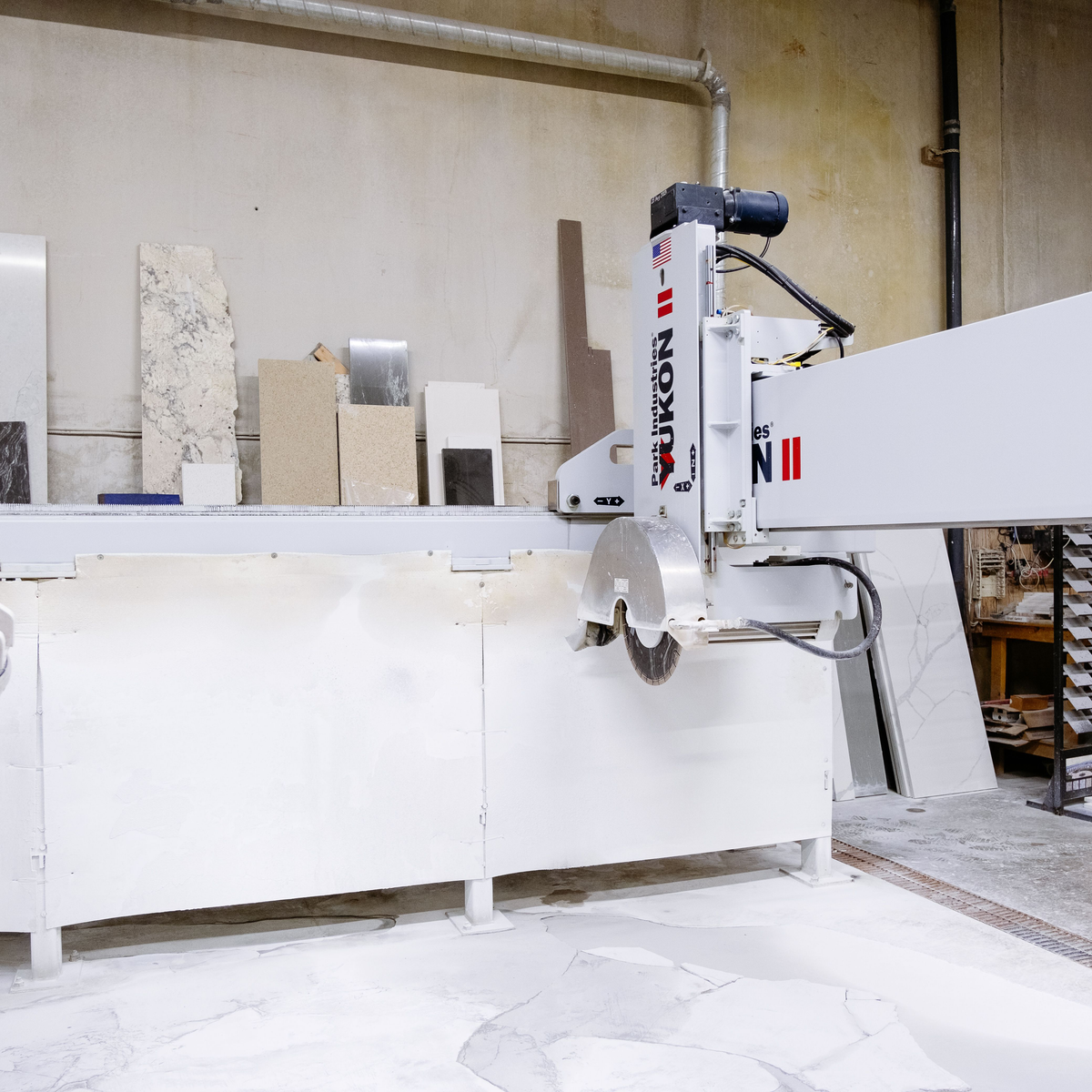
Most articles about compressed air start by telling you what to buy. This one has to start with something you are not allowed to do with it, because in a stone shop that rule shapes everything else.
You cannot blow down with compressed air. Not the benches, not the CNC bed, not the floor, and absolutely not your clothes. Stone fabrication falls under OSHA's respirable crystalline silica standard at 29 CFR 1910.1053, and that standard sets a permissible exposure limit of 50 micrograms per cubic meter over an eight hour shift, with an action level of 25. Dry sweeping and blowing settled dust with compressed air are both off the table, because both take silica that was lying still and put it back in the air everyone is breathing.
Engineered quartz is worse than granite here, because the silica content is higher. Shops have been shut down over this and fabricators have died of silicosis. So when we talk about compressed air for stone fabrication, the first thing on the list is a blow gun that stays in the drawer.
What That Rule Does and Does Not Prohibit
Worth being precise, because shops over-correct in one direction and under-correct in the other.
- Housekeeping with air is out. Blowing down machines, tables, floors, or people is the specific thing that gets cited. Wet methods or a HEPA vacuum instead.
- Blowing water off a wet slab coming off the saw is a different activity and it is normal practice, because a wet slab is not a pile of settled dry dust. Keep the slab wet, do it where the water is contained, and do not let it become a habit that migrates to the dry bench.
- Everything with air still answers to the 30 psi rule. OSHA's general requirement at 1910.242(b) limits compressed air used for cleaning to 30 psi with effective chip guarding and personal protective equipment. A regulated safety nozzle is not optional anywhere in the shop.
Your silica exposure control plan is yours and your industrial hygienist's. We sell compressors, and we are not going to pretend a piece of equipment makes you compliant. What we can do is make sure the air system is not the thing that gets you written up.
Where the Air Actually Goes
Stone shops run wet on purpose, which means a lot of what you would expect to be pneumatic is electric and water fed. The air load is real but it concentrates in a few places.
| Use | Typical demand | Notes |
|---|---|---|
| Vacuum lifters and suction cups | Often the largest single load | Usually 100 to 125 psi, often wants a dedicated supply |
| CNC saw and router pneumatics | 5 to 20 CFM | Tool changer, bed clamps, probe, cone cleaning |
| Bridge saw and waterjet auxiliaries | Varies | Clamping and indexing, not the cutting itself |
| Pneumatic hand tools | About 6 CFM for a mini polisher, 10 to 16 for a 4 or 5 inch wet polisher, 4 to 8 for a die grinder | Continuous duty, and higher than most shops assume |
| Seam setters and laminating clamps | Small, intermittent | Hold, not flow |
| Blow-off at the wet saw | Small, regulated | Wet slab only, safety nozzle, 30 psi for cleaning |
| Slurry pumps and pit equipment | Varies | Often electric, check yours |
That hand tool row catches people out. A five inch water fed pro series polisher is commonly rated at about 15.9 CFM at 90 psi, roughly triple the figure most fabricators quote from memory, and it is a continuous load rather than a short burst. We go through the real numbers and the hose and coupler problem behind them in air polishers in a wet stone shop.
Add it all up for a typical two-saw shop and you are usually looking at 30 to 70 CFM, which is a long way from what the vacuum lifter salesperson implied. The exception, and it is a big one, is below.
Vacuum Lifters, and the Number Nobody Mentions
This is the single most expensive decision in a stone shop's air system, and it usually gets made by whoever sold the lifter.
Vacuum lifters come two ways. Some use an electric vacuum pump. Many use a compressed air venturi generator, which makes vacuum by blowing high velocity air through a nozzle. The venturi version is cheaper, simpler, has no motor on the arm, and is lovely right up until you look at what it costs to run.
A venturi generator typically wants 60 to 90 psi to work properly, and a single unit can pull on the order of 20 SCFM of motive air while it is generating. On a single stage venturi the ratio of compressed air consumed to vacuum flow produced is often no better than one to one, and can be two or three to one. Multi stage units do considerably better, around one to three or better.
Here is the comparison that matters. For the same job, an electric motor driven vacuum pump can do it using something in the range of one quarter to one tenth of the energy a venturi generator uses. The full comparison is in venturi vacuum generators versus electric vacuum pumps.
So the honest guidance, from a company that would rather sell you more compressor:
- Intermittent lifting, a few cycles an hour? A venturi is fine, and the simplicity is worth something. Size the compressor to cover it.
- A lifter that holds vacuum for long periods, or a shop running lifters most of the day? Price the electric pump version. The energy difference will pay the price difference, and you will not need the compressor capacity you were about to buy.
- Already own venturi lifters? Check whether yours are single or multi stage, and check whether they run continuously or only pull down and then hold. A unit that keeps generating while holding is burning air for nothing, and a vacuum switch that cycles it only on demand is a cheap retrofit.
We would rather tell you that than sell you a 50 horsepower machine to feed four venturi generators.
The Compressor Lives in a Wet, Dusty Building
Two environmental problems, and they pull in opposite directions.
Water everywhere. A stone shop is humid. High ambient humidity means more water into the compressor inlet, more condensate, and more of it reaching your tools and CNC pneumatics. A refrigerated dryer is not optional here, it is baseline equipment, and you want real drains that somebody actually checks.
Silica where you do not want it. Even in a wet shop there is airborne dust, especially around dry polishing, the saw during slab breakdown, and anywhere the slurry has dried. A compressor is an efficient dust collector, and silica in a compressor is both a maintenance problem and a reason to care about where the exhaust goes.
- Put the intake outside, in clean air, away from the shop floor and away from the slurry pit.
- Use a restriction indicator rather than a calendar for intake filter changes.
- Keep the compressor room out of the wet zone entirely. Its own room, its own ventilation, a door that closes.
- Check cooler fins on a schedule. Dust plus humidity makes a paste on fins that no air blast will shift.
Our intake filter guide covers the hardware, and compressed air for foundries deals with the same silica problem in a hotter building if you want the deeper version.
Sizing
| Shop | Typical demand | Sensible setup |
|---|---|---|
| Single bridge saw, hand finishing, one lifter | 20 to 40 CFM | 10 to 15 HP, 120 gallon, refrigerated dryer, filtration |
| CNC plus saw, multiple lifters, several air tools | 40 to 90 CFM | 20 to 30 HP rotary screw, 240 to 400 gallon, dryer and filters |
| Multi CNC production shop with venturi lifters throughout | 100 CFM and up | Two screws in lead/lag, or fewer venturis and electric vacuum pumps |
That bottom row is the point of this whole article. If you land there, the question to ask before buying the second compressor is whether the vacuum generation should have been electric. If you want the general method, what size air compressor do I need walks it.
What Stone Shops Get Wrong
- A blow gun on every bench. It is the single most likely silica citation in your building and everyone knows it is there.
- Sizing the compressor around venturi lifters without pricing the electric alternative. The most expensive habit in the trade.
- Underestimating the polishers. The published CFM is usually two to three times the number people carry in their head.
- No dryer in a building full of water. Then wondering why the CNC pneumatics are unreliable.
- Compressor on the shop floor. Breathing dust, sitting in humidity, and adding noise to a space that is already loud.
- Venturi generators that run while holding. Free air going out the exhaust muffler all day.
- Unregulated blow-off. The 30 psi cleaning limit applies whatever you are blowing at.
- Treating the slurry pit as the only dust control. It handles the wet side. The dry polishing bench is where exposure usually happens.
Frequently Asked Questions
Can I use compressed air to clean up in a stone fabrication shop?
Not for settled dust. Stone fabrication is covered by OSHA's respirable crystalline silica standard at 29 CFR 1910.1053, and blowing settled silica dust with compressed air is prohibited because it puts the dust back into the breathing air. Use wet methods or a HEPA vacuum. Blowing water off a wet slab at the saw is a different activity, but anything used for cleaning is still limited to 30 psi with proper guarding under 1910.242(b).
What size air compressor does a countertop shop need?
A single saw shop with hand finishing and one lifter usually lands around 20 to 40 CFM, which is a 10 to 15 horsepower machine. A CNC shop with multiple lifters and air tools is typically 40 to 90 CFM. The number that moves it most is how your vacuum lifters generate vacuum, because air driven venturi units can dominate the whole load.
Should I use venturi vacuum lifters or electric vacuum pumps?
Venturi generators are simpler and cheaper to buy and they are fine for intermittent lifting. For heavy or continuous use, an electric vacuum pump can do the same work on roughly one quarter to one tenth of the energy, which usually makes it the better buy and removes a large load from your compressor. If you already run venturis, check whether they are multi stage and whether they keep generating while holding vacuum.
Do I need an air dryer in a stone shop?
Yes. A stone shop is one of the more humid industrial environments you will find, and that humidity goes straight into the compressor inlet and comes out as water in your CNC pneumatics and air tools. A refrigerated dryer holding roughly a 38 to 45 degree pressure dew point is the normal specification, along with filtration and drains somebody actually checks.
Will silica dust damage my air compressor?
It will shorten its life considerably. Silica loads intake filters quickly, and what gets past ends up in the oil and the separator on a lubricated machine. Combined with the humidity in a stone shop, dust also cakes cooler fins and causes high temperature trips that get blamed on the compressor being undersized. Put the intake in clean outside air and keep the compressor out of the production space.
Where to Start
Two things this week. Find every blow gun in the building and decide which ones have a legitimate job, because that is your biggest regulatory exposure and it costs nothing to fix. Then find out whether your vacuum lifters are air driven or electric, because that single answer determines whether your next compressor needs to be twice the size.
Browse rotary screw air compressors, or the refrigerated air dryers and filtration that belong with them. Tell us your saw and CNC count and how your lifters generate vacuum, and we will size it with you.


