


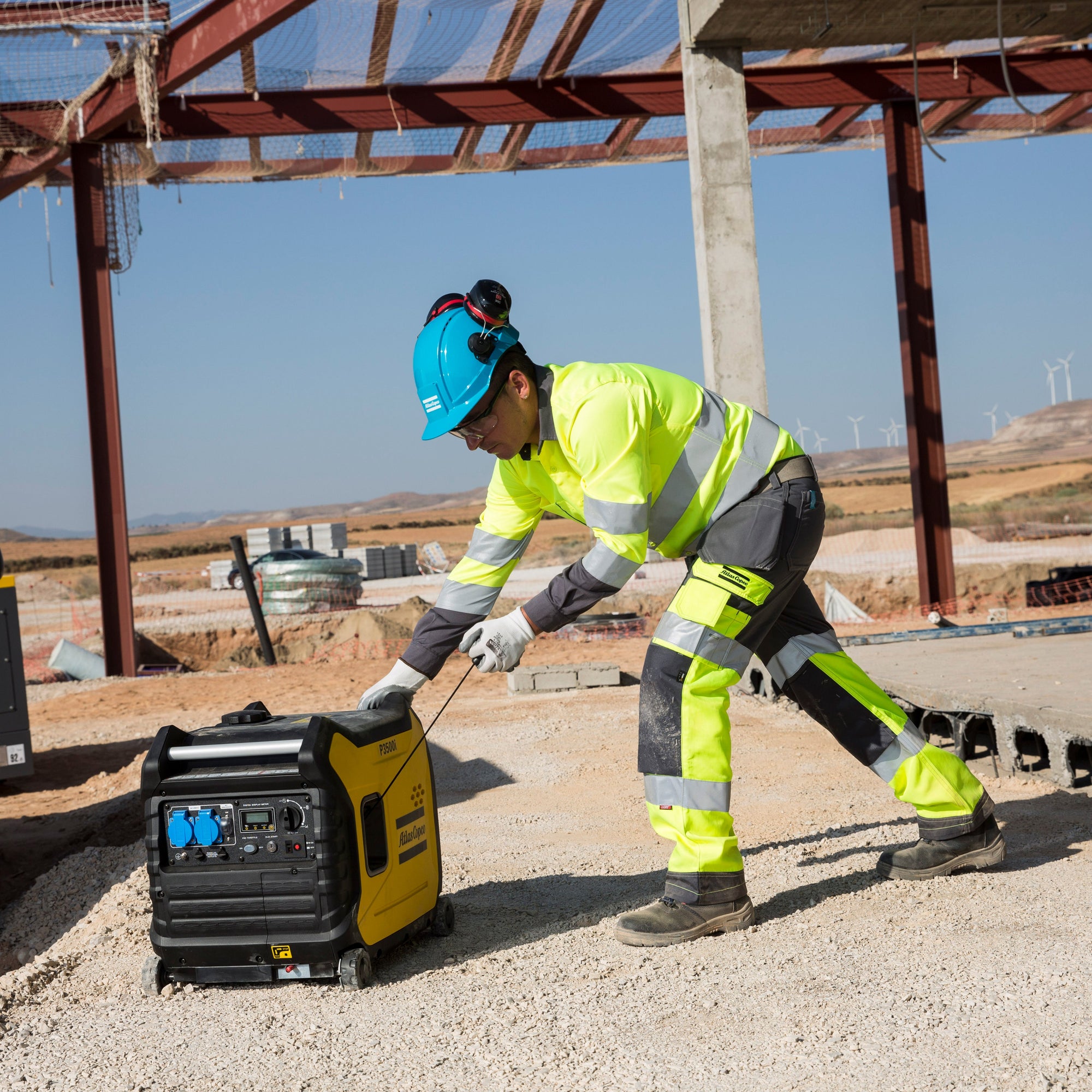
A contractor called us last spring from a bridge job about ninety minutes from the nearest outlet. He had a new 5 HP two-stage compressor on the trailer, a 7,000 watt generator he had run lights and saws off for years, and a compressor that would spin up, groan, and drop the generator offline every single time. He was convinced the compressor was defective. It wasn't. The generator was just too small, and not for the reason he assumed.
Working out what size generator to run an air compressor trips people up because the number stamped on the generator and the number stamped on the compressor measure two different things. The generator is rated for what it can hand you continuously. The compressor cares about what you can hand it for roughly half a second, while the motor is basically stalled and pulling everything it can get.
Running watts are not your problem. Starting watts are.
An induction motor at the instant you close the contacts is close to a dead short. The rotor isn't turning, so there's no back EMF pushing against the supply, and the motor draws what the electrical world calls locked rotor amps. On a typical capacitor-start single-phase compressor motor, that inrush runs somewhere around three to six times the full load amps. It lasts a fraction of a second, but the generator has to survive it.
A big utility transformer shrugs that off. A portable generator cannot. Its engine is producing a fixed amount of torque and its alternator has a fixed amount of magnetic headroom. Ask for triple the rated current and the voltage sags, the governor hunts, and either the breaker opens or the engine stalls. That's the groan our contractor was hearing.
So the rule is simple to state and easy to forget: size the generator's surge rating to the compressor's inrush, and its running rating to the compressor's continuous draw, with headroom on both.
Step 1: get the compressor's real running amps
Start at the nameplate on the motor, not the marketing sticker on the tank. You want full load amps at your supply voltage. If the plate is painted over or gone, NEC Table 430.248 gives the standard figures for single-phase motors, and they're close enough for sizing:
| Motor | Full load amps at 230V, 1-phase | Running watts (approx.) |
|---|---|---|
| 1 HP | 8 A | 1,840 W |
| 1.5 HP | 10 A | 2,300 W |
| 2 HP | 12 A | 2,760 W |
| 3 HP | 17 A | 3,910 W |
| 5 HP | 28 A | 6,440 W |
| 7.5 HP | 40 A | 9,200 W |
| 10 HP | 50 A | 11,500 W |
Watts is just amps times volts for our purposes here. If your compressor is wired for 120V instead, the amps roughly double for the same horsepower, which is exactly why nobody runs a real compressor on 120V if they can avoid it.
Step 2: multiply for the surge
Take the running watts and multiply by about 2.5 for a compressor that starts unloaded, and by 3 or more for one that starts against tank pressure. That gives you the peak the generator needs to swallow.
| Compressor | Running watts | Surge needed | Practical generator size (running watts) |
|---|---|---|---|
| 1 HP | 1,840 W | 4,600 to 5,500 W | 3,500 to 4,000 W |
| 2 HP | 2,760 W | 6,900 to 8,300 W | 5,000 to 6,000 W |
| 3 HP | 3,910 W | 9,800 to 11,700 W | 7,500 to 8,500 W |
| 5 HP | 6,440 W | 16,000 to 19,300 W | 12,000 to 14,000 W |
| 7.5 HP | 9,200 W | 23,000 to 27,600 W | 17,000 W and up |
Those generator numbers assume a machine whose surge rating sits roughly 20 to 25 percent above its continuous rating, which is how most portable units are built. Check the spec sheet rather than assuming. And notice what this does to our contractor: a 5 HP compressor wants a generator in the 12,000 watt neighborhood. His 7,000 watt unit was never going to do it.
If you're shopping the other direction, meaning you already own the generator, work backward. Divide the generator's surge rating by 3 to get a safe running-watt budget, then find the compressor that fits underneath it. Our portable air compressors list amp draw on every listing so you can do that math before you buy.
Voltage and receptacles matter as much as watts
A 12,000 watt generator with only 120V outlets is useless to a 230V compressor. You need a 240V receptacle, usually an L14-30 twist lock or a 14-50, and a cord that matches. Check the generator's 240V amp rating specifically, because a lot of units split their capacity between two 120V legs and the 240V outlet is rated lower than the headline number.
Cord length is the other silent killer. Voltage drop over 100 feet of undersized extension cord can pull a 240V supply down far enough that the motor can't make starting torque, and you get the same stall you'd get from an undersized generator. Keep the run short and the wire fat. If you have to go long, go up two gauge sizes.
Three-phase compressors are a different conversation
If your machine is three-phase, and most rotary screws over 10 HP are, a standard portable generator won't run it. You need a three-phase generator, and you need to size it the same way, on locked rotor current rather than nameplate amps. Rotary screws are a bit gentler than pistons here because most of them start unloaded and many larger ones have a wye-delta or soft starter built in, which cuts inrush substantially. Talk to us before you rent, because the right answer depends on the starter type your specific air compressor uses.
Four ways to get away with a smaller generator
- Make sure it starts unloaded. Piston compressors use an unloader valve on the pressure switch to bleed the head pressure off when they shut down. If that unloader is plugged or the check valve is leaking back, the motor restarts against full tank pressure and inrush goes through the roof. This is the single most common reason a generator that used to work suddenly won't.
- Add a soft starter. A soft start module ramps voltage to the motor over a second or two instead of slamming it on. It can cut peak draw by a third or more, and it's cheap compared to buying a bigger generator.
- Drop the cut-out pressure. If you're running tools that only need 90 PSI, there's no reason the switch has to cut out at 175. Lower cut-out means less work per cycle and a shorter run.
- Start it with nothing else running. Get the compressor up first, then plug in the lights and the saw. Stacking a compressor start on top of an already loaded generator is asking for a trip.
Inverter or conventional?
Inverter generators give you clean power and quiet operation, and they're excellent for electronics. For compressors, the clean sine wave is nice but not essential, and inverter units at the wattage a real compressor needs get expensive fast. A conventional open-frame generator with a strong surge rating usually gives you more usable starting capacity per dollar. If you're running a compressor alongside sensitive gear, a conventional unit plus a decent surge protector is a reasonable compromise.
One thing worth checking either way: the generator's engine should be rated for continuous duty at the load you're putting on it. A generator loafing at 50 percent will outlive one pinned at 90 percent, and a compressor that cycles hard keeps the generator swinging between those two states all day.
Mistakes we see over and over
- Sizing to the compressor's HP number instead of the motor's actual amp draw. Advertised horsepower on small consumer compressors is frequently optimistic.
- Reading the generator's peak or maximum rating as if it were continuous. That peak is for a few seconds, once.
- Forgetting the rest of the jobsite. If the generator is also feeding a light plant and a chop saw, subtract those loads before you size the compressor.
- Assuming a tank full of air means the compressor is off. It'll cycle back on the moment pressure drops, usually right when you don't want it to.
Frequently Asked Questions
Will a 7,500 watt generator run a 5 HP air compressor?
Usually not reliably. A 5 HP single-phase compressor draws around 28 amps running, which is roughly 6,440 watts, and it needs somewhere between 16,000 and 19,000 watts to start. A 7,500 watt generator will typically trip or stall. It may work if the compressor is fitted with a soft starter and always starts fully unloaded, but that's a thin margin to bet a jobsite on.
Can I run an air compressor on a 120V generator?
You can run small compressors, generally 2 HP and under, on a 120V generator if the generator has enough capacity on that single leg. Anything bigger should be on 240V, because the amp draw at 120V climbs high enough that both the generator outlet and the cord become the limiting factor.
Does the compressor's tank size affect generator sizing?
Not directly. The generator only sees the motor, and the motor draw is the same whether it's filling a 20 gallon tank or a 120 gallon tank. A bigger tank does help indirectly, because it means fewer starts per hour, and starts are what punish a generator. If you're on generator power, a larger tank is your friend.
Why does my compressor start fine on shore power but not on the generator?
Because the utility can supply inrush current the generator can't. This is also the classic symptom of a failing unloader valve or check valve. On utility power the compressor overcomes the extra load and you never notice, but on a generator that same extra load is enough to stall it. Check those two parts before you go shopping for a bigger generator.
Should I size for the running watts or the surge watts?
Both, and the surge number is the one that decides the purchase. Your generator's continuous rating has to cover the compressor's running watts with some headroom, and its surge rating has to cover the inrush. Meet only one of the two and the compressor either won't start or won't keep running.
The short version
Deciding what size generator to run an air compressor comes down to three numbers: the motor's full load amps, your supply voltage, and a multiplier of about 2.5 to 3 for starting surge. Get those right, keep the unloader working and the cord short, and the compressor will start the same way on generator power as it does in the shop. Get them wrong and no amount of pull-starting is going to help.
If you're putting a jobsite package together and you'd rather not guess, tell us the compressor model and what else is on the circuit. We size these every week.


