


Portable Air Compressor: How to Pick the Right One
You are on a roof two hundred feet from the nearest outlet, or under a truck at a customer's farm, or framing a deck in somebody's back yard. The tool in your hand is useless without air, and dragging a shop compressor out there is not happening. That is the whole reason a portable air compressor exists, and picking the right one is less about horsepower bragging rights and more about matching the machine to how and where you actually work.
The trouble is that "portable" covers a huge range, from a little pancake unit you carry in one hand to a towable diesel the size of a chest freezer. Grab the wrong end of that range and you either lug around way more than you need or you starve your tools all day. Let's sort out what actually matters.
What portable really means
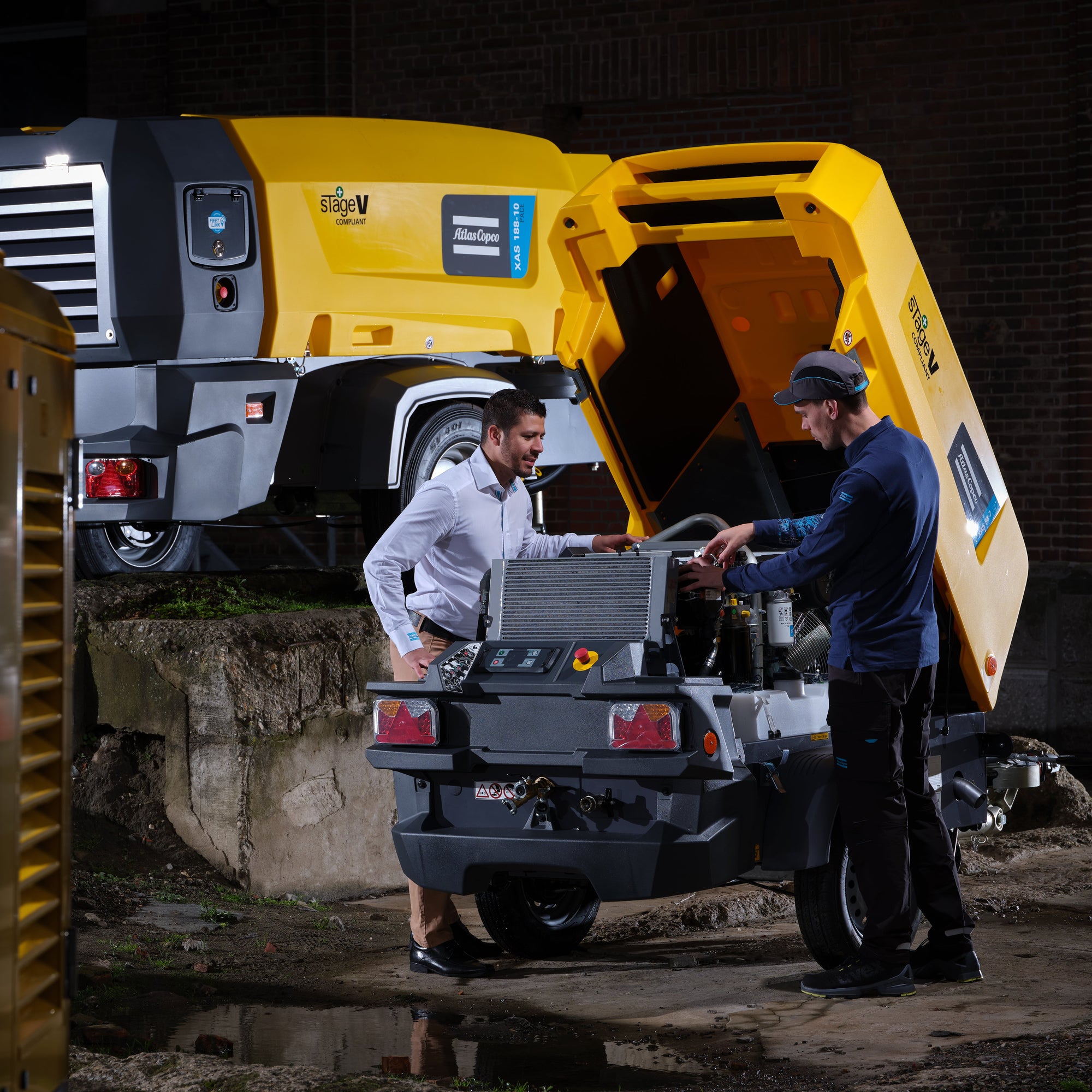
Portable is a spectrum, not a category. On the small end you have hand-carry electric units: pancakes, hot dogs, and twin-stack compressors that plug into a standard outlet and run finish tools. In the middle sit wheelbarrow and contractor units, often gas powered, that make more air and go where there is no power. On the big end are towable compressors, usually diesel rotary screw machines, that feed jackhammers and sandblasting on a job site. All of them are "portable." They just solve very different problems.
So the first question is not "how big" but "where and what." Where does it need to go, and what tools does it need to feed when it gets there?
Start with CFM, not the tank
The number that decides everything is CFM, the volume of air the compressor can deliver, usually rated at 90 PSI. Every air tool has a CFM appetite, and your compressor has to keep up with the hungriest tool you will run continuously. A brad nailer barely sips. A framing nailer takes a bit more but works in bursts. A cut-off tool, a die grinder, or an impact wrench drinks air steadily and will expose an undersized compressor in about ten seconds.
Find the CFM rating of your thirstiest tool, add roughly 30 to 50 percent headroom so the pump is not pegged at full tilt, and shop for a portable that meets that delivered number at 90 PSI. Tank size matters too, but not the way people think. The tank is a buffer for bursts, not a source of endless air. A big tank helps a nailer that fires in spurts. It does nothing for a grinder that runs nonstop, because once the tank drains you are living on the pump's CFM alone.
Portable types at a glance
| Type | Power | Typical use | Portability |
|---|---|---|---|
| Pancake / hot dog | Electric (120V) | Trim, brad and finish nailing, tire inflation | Carry in one hand |
| Twin-stack | Electric (120V) | Framing, roofing, small punch lists | Two-hand carry |
| Wheelbarrow / contractor | Gas | Multiple nailers, remote job sites | Roll or lift into a truck |
| Towable rotary screw | Diesel or gas | Jackhammers, sandblasting, heavy air | Tow behind a vehicle |
Electric or gas
This is the fork in the road for most buyers, and it comes down to one thing: is there power where you work?
Electric portables are quieter, cleaner, and cheaper to run. They need an outlet, and a 120V unit on a long cord can trip breakers or lose power if you are not careful with cord gauge. For a garage, a shop, or any site with power, electric is usually the right call. Many of the small electric units are also oil-free, which means less upkeep and no oil to check.
Gas portables go where the power does not. That freedom costs you: they are louder, they need fuel and oil changes, and you cannot run them indoors because of exhaust. If your work is genuinely off-grid, new construction before the power is on, roadside service, rural jobs, gas earns its keep. If you have an outlet nearby, gas is just extra noise and maintenance you do not need.
The details that separate good from frustrating
Once CFM and power source are settled, a few practical things decide whether you will actually enjoy using the thing.
Weight and how you move it. Be honest about lifting. A 40 pound pancake goes up a ladder. A 90 pound twin-stack does not, not comfortably. If it has wheels, check whether they are flat-free and whether the handle folds for the truck bed.
Noise. If you work around people, or inside finished homes, decibels matter. Oil-free electric units and the newer quiet-series compressors run far softer than an old direct-drive gas unit that sounds like a lawnmower.
Duty cycle and cooling. Small portables are built for intermittent work. Run one flat out for an hour on a demanding tool and it will get hot and cut out. If your work is continuous, size up or step toward a rotary screw. Match the machine's rated duty to the way you actually run it.
Recovery time. How fast does the tank refill after it drops to cut-in? A slow-recovering compressor leaves your crew standing around waiting for air. Higher CFM and a well-matched motor fix this.
Match the compressor to the job, not the spec sheet
A trim carpenter and a mobile mechanic both want a portable, but they should walk out with very different machines. The trim guy wants light, quiet, and oil-free, because he is running finish nailers inside a house and carrying the thing all day. The mechanic wants more CFM and a bigger tank, maybe gas, because impacts and blow guns eat air and the truck goes where there is no outlet. Neither one is "better." They are matched to the work.
Think through a normal day. List the tools, find the biggest continuous CFM draw, decide whether you have power, and be realistic about how far you carry it and how long it runs at a stretch. That gives you a target, and the target picks the machine.
A few mistakes worth dodging
The same avoidable errors come up again and again. The biggest one is buying on tank size alone. A shiny six gallon tank looks reassuring, but if the pump behind it only makes a couple of CFM, it will empty fast and leave you waiting. Always check the delivered CFM at 90 PSI before you look at the gallons.
The second mistake is underrating the cord problem on electric units. A 120V compressor at the end of a long, thin extension cord loses voltage, works harder, and can trip its own breaker or overheat the motor. If you must use a cord, keep it short and heavy gauge, and plug straight into a good circuit. The third mistake is buying gas when you did not need to. Gas is great off-grid, but if you have power, you are signing up for noise, fuel, and oil changes you could have skipped. Be honest about where the machine will actually live before you pay the gas premium.
The bottom line
A portable air compressor is worth buying right, because the wrong one shows up every single day. Size it by the CFM of your thirstiest tool with headroom, pick electric when you have power and gas when you do not, and weigh the boring stuff like weight, noise, and recovery time, because that is what you live with. Get those calls right and the machine disappears into the work, which is exactly what you want.
You can compare units in our portable air compressor collection. If your work is truly off-grid, the truck-mounted compressors are worth a look, and if you are weighing a portable against a stationary shop unit, browse the full range of air compressors to compare.
Frequently Asked Questions
What size portable air compressor do I need?
Size it by CFM, not just the tank. Find the CFM rating at 90 PSI of the thirstiest tool you will run continuously, add about 30 to 50 percent headroom, and pick a portable that delivers that number. Tank size helps with burst tools like nailers but does not replace pump CFM for tools that run nonstop.
Is a portable air compressor good for air tools?
It depends on the tool. Small electric portables handle nailers, staplers, and tire inflation easily. Continuous-draw tools like grinders, cut-off tools, and impact wrenches need higher CFM, so you want a larger contractor or gas unit, or a rotary screw, to keep them fed without bogging.
Should I buy an electric or gas portable compressor?
Choose electric when you have power nearby. It is quieter, cleaner, cheaper to run, and often oil-free. Choose gas only when you work off-grid, since it goes anywhere but is louder, needs fuel and oil changes, and cannot run indoors because of exhaust.
How big a tank do I need on a portable?
The tank is a buffer for bursts of demand, not a source of endless air. A larger tank helps tools that fire in spurts, like nailers, by reducing how often the pump cycles. For tools that run continuously, the pump's CFM matters far more than tank gallons.
Can I run a portable air compressor indoors?
Electric portables can run indoors with proper ventilation for cooling. Never run a gas powered compressor indoors or in an enclosed space, because the engine produces carbon monoxide. For inside work, use an electric, and preferably oil-free, unit.


