


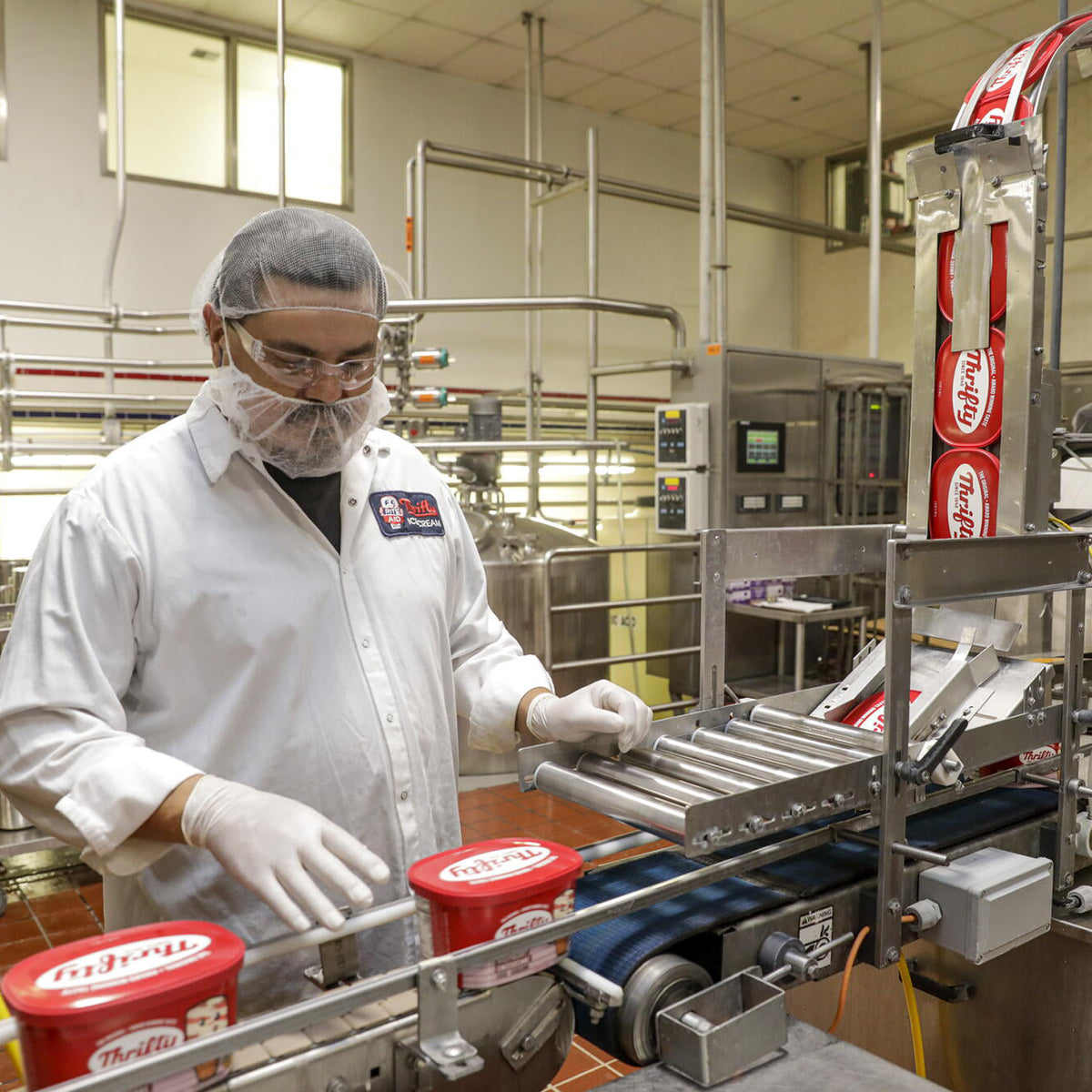
A single frozen novelty line can turn out more than 20,000 bars an hour. Unilever's Magnum plant in Heppenheim, Germany runs five of them, each freezing product down to about -13 F (-25 C), and every one of those lines is full of pneumatic valves, cylinders and fillers that fire all day. When the air behind that kind of line is wet, short, or sloppy, you do not get a gentle slowdown. You get a stopped line and a lot of melting inventory.
This guide is about compressed air for ice cream and frozen dessert plants. We will use the real plant case studies we could find, say what we could not verify, and stay out of the parts of the trade that belong to a dairy-process engineer.
What makes an ice cream plant different
Ice cream shares a building with the dairy trade, but the air story is its own. Three things set it apart.
First, cold. Hardening tunnels, freezers and cold rooms sit next to the production floor, and any air line that runs near them sees temperatures where leftover moisture freezes. Second, speed. Novelty lines are built around high-rate pneumatic motion, so a pressure dip shows up as a rejected product or a jam. Third, the air often meets packaging or product, which puts it under the same food-safety scrutiny as the rest of the plant.
If you want the general dairy picture, our guide to compressed air for dairy farms and milk plants covers farm and fluid-milk plants. This one stays on the frozen side.
What the published plant cases show
Two public case studies give us real numbers to work from.
The Magnum lines in Germany
Unilever's Heppenheim plant added an energy efficiency module from Festo on its five Magnum lines. The module handles up to 5,000 liters per minute and shuts off air automatically during breaks, so the line is not leaking pressure while nobody is working. The reported savings were about $650 (roughly 500 euro) per line per year. That is not a huge figure, and we will not pretend it is. The lesson is that even a modest, automatic shutoff pays on a line that runs this fast, and that leak and idle losses are a real item on novelty lines.
A cheese and ice cream plant in Winnipeg
The more useful case is a combined cheese and ice cream plant in Winnipeg, where the compressed air system was reworked and energy cost dropped 56 percent. The savings were 201,000 kWh a year, a 16 kW cut in peak demand and about $8,100 a year. The problem was a load/unload compressor with too little receiver storage, so it cycled hard. The fix had several parts.
| Problem | Fix |
|---|---|
| Load/unload compressor, little storage | Variable speed compressor |
| Pressure swings in the plant | Flow control valve |
| Dryer cycling wasted air | Thermal mass dryer |
| High pressure drop across filters | Dual parallel filters, about 75 percent lower drop |
| Timer drains blowing air | Airless drains |
The same site's milk plant had a separate lesson. A failed exhaust valve on a two-liter carton filler caused a 30 psi pressure drop. One bad part took 30 psi out of the system, which tells you how sensitive a filling line is to its air supply.
We could not find the horsepower, pressure or CFM of that Winnipeg plant, so we are not going to quote them.
Storage: the cheapest fix on the list
The Winnipeg plant's core problem was storage, and it is the most common one we see. The article that reported it gives a guideline we like: about 1 gallon of receiver per CFM for a load/unload compressor, and 5 to 10 gallons per CFM if you want a large buffer. A 100 CFM compressor on load/unload control wants roughly 100 gallons at the low end. Plants with fast fillers and tunnel loading often want more. We cover the sizing in our air receiver tank guide, and you can shop air compressor tanks in sizes from small to large.
Controls: follow the load, do not fight it
An ice cream plant swings. Production days are heavy, sanitation shifts are light, and weekends can be nearly dead. A fixed-speed machine on load/unload spends those hours blowing off air. A variable speed compressor follows the demand, and the Winnipeg result is a good example. Our article on when variable speed pays back explains how to check it against your own load profile.
Drains, dryers and cold lines
Water is the enemy near a freezer. Moisture that survives the dryer condenses in a cold drop line, freezes, and blocks a valve exactly when you need it. Three habits help.
- Use zero-loss drains at every low point, not timer drains. See our comparison of timer versus zero loss drains.
- Dry the air to a dew point well below the coldest line temperature it passes. A refrigerated dryer is fine for general plant air, but lines that run into cold rooms often want a desiccant dryer. Our refrigerated versus desiccant dryer guide shows where the line falls.
- Slope the piping and take branches off the top of the header. Our piece on compressed air for cold storage covers cold-room piping in more depth.
Browse our refrigerated air dryers and desiccant air dryers.
Air quality targets
Air that touches product or packaging is held to a food standard. The ISO 8573-1 classes are the usual language. Using figures from a food-plant compliance guide (a secondary source, so confirm against the standard):
| Measure | Class 1 | Class 2 |
|---|---|---|
| Particles | 0.1 micron or smaller, 10,000 per cubic meter | 1 micron or smaller, 400,000 per cubic meter |
| Pressure dew point | -70 C or lower | -40 C or lower |
| Oil | 0.003 mg per cubic meter | 0.1 mg per cubic meter |
The same source notes that food-safety schemes such as SQF, BRC and IFS expect compressed air to be managed as a risk, with annual third-party air testing being typical. It says nothing specific about ice cream, and neither could we find an ice-cream-specific air standard. Ask your auditor which classes they will accept and write the answer into your food safety plan. Our food grade compressed air guide covers what auditors look at.
What we could not verify
We looked for the air used to aerate ice cream (overrun), freezer controls and carton fillers, and found no published pressures or CFM figures. We would rather say that than guess. Get those numbers from your equipment manufacturers' manuals and from a flow meter on your own header. Our flow meter guide explains how.
Mistakes we see in frozen dessert plants
- Too little storage for a fast line.
- Timer drains near freezers.
- Letting a filler exhaust valve fail quietly and cost 30 psi.
- Letting dryers and filters run past service intervals.
- Skipping annual air testing.
Where we can help and where we cannot
We supply compressors, dryers, filters, drains, tanks and piping, and we can help size the air side. We do not sell freezers, fillers or process equipment, and we are not dairy process engineers. If you are laying out a new novelty line, bring in the equipment maker and your food safety lead early.
Where to start
Check your receiver size against the 1 gallon per CFM guideline, fix any timer drains near cold lines, and ask your auditor which ISO class applies. Then compare dryers in our refrigerated air dryer range and call us with your flow and dew point target.
Frequently Asked Questions
How much compressed air does an ice cream plant use?
It depends on the lines. We could not find a published plant-level figure. A Magnum line plant studied in Germany used an energy module rated up to 5,000 liters per minute per line, but your plant will differ. Meter your header.
What dew point do I need for cold lines?
It depends on your coldest line. ISO 8573-1 Class 2 is a pressure dew point of -40 C or lower, a common target for food plants. Confirm with your auditor.
Do I need oil-free air for ice cream?
It depends on whether the air touches product or packaging. Many plants use oil-free air or a full filter train for contact air. Ask your auditor and your food safety lead.
How big a receiver tank do I need?
One published guideline is about 1 gallon per CFM for a load/unload compressor and 5 to 10 gallons per CFM for a large buffer.
Why do air lines freeze near my hardening tunnel?
Moisture that survives the dryer condenses and freezes in cold drops. Better drying, zero-loss drains and sloped piping fix most of it.


