


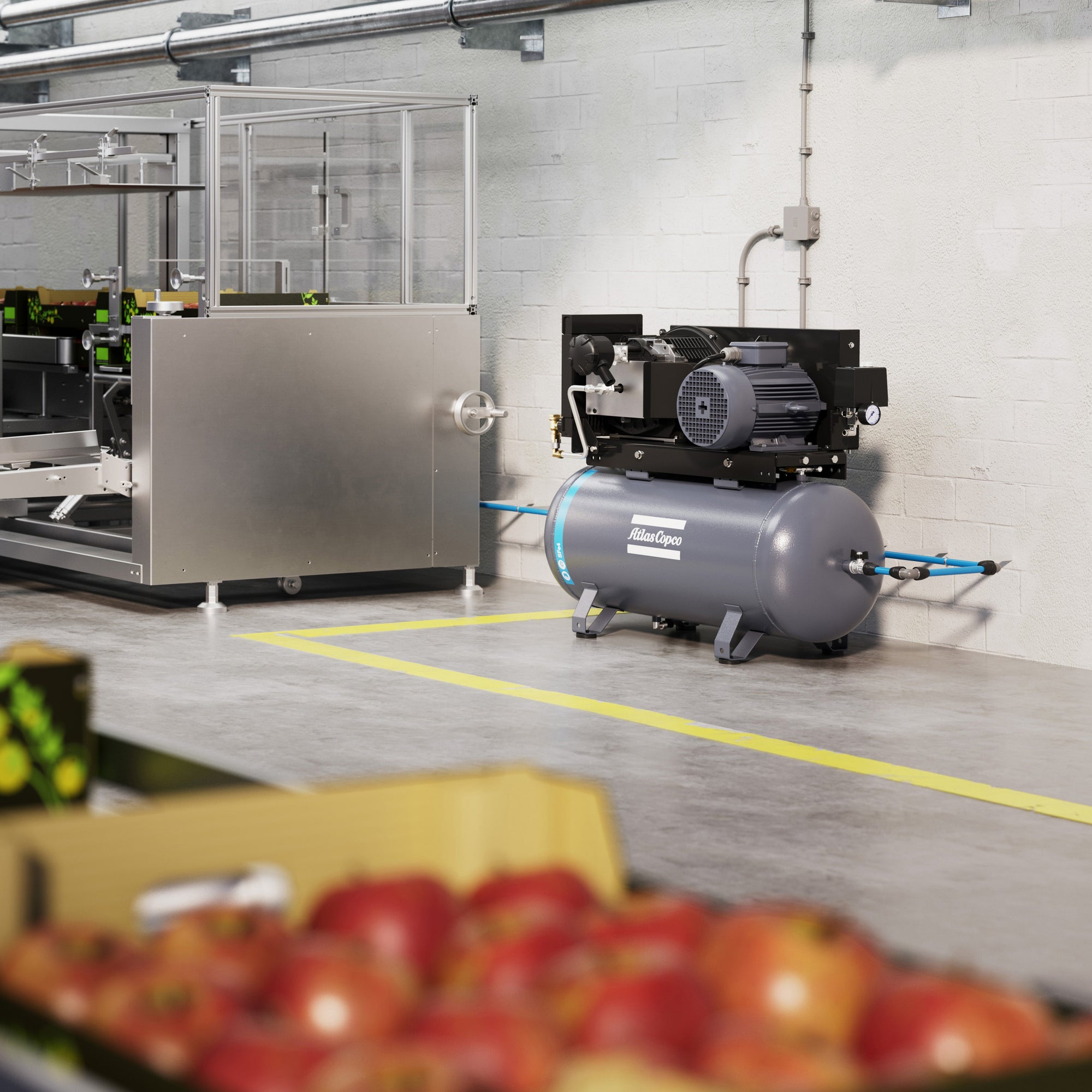
Scroll Air Compressor Guide: The Quiet, Oil-Free Option
We get a call about once a week that goes something like this. A dental office, a small testing lab, or a coffee roaster needs compressed air, but they can't have a trace of oil in it and they can't have a loud machine hammering away on the other side of the wall. Nine times out of ten, that is a job for a scroll air compressor. It is one of the quietest, cleanest ways to make compressed air, and a lot of shop owners have never heard of it because it lives in a different world than the big rotary screw units.
So here is the plain version of what a scroll compressor is, how it makes air without a drop of oil, what it can and can't do, and who should actually buy one.
How a scroll air compressor works
Picture two metal spirals nested inside each other. One stays put. The other one orbits around it in a small circle. It does not spin like a fan blade. It wobbles in a tight orbit. As it moves, it traps a pocket of air at the outer edge and slowly walks that pocket toward the center, squeezing it smaller the whole way. By the time the air reaches the middle, it is at full pressure and it gets pushed out the discharge port.
That is the whole trick. There are no pistons slapping up and down, no reed valves flexing open and shut, no vanes scraping a rotor. One part moves, and it moves smoothly. That smoothness is why a scroll air compressor runs so quietly and vibrates so little. It is also why it makes clean air, which we will get to in a second.
Why the oil-free part matters
In a piston or rotary screw compressor, oil is doing real work. It seals gaps, carries away heat, and lubricates parts that rub. That oil does its job well, but a little of it always ends up in the air stream as fine mist. For most shops that is fine. You run the air through a coalescing filter and move on.
A scroll compressor compresses air in a chamber that never touches oil. The orbiting scroll is supported by sealed bearings off to the side, so the compression space stays dry. Nothing in that pocket of air can pick up oil, because there is no oil in the pocket to begin with. That is what people mean by "oil-free" or "oilless." You still get water vapor out of the ambient air, so you may still want a dryer, but you are not fighting oil carryover.
For a body shop this is a nice-to-have. For a dental clinic, a pharmacy compounding lab, an electronics assembler, or a food line, it is the whole point. Oil in the air can ruin a product or fail an inspection, and a scroll unit takes that risk off the table.
How much air you actually get
Here is where you need clear eyes. Scroll compressors are low-capacity machines. They are built to make clean air, not a lot of air. Most single scroll pumps land somewhere in the 2 to 5 HP range, and manufacturers stack several pumps into one enclosure to reach higher output. Packaged units run roughly 3 to 30 HP, and airflow lands in the ballpark below.
| Motor size | Rough CFM (at working pressure) | Typical fit |
|---|---|---|
| 3 to 5 HP | 10 to 18 CFM | Dental office, small lab |
| 7.5 to 10 HP | 22 to 35 CFM | Clinic, electronics bench, small food line |
| 15 to 20 HP | 50 to 80 CFM | Larger clean-air facility, multi-chair dental |
| 25 to 30 HP | 90 to 125 CFM | Full lab or production area needing clean air |
Treat those numbers as a starting point and always check the spec sheet for the exact model, because output depends on the pressure you run and how many scroll modules are in the box. Most scroll units top out around 116 to 145 PSI, which covers general shop pressure but not high-pressure work.
The takeaway: if you need 40 CFM of clean air, a scroll compressor is a great answer. If you need 200 CFM to run a busy production floor, you are into oil-free rotary screw territory instead. Compare full-size units in our air compressors collection to see where the line falls.
Where a scroll air compressor is the right call
The pattern is simple. Any place that cares more about air quality and noise than raw volume is a candidate. That includes:
- Dental and medical offices, where oil-free air is often required by code
- Pharmacy and compounding labs
- Electronics and semiconductor assembly
- Food, beverage, dairy, and brewing lines
- Optical and lens production
- Any office or clinic where the compressor sits close to people
Noise is a real selling point here. Enclosed scroll packages commonly run between 55 and 68 dBA, which is closer to a conversation than to the roar of a piston unit. You can put one in a utility closet near an exam room and nobody complains.
Where it is the wrong call
A scroll compressor is not a do-everything machine, and we would rather tell you that up front. It is not built for high CFM, so it will disappoint you running a sandblaster, a plasma table, or a bank of air-hungry impact tools. It usually will not hit high pressure. And per CFM it costs more than a comparable piston unit, because you are paying for the clean-air design.
The scroll tips themselves have a soft seal that wears over time and needs periodic service, so there is upkeep, just a different kind than an oil change. If your work is dirty, loud shop air for general tools, a two-stage piston or a standard rotary screw is a better value.
Scroll vs rotary screw vs piston
Here is the honest comparison so you can place the scroll where it belongs.
| Feature | Scroll | Rotary screw | Piston |
|---|---|---|---|
| Oil in air stream | None by design | Trace (oil-flooded) or none (oil-free type) | Trace mist |
| Noise | Very low (55 to 68 dBA) | Low to moderate | High |
| Airflow range | Low (10 to 125 CFM) | Wide (up to hundreds of CFM) | Low to moderate |
| Duty cycle | Continuous | Continuous | Intermittent (most) |
| Cost per CFM | Higher | Moderate | Lowest |
| Best for | Clean, quiet, low volume | High steady volume | General shop air on a budget |
Living with one: maintenance
The good news is there is no oil to change in the air end. Day to day, a scroll compressor asks for very little. Keep the intake filter clean, because that is the one thing the pump breathes through, and a dirty filter starves it and drives up heat. Keep the cooling fan and fins free of dust so the unit sheds heat. And plan for a tip seal and bearing service at the interval the maker lists, usually measured in running hours.
Because the air is clean and dry-ish coming out, your downstream gear lasts longer too. A lot of clean-air buyers still add a small refrigerated or membrane dryer to knock out water vapor, then a point-of-use filter for polish. You can pair one with a unit from our air dryers collection, and grab replacement intake and line filters from air filters.
So, is a scroll air compressor right for you?
Ask two questions. Do you need genuinely clean, oil-free air? And is your volume on the modest side, under roughly 125 CFM? If both answers are yes, a scroll air compressor is hard to beat on cleanliness and quiet. If you need big volume or high pressure, look at rotary screw or piston instead and treat the air quality with filtration. Buy for the job in front of you, not the spec sheet that looks the most impressive.
Frequently Asked Questions
Is a scroll air compressor truly oil-free?
Yes. The compression chamber never contacts oil, so the air coming out carries no oil mist. Bearings that support the orbiting scroll are sealed and sit outside the air path. That is different from an oil-flooded rotary screw, where you rely on filters to strip oil back out.
How long does a scroll compressor last?
The pump can run for many thousands of hours, but the tip seals are wear items and need replacing on a schedule, often in the range of 10,000 running hours depending on the brand. Stay on top of that service and the unit will give you a long life.
Do I still need a dryer with a scroll compressor?
Usually yes. Oil-free means no oil, not no water. The air still holds moisture from the room, so most clean-air users add a refrigerated or membrane dryer to hit the dew point their process needs.
Why does a scroll unit cost more than a piston of the same HP?
You are paying for the oil-free, low-noise design and the tighter machining it takes to make it. For general shop air that premium is not worth it. For clean-air work it pays for itself by protecting your product and passing inspections.
Can a scroll compressor run continuously?
Yes. Unlike many piston units that need to rest, a scroll compressor is rated for continuous duty, which is part of why labs and clinics like them for all-day use.


