


A plant adds a laser with a high pressure assist gas requirement, or a PET line that needs 550 psi to blow bottles. The reflex is to look for a compressor that makes 550 psi and size it for the whole demand. That is almost always the wrong machine and a very expensive answer.
The right answer is usually a booster compressor: a second machine that takes air your existing plant compressor already made at 100 psi and raises just the portion you need up to 350, 500 or 600 psi. The rest of the plant keeps running at 100 psi where it belongs, and you only pay the high pressure penalty on the air that actually needs it.
Why Boosting Beats One High Pressure Machine
Compression work scales with pressure ratio, not with pressure difference. Going from atmospheric to 100 psi is a ratio of roughly 7.8 to 1. Going from 100 psi to 550 psi, in absolute terms, is a ratio of about 4.9 to 1. The second jump sounds bigger in psi and is actually less work per unit of air, because the air going into the booster is already dense.
That is the whole economic case. Your plant compressor has already done the expensive first compression on a large volume of air. The booster does a smaller amount of additional work on only the volume that needs high pressure.
The alternative, running one machine at 550 psi and regulating down for everything else, is the worst possible arrangement. You would be compressing every cubic foot in the plant to 550 and then throwing most of that energy away across regulators. The rough rule is 1 percent more energy for every 2 psi of extra pressure, and you would be adding more than 400 psi to everything.
Where Boosters Earn Their Keep
- PET bottle blowing. The classic application. Blow molders need roughly 500 to 600 psi, while the conveying, capping and general plant air around them runs at normal pressure. Boosters raising 100 psi air to 500 to 600 psi are standard practice in PET plants.
- Laser and plasma cutting. High pressure assist gas, and boosters are routinely used in metal cutting for exactly this.
- Pressure and burst testing. Component testing rigs that need a few CFM at high pressure.
- Pneumatic presses and clamping where force requirements outrun what 100 psi can deliver through a reasonable cylinder size.
- Seat and valve testing, leak testing at elevated pressure, and various process applications where one machine on the floor is the outlier.
The pattern is always the same: one machine or one cell needs far more pressure than the building, and the volume it needs is modest relative to total plant demand.
How They Are Built
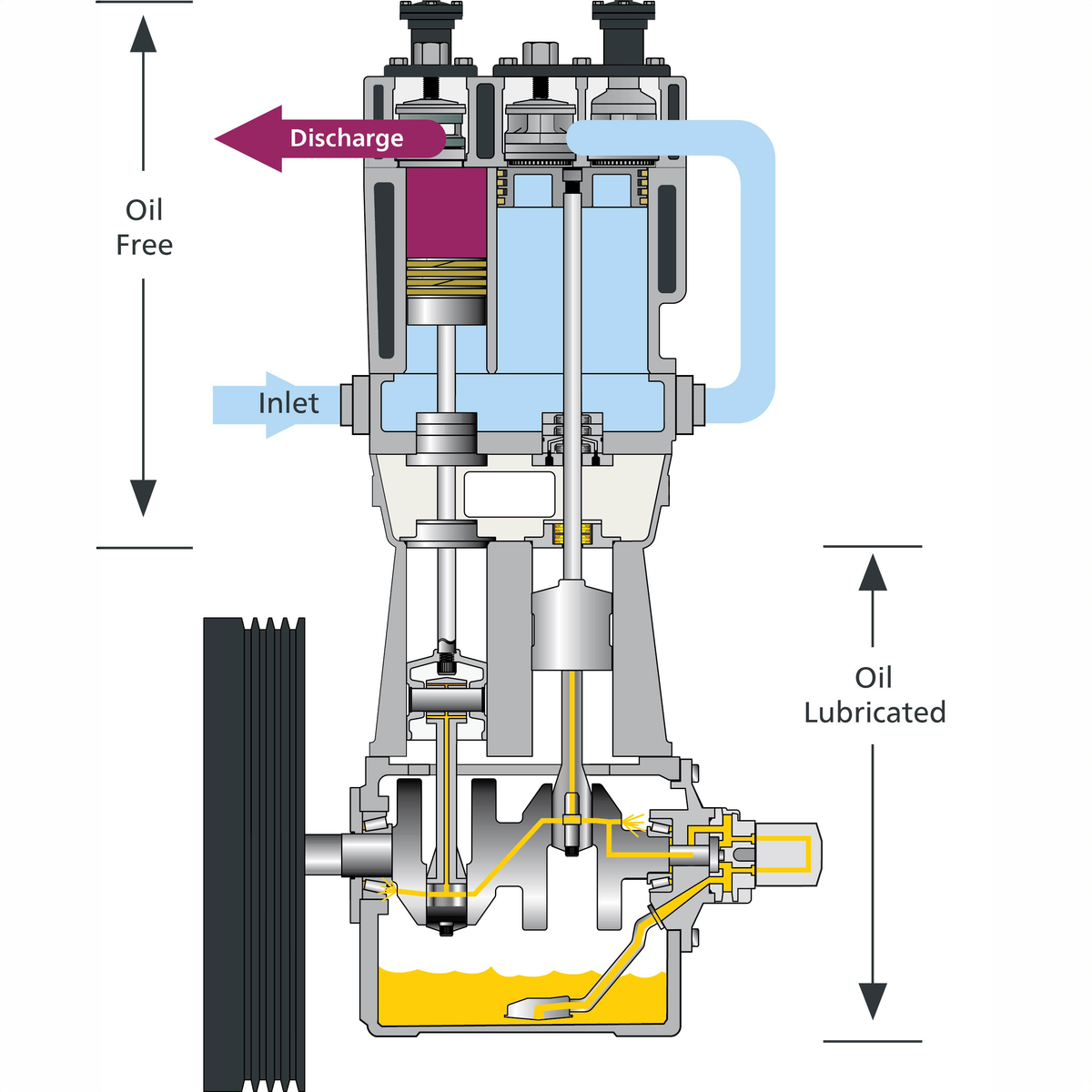
Most air boosters in this range are reciprocating machines, usually two stage, because ratio per stage is limited by discharge temperature. Cramming too much ratio into one stage makes air hot enough to cook the valves and the oil.
Sensible design keeps each stage in the range of roughly 2.5 to 3.5 compression ratio. For a booster taking 115 psi inlet to 550 psi discharge, that works out to about 2.09 ratio per stage across two stages, which is comfortably within the sane range and is why that configuration is common.
A properly built booster package includes, after each stage of compression:
- A heat exchanger, air cooled as standard with water cooling usually available as an option
- A pressure safety valve
- A moisture separator
- Automatic condensate drainage
The intercooling is not optional and it is not a nicety. Each stage of compression adds heat, and without removing it between stages the second stage is compressing hot, low density air, which costs efficiency and raises final discharge temperature into territory that shortens valve and lubricant life. On continuous high pressure duty, oversized multi stage intercoolers and aftercoolers that bring the air back down close to ambient before it reaches the drying train are standard practice.
What People Get Wrong
Forgetting that water concentrates. This is the big one. Compressing air further raises its pressure dew point. Air that was perfectly dry at 100 psi can drop liquid water as soon as you take it to 500. If your high pressure application is a PET blow molder or a laser, water at the point of use is a product quality problem. Plan the drying at high pressure, not just at plant pressure, and remember that a dryer has a maximum working pressure that plant dryers do not meet.
Sizing the booster on peak instead of on average with storage. High pressure demand is often cyclical. A receiver rated for the high pressure side lets a smaller booster cover a peak that would otherwise drive you to a larger machine.
Ignoring inlet pressure dependency. A booster's output depends on what it is fed. If plant pressure sags to 85 psi during a busy shift, the booster's capacity and discharge pressure fall with it. Boosters are usually specified at a stated inlet pressure, and if your header cannot hold that pressure reliably, the booster will disappoint in a way that looks like a booster fault and is not.
Using standard plant components on the high pressure side. Fittings, hose, gauges, valves and receivers all have pressure ratings. A 175 psi rated receiver does not belong anywhere near a 500 psi line, and this is a safety issue rather than a performance one.
Overlooking the duty cycle. Boosters in continuous service, like a PET line running three shifts, need to be specified for that. A booster sized for intermittent testing duty will not survive continuous blow molding.
Specifying One
- Inlet pressure, realistically, including what your header actually holds during a busy shift rather than its setpoint.
- Discharge pressure at the machine, after losses, not at the booster outlet.
- Flow at discharge conditions, and be careful about units since high pressure flow figures get quoted several ways.
- Duty cycle, honestly. Continuous, intermittent, or occasional.
- Air quality at high pressure, including the dryer and filtration that will sit downstream and their maximum working pressure.
- High pressure storage, rated for the service, to smooth cyclic demand.
Browse air compressors for the base machine that feeds the booster, and remember that an unreliable 100 psi supply makes a good booster look bad. If you are weighing this against simply buying a high pressure machine outright, there is background in high pressure air compressors, and the cost of running the whole plant higher than it needs is quantified in specific power.
Frequently Asked Questions
What is a booster compressor?
A compressor that takes already compressed air as its inlet, typically plant air at around 100 psi, and raises it to a much higher pressure, commonly 350 to 600 psi. It serves the one machine or cell that needs high pressure without forcing the entire plant to run at that pressure.
Why not just buy a high pressure compressor instead?
Because then every cubic foot in the plant is compressed to high pressure and regulated back down for normal uses, which wastes energy on roughly a 1 percent per 2 psi basis across hundreds of psi. Boosting is cheaper because the plant compressor has already done the first compression stage efficiently on the bulk air, and the booster only works on the volume that genuinely needs the pressure.
How many stages does a booster need?
Usually two for the 350 to 600 psi range. Compression ratio per stage is limited by discharge temperature, with roughly 2.5 to 3.5 ratio per stage being a sane design window. Taking about 115 psi inlet to 550 psi discharge in two stages works out near 2.09 ratio per stage, which is why that arrangement is common.
Do I need a dryer on the high pressure side?
Usually yes. Raising pressure raises the pressure dew point, so air that was dry enough at 100 psi can drop liquid water at 500. For PET blowing or laser assist that becomes a product quality problem. Also check the maximum working pressure of any dryer and filtration you plan to use, since plant rated equipment is not built for that service.
What happens if my plant pressure drops?
The booster's capacity and achievable discharge pressure fall with its inlet pressure, since boosters are rated at a stated inlet condition. If your header sags during busy shifts, the booster underperforms in a way that looks like a booster fault but is actually a supply problem. Fix the header before replacing the booster.
The Takeaway
If one machine in your plant needs several times the pressure everything else does, the answer is almost never to raise the whole system. Boost the small volume that needs it, stage it properly with real intercooling, dry it at the pressure it will actually be used at, and use components rated for the service. That is the entire logic of a booster compressor, and it is one of the few places in compressed air where the cheaper answer is also the more efficient one.


