


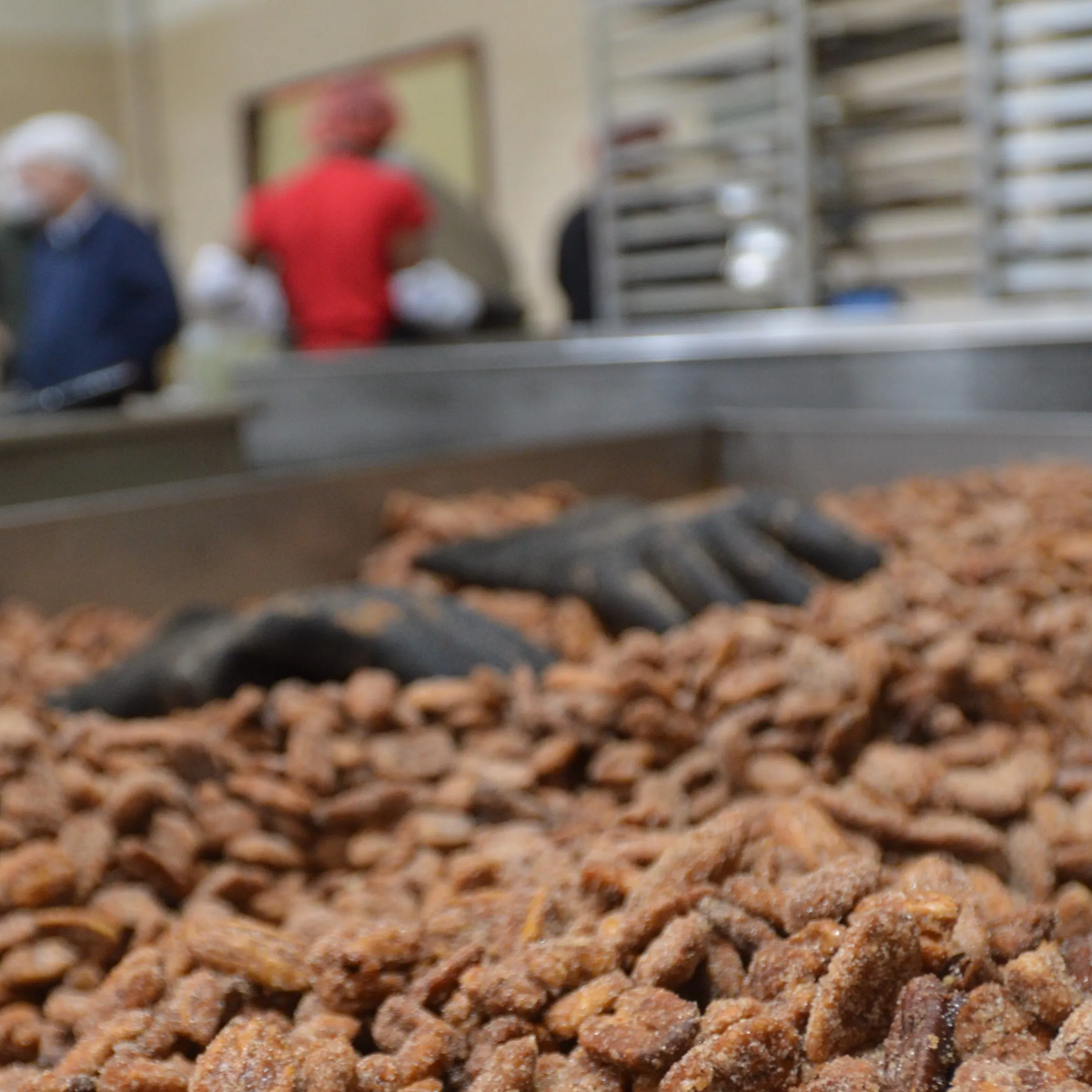
Most food plants have one dust problem. A candy plant has two, and they are both on the list of things that have blown buildings up.
Sugar dust carries a deflagration index around 138 bar-meters per second, which puts it in the St 1 class. Cornstarch, the stuff that fills every tray on a mogul line, tests higher, commonly reported around 200 bar-meters per second with a low minimum ignition energy. Neither of those numbers is academic in a building where both are airborne by design.
That is why compressed air for candy and confectionery plants is a different conversation from compressed air for a bakery. The machinery is similar enough. The housekeeping rules are not, and they decide what you are allowed to do with an air hose.
Start With the Blowdown Rule
Every confectionery plant we talk to has an air hose hanging near the mogul, and most of them are using it wrong.
NFPA 652, which the food and agricultural standard NFPA 61 works alongside, does permit compressed air blowdown as a cleaning method. It does not permit it as the first thing you reach for. Before air is used, surfaces that can be safely accessed have to be cleaned by vacuum, sweeping or water washdown. Dust accumulations in the area after that initial cleaning must already be below the threshold housekeeping level. Compressed air hoses used for blowdown have to be fitted with pressure relief nozzles. The standard is blunt about why: blowdown creates dust plumes, and it should be used only where other methods present a higher risk.
Layered on top of that is OSHA at 1910.242(b), which limits compressed air used for cleaning to 30 psi with effective chip guarding and PPE. That rule applies whatever you are blowing at.
So the practical answer in a candy plant is that the air hose is the last cleaning tool, not the first, it has a regulated safety nozzle on it, and the area is already clean before it comes out. Your dust hazard analysis belongs to you and your fire protection engineer. We sell the compressor, and our job is to make sure it is not the thing that gets you cited.
Where the Air Actually Goes
| Area | Demand character | Notes |
|---|---|---|
| Mogul: tray handling, stamping, depositor | Cyclic, continuous while running | Pneumatic dies, tray indexing, depositor valves, all food contact adjacent |
| Mogul destarching jets | Continuous, often large | Air jets blowing starch off deposited pieces, the single biggest air user on the line |
| Enrobers and cooling tunnels | Mixed | Belt tracking and valve actuation on air, the chocolate curtain blower usually is not |
| Panning drums | Low, intermittent | Spray guns for coating and glaze, air quality matters here |
| Wrappers and flow wrappers | Continuous, high cycle | Many small cylinders at high counts, the sleeper load in most plants |
| Checkweighers, metal detectors, rejects | Short bursts | Small but the pressure has to be stable or ejection drifts |
| Dust collection pulse cleaning | Violent pulses on a timer | Wants local storage, and a failed diaphragm bleeds continuously |
| CIP and process valve actuation | Steady | Small flow, zero tolerance for water in the line |
Two rows there are worth more attention than they usually get. The destarching jets are frequently the largest continuous load in the building and almost nobody has metered them. The wrappers are the second, because a flow wrapper running a full shift is hundreds of small actuations a minute and the total adds up quietly.
The destarching jets get a page of their own, because the arithmetic is worth seeing. A quarter inch open pipe blow-off consumes about 33 SCFM at 80 psig where an engineered nozzle doing the same job uses about 14, and most mogul lines are running a row of drilled pipe. See destarching jets and blow-off on a mogul line for how to count yours and what to do about it.
Two Things That Are Not Compressed Air
We would rather lose the sale than size you the wrong machine, so be clear on these before you shop.
- Bulk sugar and starch conveying runs on blowers, usually positive displacement or regenerative, not on a compressor. High volume at low pressure. If somebody has quoted you a screw compressor to move bulk sugar, go back and ask what pressure the conveying system actually needs.
- Chocolate tempering is a heat transfer problem, water jacketed or shell and tube. Air shows up only in the valves and the pumps around it.
We also do not sell the mogul, the dust collector, or the explosion venting. We sell the air system that feeds the machinery, and we will tell you where that line is.
Air Quality: It Touches the Product
Candy is food, and in a confectionery plant air touches it in more places than most people list. Destarching jets blow directly on finished pieces. Panning spray guns atomize coating with air. Wrapper blow-off handles unwrapped product. Depositor valves sit in the product stream.
The reference people cite is BCAS Best Practice Guideline 102, which points at the ISO 8573-1:2010 purity classes. Direct contact is commonly written as Class 2:2:1, indirect contact at 2:4:2, and some schemes specify the tighter 1:2:1. Read your own scheme rather than guessing, because the filtration follows from that number.
In practice:
- Oil free is the easy answer below roughly 25 horsepower, because the premium is small at that size and it takes oil carryover off your food safety plan entirely.
- A lubricated screw is defensible above that, with coalescing and activated carbon filtration and a testing regime that proves it. You then own the element change schedule and the test records. Our writeup on food grade compressed air covers what an auditor asks to see.
- If you go lubricated, use an NSF H1 rated fluid. See food grade compressor oil.
Dry Air Matters More Here Than in Most Food Plants
Candy is hygroscopic. Hard candy picks up moisture and goes sticky, gummies weep, panned coatings bloom, and wrapping film stops sealing reliably. Most confectionery plants already spend money controlling room humidity, which makes it strange how often the compressed air blowing directly onto product is wetter than the room.
A refrigerated dryer holding roughly a 38 to 45 F pressure dew point covers an indoor, heated plant. Go to desiccant where a line runs through a cooling tunnel, an unheated bay, or anywhere the air gets colder than the dryer outlet, because that is where a refrigerated dryer stops protecting you. The refrigerated versus desiccant comparison walks the choice, and dew point explained covers why the pressure dew point is the number to ask for.
One specific trap. If your destarching jets blow damp air at a freshly deposited gummy, you have built a humidifier aimed at product. That is a quality problem that nobody will trace back to the compressor room.
Sizing
| Plant | Typical demand | Common setup |
|---|---|---|
| Small batch confectioner, hand work, one wrapper | 10 to 25 CFM | 5 to 10 HP oil free, 80 to 120 gallon, refrigerated dryer, filtration |
| One mogul line with depositing and wrapping | 40 to 120 CFM | 15 to 30 HP, 240 to 400 gallon, dryer and three stage filtration, storage at the dust collectors |
| Multi line plant with panning, enrobing and packaging | 150 CFM and up | Multiple machines with a real control strategy, metered baseline before adding capacity |
Those are starting points. At the second row and above, put a flow meter on the main and measure a full production week before you buy, because the destarching jets and the wrappers are the two loads that get estimated badly and they are the two biggest.
The Compressor Is Breathing Sugar and Starch
A compressor is an efficient dust collector, and a candy plant supplies it with two kinds of fine organic dust. Both of them are combustible, which makes an intake inside the production space a bad idea for reasons beyond filter life.
- Pull the intake from clean outside air, away from the mogul room, the bulk unloading point and the dust collector discharge.
- Change intake elements on a restriction indicator, not a calendar. Plants in this environment commonly load an element in weeks that the manual rates for a year.
- Keep the compressor in its own room with its own ventilation and a door that closes.
- Clean cooler fins on a schedule. Sugar dust plus humidity makes a film on fins that no air blast will shift, and that is what causes the summer high temperature trips.
What Candy Plants Get Wrong
- Using the air hose as the first cleaning tool. It is meant to be the last one, after vacuum or washdown, with a relief nozzle fitted.
- Never metering the destarching jets. Usually the largest continuous load in the plant and almost always estimated.
- Forgetting the wrappers. Small cylinders at high cycle counts add up to real flow.
- A lubricated machine on product contact air with no testing. Fine until the audit.
- Refrigerated air blowing at product that then goes into a cooling tunnel. The dew point has to beat the coldest point downstream.
- Compressor intake in the mogul room. Combustible dust and a short filter life, both avoidable.
- No storage at the dust collectors. Pulses pull from the whole plant and drop pressure at the wrappers.
Frequently Asked Questions
Can you use compressed air for cleaning in a candy plant?
Only as a last resort and under conditions. NFPA 652 permits compressed air blowdown, but requires that accessible surfaces be cleaned first by vacuum, sweeping or water washdown, that remaining accumulations are already below the threshold housekeeping level, and that hoses carry pressure relief nozzles. OSHA at 1910.242(b) separately limits cleaning air to 30 psi with guarding and PPE. Blowdown creates dust plumes, which is exactly what you are trying to avoid with sugar and starch.
How much compressed air does a confectionery plant need?
A small batch confectioner with hand work and one wrapper usually lands at 10 to 25 CFM. One mogul line with depositing and wrapping is commonly 40 to 120 CFM, and a multi line plant with panning and enrobing goes well past 150. The two loads that are most often underestimated are the mogul destarching jets and the flow wrappers, so meter a production week before committing.
Do candy plants need oil free compressors?
If air contacts product, which it does at the destarching jets, the panning spray guns and the wrapper blow-off, then in practice yes. Below about 25 horsepower an oil free machine costs little enough over a lubricated one that it is the simple call and removes oil carryover from your food safety plan. Above that, a lubricated screw with coalescing and carbon filtration is defensible, but you own the testing and element records that prove it.
What air dryer does a candy plant need?
A refrigerated dryer at roughly a 38 to 45 F pressure dew point covers a heated indoor plant. Use desiccant where air follows product into a cooling tunnel or any space colder than the dryer outlet, because a refrigerated dryer only protects you down to its own dew point. Candy is hygroscopic, so damp air blowing on product is a quality problem as well as a pneumatics problem.
Is sugar dust really explosive?
Yes. Sugar dust carries a deflagration index around 138 bar-meters per second and classifies as St 1, and cornstarch tests higher, commonly around 200 with a low minimum ignition energy. Both are present in a mogul plant by design. That is the reason the housekeeping rules around compressed air are stricter here than in a general food plant.
Where to Start
Two things. Walk the plant and find every air hose, then decide which ones have a legitimate job and fit relief nozzles to those, because that is your cheapest regulatory fix. Then meter the destarching jets, because that is almost certainly the biggest air user in the building and almost certainly a guess on your current load sheet.
Browse oil free air compressors, or the air dryers and filtration that belong with them. Send us your line list and a week of metered data and we will size it properly.


