


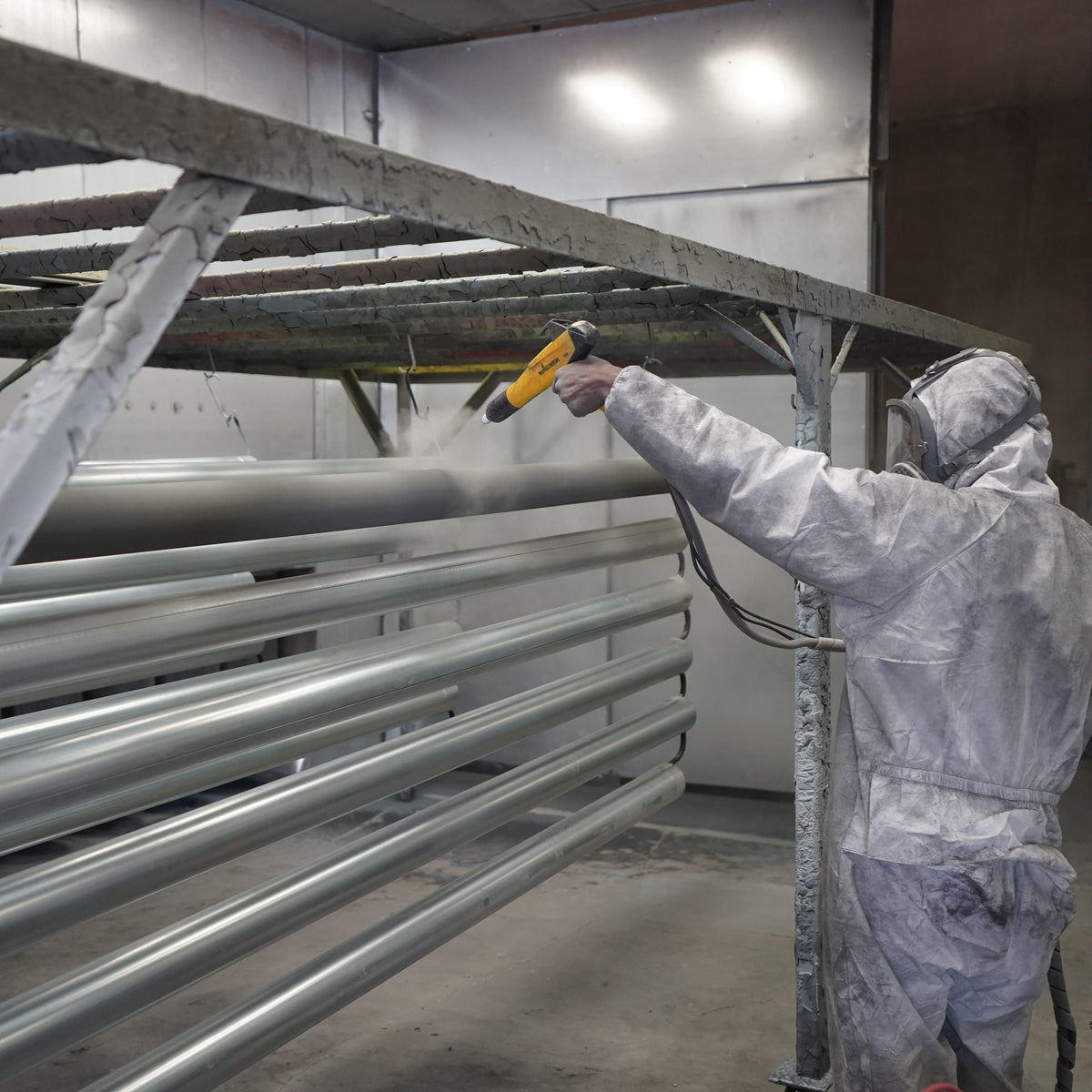
A coater pulls a part out of the oven and there they are. Three little craters on a flat panel that looked perfect going in. The powder was fine. The gun was fine. The oven held temperature. What killed the finish was a slug of water and compressor oil that came down the line at 7:40 that morning and landed on a part nobody was watching.
That is the whole story of finishing air. A powder line does not need enormous volume. It needs air that is dry, oil free, and boringly consistent, because every defect it causes shows up an hour later in the oven when the part is already worth money. If you are shopping for an air compressor for powder coating, the compressor is honestly the easy part. The treatment behind it is what decides whether you spend Fridays reworking parts.
Why finishing air is different from shop air
A general fab shop runs impact guns, grinders, and blow-off. Those tools tolerate wet air. They will corrode faster and they will spit water on the floor, but they still turn. A powder gun does not work that way. Electrostatic powder relies on dry, free-flowing particles picking up a charge and following a field to a grounded part. Add moisture and the powder clumps in the hopper, bridges in the fluidizing bed, and comes out of the gun in surges instead of a steady cloud. Add oil and you get fisheyes, craters, and adhesion failures that only appear after cure.
Then there is the reclaim side. If you run a cartridge booth and reclaim powder, contaminated air does not just ruin the parts you sprayed this morning. It ruins the powder you are going to spray next week, because moisture and oil get recycled straight back into the hopper. One bad morning becomes a bad month.
So the requirement is not "more CFM." The requirement is a number on a dew point meter and a filter train you actually service.
The air quality target for a powder line
Equipment builders publish this in their manuals, and the numbers land in a tight range. Plan on all three of these at the gun, not at the compressor:
| Property | Target for powder coating | What happens if you miss it |
|---|---|---|
| Pressure dew point | 35°F or lower, and typically in the 20°F to 38°F band at 100 psi | Powder clumps, hopper bridges, gun spits, surface craters |
| Oil content | 0.1 ppm maximum, aerosol and vapor | Fisheyes, poor adhesion, contaminated reclaim powder |
| Particulate | Nothing larger than 10 micron, with filtration 99% efficient on particles above 0.3 micron | Bits in the film, plugged gun passages, worn nozzles |
If you want to speak the same language as your customers' quality auditors, that combination sits right around ISO 8573-1 Class 2 for water, Class 2 or better for oil, and Class 1 or 2 for particulate. We wrote a plain-English breakdown of what those class numbers mean in ISO 8573-1 Air Quality Classes, Decoded, and it is worth ten minutes if you have ever been handed a spec sheet with "Class 1.2.1" on it and no explanation.
One thing to be clear about: a 35°F pressure dew point is a refrigerated dryer number. You do not need desiccant for a typical indoor powder line running an indoor booth. You need desiccant when the air lines run outdoors or through an unheated space where a 35°F dew point will still condense, when you spray in a humid southern summer with no climate control, or when a customer spec explicitly calls for a lower dew point. We break that decision down in detail in Desiccant Dryers for Powder Coating: When You Need -40 Dew Point.
Sizing the compressor
Powder guns are modest air users. A manual gun in normal operation lands around 6 SCFM once you add flow air and atomizing air together, and manufacturers commonly quote flow and atomizing air in the range of 0 to 3.5 SCFM each. The number that surprises people is the hopper. A fluidizing bed on a reclaim module can pull 20 SCFM by itself, and it pulls it continuously, not in bursts.
Build your load list this way:
- Guns. 6 SCFM each in normal operation. Count every gun that can be triggered at once, not the total number of guns hanging on the wall.
- Fluidizing beds and reclaim. Roughly 20 SCFM per bed, continuous. This is usually the biggest single line item in a small shop.
- Blow-off before the booth. Whatever you use to knock dust off parts after pretreatment. An open 1/4 in. tube will eat 30 SCFM and give you nothing back. Engineered nozzles cut that hard.
- Pneumatic conveying, vibratory feeders, sieves, gun movers. Small individually, real in aggregate.
- Blast cabinet, if you have one. This will dwarf everything else and it needs its own conversation. A cabinet nozzle can pull 15 to 50 SCFM depending on orifice.
Total it up, add 25% headroom, and shop from that. A two gun manual line with one fluidizing hopper and light blow-off usually lands between 40 and 60 SCFM, which is a 10 to 15 HP machine. Two things matter more than the badge on the enclosure:
Pick a compressor that is happy running continuously. Powder lines run steady loads, not bursts. That is exactly where a rotary screw shines and where a piston machine can get itself in trouble on duty cycle. If the load is 50 SCFM eight hours a day, a screw is the right answer. If you are a small custom shop coating a few racks a day, a properly sized two-stage piston with a big receiver is fine, and cheaper. Our breakdown of rotary screw vs piston covers where the line actually falls.
Do not go oil free just to solve oil carryover. This is the most common expensive mistake in finishing. An oil-lubricated screw with a good coalescing filter and a carbon element will hit 0.1 ppm all day for a fraction of what an oil-free machine costs. Oil free earns its money when you have a spec that forbids hydrocarbons at the source, not when you just want clean air at the gun.
The treatment train, in order
Order matters, and getting it wrong is why some shops buy good equipment and still get water at the booth. Left to right:
- Aftercooler and separator. Drop the discharge temperature and knock out the bulk liquid before it goes anywhere. Most screw compressors have this built in. Most pistons do not.
- Wet receiver. Tank ahead of the dryer. Gives the air time to cool and gives you somewhere to drain.
- General purpose particulate filter. Protects the dryer.
- Dryer. Refrigerated for a 35°F to 38°F dew point on an indoor line. Desiccant if you need lower or you have outdoor runs.
- Coalescing filter. This is the one that does the oil work. Rate it for 0.01 micron and 0.01 ppm oil carryover.
- Activated carbon element. Catches oil vapor, which a coalescer will pass right through. Cheap insurance on a finishing line.
- Dry receiver and the drop to the booth. Regulator and a point-of-use filter at the gun, sized generously so it is not your pressure bottleneck.
We laid this whole sequence out with the reasoning behind each stage in Compressed Air Treatment: Building the Train in the Right Order. If you only fix one thing after reading this article, fix the order.
Shop the pieces here: air dryers, coalescing filters, and compressed air filters and elements.
Mistakes powder shops make specifically
Measuring dew point at the dryer instead of at the gun. Your dryer can be doing its job perfectly and you can still have wet air at the booth, because 80 feet of black iron running through an unheated bay is a condenser. Put the gauge where the powder is.
Running the booth off the same drop as the blast cabinet. The cabinet drops line pressure, the gun sees a swing, and the cloud density changes mid-part. Separate drops, separate regulators, and size the header for both running at once.
Skipping the carbon element. Coalescing filters remove liquid oil and aerosol. They do not remove oil vapor. On a compressor running hot, vapor is a meaningful share of total carryover, and it is the part that causes adhesion failures you cannot explain.
Manual drains that nobody pulls. Every drain in the train needs to be automatic. A manual drain is a drain that gets pulled the week after the problem starts.
Ignoring what the condensate is. Oily condensate off a lubricated compressor is not something you can legally send to a floor drain in most places. An oil water separator handles it, and there are real numbers behind that requirement. We covered the rules in Compressed Air Condensate Disposal.
Undersized piping to the booth. A 1/2 in. drop feeding two guns and a hopper is a pressure drop machine. Size the branch for the full load with margin. Our pipe sizing guide has the tables.
What a typical small powder shop actually buys
Here is a realistic package for a two gun manual line with one reclaim hopper, running one shift:
| Item | Typical spec | Why |
|---|---|---|
| Compressor | 15 HP rotary screw, 55 to 60 SCFM at 125 psi | Steady continuous load, low duty cycle stress |
| Wet receiver | 120 to 240 gallon | Cooling volume and drain point ahead of the dryer |
| Dryer | Refrigerated, rated above compressor CFM at your inlet temperature | Hits the 35°F to 38°F dew point target |
| Filtration | Particulate, then 0.01 micron coalescer, then carbon | Gets oil under 0.1 ppm at the gun |
| Drains | Zero-loss automatic at every low point | Removes the human from the equation |
| Piping | Aluminum, 1 in. main, dedicated drops per booth | No rust scale, no pressure drop surprises |
Size the dryer off your actual inlet conditions, not the compressor nameplate. Dryer capacity ratings assume 100°F inlet air and 100 psi. Feed one 120°F air in an unventilated compressor room in August and its real capacity drops. We walk through the correction factors in How to Size a Compressed Air Dryer the Right Way.
Frequently Asked Questions
Do I need an oil-free compressor for powder coating?
No, not for most shops. An oil-lubricated compressor with a 0.01 micron coalescing filter and an activated carbon element will hold oil carryover at or below 0.1 ppm, which is the number powder equipment builders ask for. Oil free makes sense when a customer specification prohibits hydrocarbon lubricants anywhere in the system, or when you also coat food contact or medical parts under a spec that requires it.
Refrigerated or desiccant dryer for a powder line?
Refrigerated is the default. It gets you to roughly a 35°F to 38°F pressure dew point, which meets the published requirement for electrostatic powder equipment. Move to desiccant if your air lines run outdoors or through unheated space where a 35°F dew point will still condense, if you spray in high humidity without climate control, or if a customer spec calls for a lower dew point in writing.
How much CFM does a powder gun use?
About 6 SCFM per gun in normal operation once flow air and atomizing air are added together. The bigger draw is the fluidizing bed on a hopper or reclaim module, which can run around 20 SCFM continuously. Size for guns plus hoppers plus blow-off, then add 25%.
Why does my powder clump in the hopper?
Almost always moisture in the fluidizing air. Check the pressure dew point at the hopper, not at the dryer, and check that the automatic drains ahead of the dryer are actually cycling. A plugged or bypassed drain sends slugs of water straight through. Powder that has already absorbed moisture will not recover, so replace it once the air is fixed.
Where should the filter and regulator go?
The main treatment train sits at the compressor. You still want a point-of-use filter and regulator at each booth drop, sized above the drop's peak flow so it does not become the restriction. Separate drops for the booth and for anything with a big transient load, like a blast cabinet.
Can I use PVC for the air line to the booth?
No. PVC is not rated for compressed air and OSHA has cited shops for it. It fails by shattering. Use aluminum, black iron, or copper. We covered why in PVC Pipe for Compressed Air: Why OSHA Says No.
The short version: pick an air compressor for powder coating that is comfortable at a steady load, then spend real money on the dryer and the filter train behind it, then measure the dew point where the powder is. Do those three things and the craters stop.


