


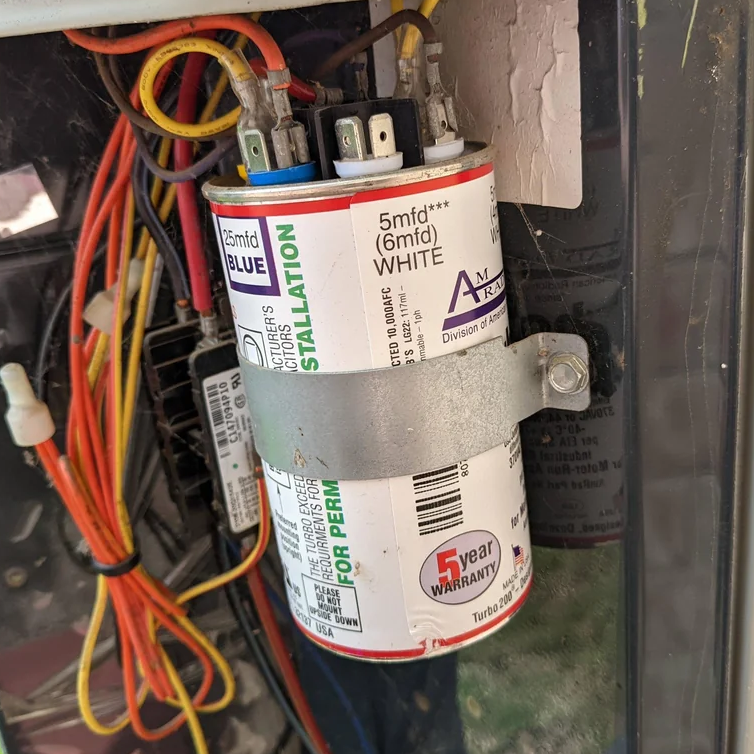
A single-phase compressor that hums but won't spin, trips the breaker, or starts hard on a cold morning is usually telling you one thing: check the capacitor. We get this call a lot. The motor looks fine, the pump turns free by hand, and yet the thing just sits there buzzing. Nine times out of ten the fix is a five dollar part hiding in a little black or silver can bolted to the side of the motor. An air compressor capacitor is one of the cheapest parts on the whole machine, and it is also one of the most misunderstood.
This guide walks through what the capacitor actually does, the difference between a start and a run capacitor, how to test one safely, and how to pick the right replacement so your motor starts every time.
What an air compressor capacitor does
Single-phase motors have a problem. Unlike three-phase power, single-phase power alone cannot create the rotating magnetic field a motor needs to get moving from a dead stop. So the motor uses a second winding, the start winding, and a capacitor to shift the electrical phase and give the rotor a shove in the right direction. Think of it like the kick you give a merry-go-round to get it turning. Once it is spinning, it mostly keeps itself going.
That is the whole job of the air compressor capacitor: store a burst of electrical energy and release it to the start winding at the right moment so the motor can overcome the pressure sitting on top of the pump and break into rotation. On a compressor this matters more than on most motors, because the pump often has to start against tank or line pressure, which is a heavy load right at the moment of startup.
Start capacitor vs run capacitor
Most compressor motors use one of two setups. Smaller motors use a single start capacitor. Larger or higher-efficiency motors use both a start capacitor and a run capacitor, which is called a capacitor-start, capacitor-run motor. Here is how the two differ.
| Feature | Start capacitor | Run capacitor |
|---|---|---|
| When it works | Only for the first fraction of a second at startup | Stays in the circuit the entire time the motor runs |
| Typical rating | High capacitance, often 70 to 400 microfarads (uF) | Lower capacitance, often 2.5 to 100 uF |
| Case | Usually black plastic | Usually a metal (aluminum) can, oval or round |
| Voltage rating | Commonly 125V or 250V | Commonly 370V or 440V |
| What it improves | Starting torque, the punch needed to break away | Running efficiency, torque, and motor temperature |
A start capacitor is switched out of the circuit by a centrifugal switch or a relay once the motor reaches roughly 75 percent of full speed. If that switch sticks closed, the start capacitor stays energized and cooks itself, which is why a bad switch and a blown start cap often show up together. The run capacitor is built to stay in the circuit continuously, so it carries a much lower capacitance but a higher voltage rating.
The two are not interchangeable. Never drop a run capacitor into a start position or the other way around, and never guess at the values. The numbers printed on the side of the can set the operating characteristics of the motor. Match them exactly.
How to read the numbers
Every capacitor has two figures that matter. The first is capacitance, measured in microfarads and written as uF, MFD, or mF on the label. The second is the voltage rating, written as VAC. When you replace a capacitor, the microfarad value must match the original. The voltage rating can be equal to or higher than the original, but never lower. So a 35 uF 370V run cap can be safely replaced with a 35 uF 440V, but not with a 35 uF 250V.
Signs your capacitor is going bad
Capacitors fail in ways that look like bigger, scarier problems, which is why people replace motors that were perfectly fine. Watch for these:
- The motor hums but does not turn, then trips the overload or breaker after a few seconds.
- The compressor starts slowly or struggles to come up to speed, especially when cold.
- You hear a click from the pressure switch but the motor barely reacts.
- The start capacitor case is swollen, cracked, leaking, or has a bulged top.
- The motor only starts if you give the pulley a spin by hand (that is the classic dead start capacitor symptom).
A swollen or leaking can is a dead giveaway. But plenty of failed capacitors look perfectly normal on the outside, so the only sure way to know is to test it.
How to test an air compressor capacitor
You can test a capacitor with a multimeter that has a capacitance setting. Before you touch anything, respect the fact that a capacitor stores voltage even after the power is off, and it can hold enough charge to give you a serious shock. Treat every capacitor as live until you have discharged it.
- Kill the power. Unplug the compressor or shut off the breaker. Do not rely on the pressure switch being open.
- Discharge the capacitor. With the power off, short across the two terminals with an insulated screwdriver, or better, through a resistor to avoid a hard spark. This drains any stored charge.
- Disconnect it. Note where each wire goes (take a photo), then pull the leads off the terminals so you are testing the capacitor by itself.
- Set the meter to capacitance. Use the uF or MFD setting. Touch one probe to each terminal.
- Read and compare. The meter should settle on a number close to the rating printed on the can. Most capacitors are within about 6 percent when new. If the reading is well outside the tolerance range on the label, or reads zero or open, the capacitor is bad.
No capacitance setting on your meter? An analog meter set to a high ohms range will show the needle jump toward low resistance and then drift back toward infinity as the cap charges from the meter battery. A meter that reads a dead short or stays at infinity points to a failed capacitor. It is a rougher test, but it will catch a clearly dead part.
Replacing the capacitor
Once you have confirmed the value, replacement is straightforward. Match the microfarad rating exactly and the voltage rating equal or higher. Mount the new capacitor in the same cover or bracket, reconnect the leads to the same terminals, and make sure the wiring is tucked away from the pulley and belt. On a capacitor-start, capacitor-run motor, check both capacitors while you are in there, since they age together and a weak run cap will make the motor run hot and shorten its life.
If you replace the capacitor and the motor still will not start, look at the centrifugal switch or start relay next. A stuck switch is the most common reason a fresh start capacitor blows again within days. And if the motor itself is drawing heavy current, buzzing hard, or smells burnt, the windings may be shot. When that is the case, browse our air compressor motors to match a replacement by horsepower, frame, and voltage rather than throwing more parts at a dead motor.
Where the capacitor fits with the rest of the controls
The capacitor does not work alone. It is part of the starting circuit along with the pressure switch, the unloader, and on many motors a centrifugal switch or relay. If your compressor short cycles, will not shut off, or will not restart under pressure, the trouble might be upstream in the pressure switch rather than the capacitor. It pays to understand the whole chain before you start swapping parts. For the rest of the small components that keep a compressor cycling right, our compressor parts section has the switches, valves, and hardware that tend to fail together.
Frequently Asked Questions
Can I run my compressor without a capacitor?
No. A single-phase motor needs the capacitor to create the phase shift that gets it turning. Without it the motor will hum, draw heavy current, and trip its overload. Running it that way risks burning the start winding.
Can I use a capacitor with a higher microfarad rating?
Not for the start winding. The microfarad value is matched to the motor design, and going higher changes the current in the start winding, which can overheat it. Match the uF exactly. Only the voltage rating can go higher, never lower.
Why does my start capacitor keep failing?
Repeated start capacitor failure usually points to a stuck centrifugal switch or relay that leaves the cap energized too long, or to very frequent starting and stopping. Fix the switch and check your cut-in and cut-out settings before you install another one.
How long does an air compressor capacitor last?
A run capacitor often lasts many years. Start capacitors live shorter lives because they take a surge on every startup. Heat is the enemy for both, so a compressor in a hot room or one that cycles constantly will go through capacitors faster.
Is the capacitor the same as the pressure switch?
No. The pressure switch senses tank pressure and tells the motor when to turn on and off. The capacitor helps the motor actually start once the switch calls for it. They are different parts, and both can cause a no-start.
The bottom line
Before you condemn a motor, test the capacitor. An air compressor capacitor is cheap, quick to swap, and the single most common reason a single-phase compressor hums, trips, or refuses to start. Match the microfarad rating exactly and the voltage equal or higher, respect the stored charge, and check the centrifugal switch if start caps keep dying on you. Get that little can right and the motor will spin up the way it should.


