


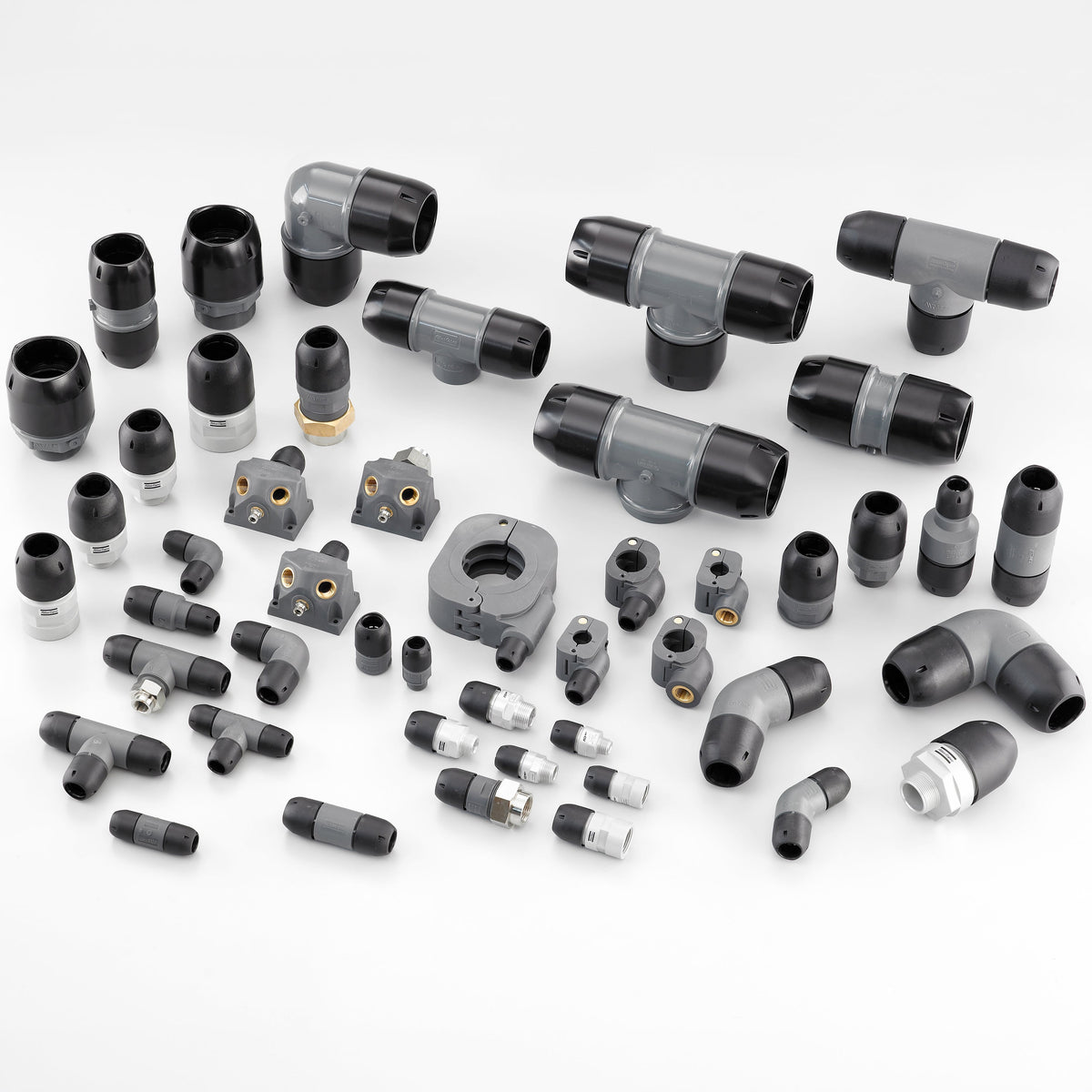
People call AIRnet "plastic pipe that looks like aluminum" or "just another quick-connect kit," and both are wrong. AIRnet is extruded aluminum pipe from Atlas Copco and Chicago Pneumatic, and it is one of the most common ways to pipe a compressed air system without a pipe threader, a torch or a can of glue. We stock it, we sell a lot of it, and it is not right for every shop. Here is what it is, what it covers and where it does not.
What you are buying
AIRnet pipe is made from extruded aluminum alloy EN AW-6060 T6. The outside is polyester powder-coated, blue for compressed air. Atlas Copco's documents describe an anti-corrosion treatment on the inside, and a 10 year warranty on pipes and fittings. The system is designed in line with EN 13480-3 and calculated to ASME B31.1, according to the maker's engineering documents.
The headline numbers, from Atlas Copco's published specifications:
- Maximum working pressure of 16 bar, which is 232 psi. The largest size, 158 mm, is limited to 13 bar, or 188 psi.
- Temperature range from minus 20 to 80 degrees Celsius (minus 4 to 176 degrees Fahrenheit).
- Suitable for vacuum, down to 13 mbar absolute.
- Listed for compressed air, nitrogen and inert gases including helium, argon, neon, xenon and krypton.
The eight sizes
AIRnet comes in eight outside diameters. There is no 32 mm size, which matters, because many shops want a 1-1/4 inch main and cannot get it in this range.
| Outside diameter | Nominal size | Joint type |
|---|---|---|
| 20 mm | 3/4 inch | Push-to-fit |
| 25 mm | 1 inch | Push-to-fit |
| 40 mm | 1-1/2 inch | Push-to-fit |
| 50 mm | 2 inch | Push-to-fit |
| 63 mm | 2-1/2 inch | Torque-to-grip |
| 80 mm | 3 inch | Torque-to-grip |
| 100 mm | 4 inch | Bolt clamp |
| 158 mm | 6 inch | Bolt clamp |
The small sizes, 20 through 50 mm, use a push-to-fit fitting you assemble by hand. The 63 and 80 mm sizes use a torque-to-grip fitting. The 100 and 158 mm sizes use a bolt clamp. None of them needs threading, soldering, gluing or heavy tools. The seals are NBR rubber, and the push-to-fit seals have a PTFE coating.
For a 1/2 inch or 1-1/4 inch run, the AIRnet aluminum range will not do it. We cover those sizes with Prevost aluminum pipe or AIRnet polyamide pipe, depending on the job.
Why shops pick it
The case for aluminum over black iron is simple. It is light, it does not rust, and the bore stays smooth, so the pressure drop at year ten is close to the pressure drop at year one. Black iron scales and sheds rust that ends up in your tools and filters. That is the main argument in our pipe materials comparison.
Atlas Copco says installation is dramatically faster than with threaded steel. The figures in their own documents differ from one document to the next, so we are not going to print a percentage. What we can say is that an experienced installer working with push-to-fit is not carrying a pipe machine around the building, and a layout can be changed later without cutting anything. It is also reusable. If you move the shop, you can take the pipe with you.
Color coding
The exterior color tells the next person what is in the line:
- Blue (RAL 5012) for compressed air.
- Green (RAL 6018) for compressed inert gas, in the 20 and 25 mm sizes. Larger green sizes are special order.
- Grey (RAL 7001) for vacuum.
Drops and take-offs
Take the air off the top of the main, never the bottom, so water in the main does not run down into your tools. AIRnet makes a quick drop for this, and the maker says it is condensate-free and can be mounted horizontally or vertically. We also carry socket boxes and manifolds. Browse the AIRnet collection for the fittings, and the broader aluminum air pipe category for other brands.
How to size it
Pipe size is about flow, length and allowable pressure drop, not about the compressor's outlet size. A common rule is to keep the total drop from the compressor to the farthest tool to a small fraction of system pressure, and to size the main for the future load. Our pipe sizing guide walks through the method. Larger mains cost more, but they are cheap compared to the energy lost to pressure drop over the life of a system.
We lay out AIRnet systems for customers regularly. If you send us a floor plan with the compressor location, drop points and tool list, we will size the run and give you a parts list. That is a free service, and it prevents most of the mistakes we see.
Where AIRnet falls short
It is good pipe, and we try to be straight about the limits:
- No 1/2 inch or 1-1/4 inch size. See above.
- Not for corrosive environments. Atlas Copco's engineering specifications say it is not for caustic cleaning agents, bleach or other corrosives, and not for oxygen or acetylene.
- Weather. The same document says protection is not guaranteed under direct UV or rain, so outdoor runs need thought.
- Heat. The top temperature is 80 degrees Celsius (176 degrees Fahrenheit). Pipe right off a hot compressor discharge should be steel or copper until the air has been cooled in an aftercooler.
- Thermal movement. Aluminum expands and contracts, and none of the sources we reviewed addresses expansion on long runs. Ask us or the manufacturer before you design a long outdoor or unconditioned run.
- Pressure. 232 psi covers most shops but not high-pressure systems such as a booster or a bottle-fill line.
The two documents we reviewed disagree on a few details, for example the lowest allowable dew point for the system, so check the current Atlas Copco datasheet for your application before you commit.
Other things to consider
Many shops also look at RapidAir MaxLine and FastPipe for smaller jobs. We compare those in our aluminum air pipe guide. If you have a small garage and under about 100 feet of run, tubing may be enough, and the comparison there favors a lower-cost kit. For a full shop or a plant, AIRnet is a strong choice.
Start with the AIRnet collection, and send us your layout if you want a second pair of eyes.


