


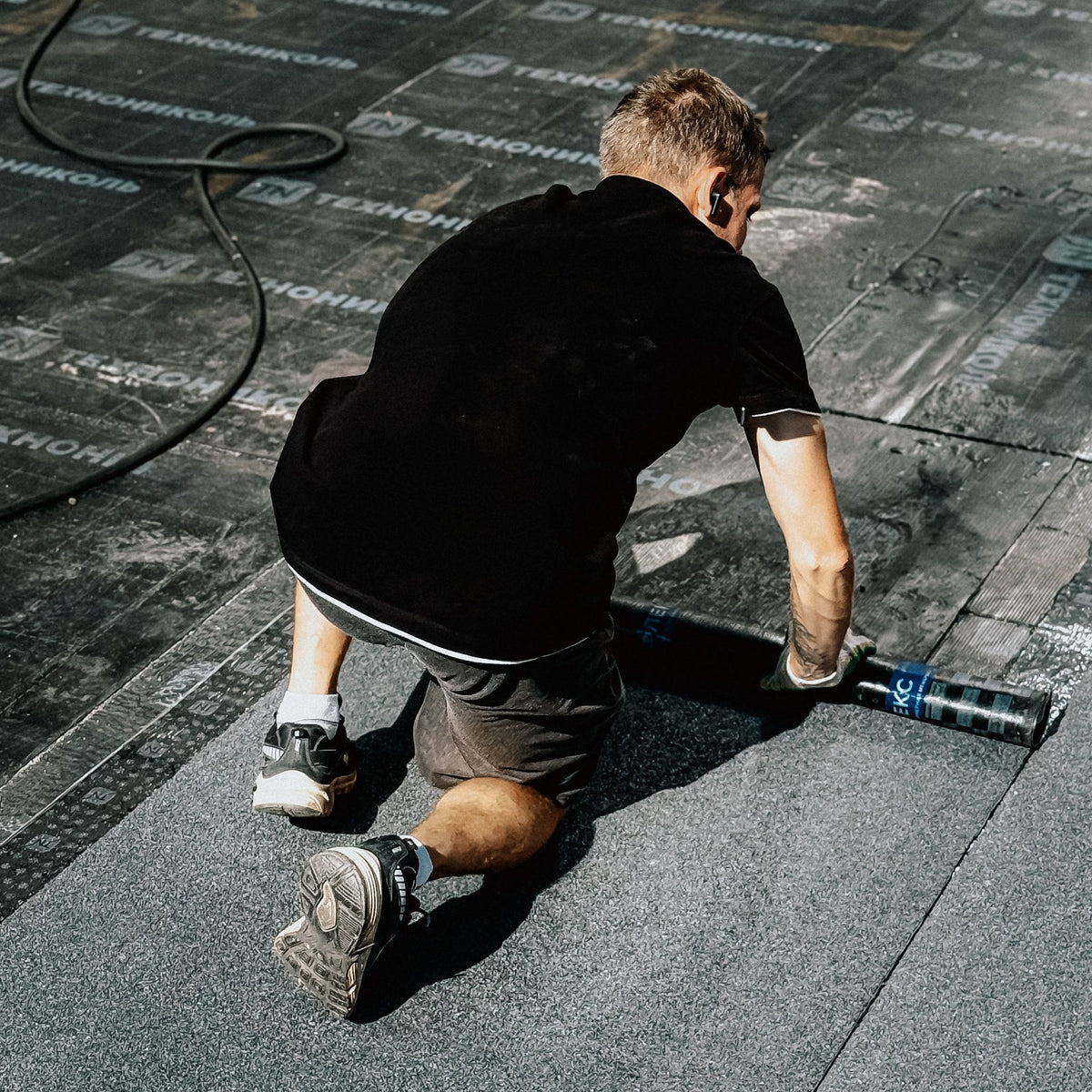
Picture a three-man crew on a 30-square tear-off. Two guys are nailing down felt and shingles, the third is running the starter course, and the compressor is down in the driveway with 150 feet of hose snaking up a ladder. Every few minutes one nailer coughs and fires a nail proud. The foreman blames the gun. Nine times out of ten the gun is fine. The compressor can't keep up, or the hose is choking it, or both.
That's the roofing air compressor problem in one scene, and it's different from what a framing crew or a shop deals with. The tool is small and hungry in bursts, the hose run is long and vertical, the weather is rarely friendly, and nobody is going to carry a 60 gallon tank up to a second story. Here's how we size it for roofers, and where the money gets wasted.
What makes a roofing air compressor different
A coil roofing nailer is a light tool. It shoots 3/4 inch to 1-3/4 inch coil nails, runs in the neighborhood of 90 to 120 PSI, and fires fast. Figures you'll see quoted for these guns land around 2.0 to 2.2 SCFM at 90 PSI when they're firing steadily, at something like 60 to 100 nails a minute. That is not a lot of air. It's about what a good portable compressor makes without breaking a sweat.
So why do roofing crews have so much trouble? Three reasons, and none of them is the nailer itself.
First, there are usually two, three or four guns on one compressor, all firing at once when the crew gets rolling. Second, the hose is long. A compressor on the ground and a ridge 25 feet up with a few offsets means 100 to 200 feet of hose is normal, and every foot costs pressure. Third, cold. Shingles are nailed in November and January, and a compressor that's fine at 70 degrees starts to behave badly at 25.
Sizing the compressor by crew size
Start with the nailer number and add a buffer. One widely repeated rule is to take the tool's SCFM and multiply by 1.5 so the pump isn't running flat out all day. Using 2.2 SCFM at 90 PSI as the working number, here is how it stacks up:
| Nailers running | Continuous demand at 90 PSI | With 1.5 buffer | Compressor to look for |
|---|---|---|---|
| 1 | about 2.2 SCFM | about 3.3 SCFM | Hot dog or pancake, 3.5 SCFM or better at 90 PSI |
| 2 | about 4.4 SCFM | about 6.6 SCFM | Twin stack or small wheeled unit, 6.5 to 8 SCFM at 90 PSI |
| 3 | about 6.6 SCFM | about 9.9 SCFM | Larger wheeled or 2-stage portable, 10 SCFM or more at 90 PSI |
| 4 | about 8.8 SCFM | about 13 SCFM | Big portable or a small towable, 13 SCFM or more at 90 PSI |
Those are conservative. Nobody fires a nailer continuously, so real crews get away with a bit less. We still don't like to see a three-man crew on a compressor rated 5 SCFM at 90 PSI. It'll limp along on a calm day and fall over when everyone is working fast.
Always compare the SCFM at 90 PSI, not the number on the box that says "max PSI." Our SCFM vs CFM guide explains why two compressors with the same horsepower can differ by 30 percent.
Tank size: less than you think
Roofers always ask about tank gallons. With a tool this small, tank size matters less than pump output. A bigger tank buys you more nails before the motor kicks on, but it's the SCFM that decides how fast the tank refills when three guys are shooting. A 6 to 8 gallon twin stack with honest output will beat a 20 gallon unit with a weak pump every time.
The one place storage does earn its weight is cold starts and long hose runs. A larger tank gives the pump a break and keeps pressure steadier at the tool. Just weigh it against the ladder.
Electric or gas on a roof job
Most residential roofing crews run electric because it's quiet and the homeowner is standing in the yard. You need a 120 volt outlet and a proper extension cord. A thin cord on a long run starves the motor, and a compressor with a starved motor blames the nailer. Our extension cord guide covers the gauges.
Gas or engine-driven units make sense on new construction and commercial re-roofs where there's no power yet. Expect more output, more noise, and a rule that the compressor never runs inside a garage or enclosed space. For bigger crews, a small towable is the right move. See our portable air compressor guide for how the types compare.
The hose is where roofing air gets lost
A long hose with small fittings throws away the pressure you paid for. Roofers commonly run 3/8 inch hose because it's light, and that's fine for one gun at a short distance. Put three guns on a 150 foot run of 3/8 inch hose and the last gun on the line is starved.
- For one nailer and a short run, 3/8 inch hose is fine.
- For two or more nailers or a run over about 100 feet, step up to 1/2 inch hose for the main line and use short 3/8 inch whips at the tool.
- Use a manifold or splitter close to the work so each gun has its own short leg instead of daisy-chaining.
- Replace cheap couplers. Restrictive, leaking couplers are a bigger loss than most guys realize.
Our hose guide goes through diameters and lengths, and you can shop our air hoses and couplers directly.
Cold weather and wet air on the roof
A compressor makes water. At 20 degrees that water freezes in the drain valve, the regulator and the nailer's trigger valve, and now you've lost a morning. A few habits cut most of the problems:
- Drain the tank at the end of every day, with the compressor shut off and the tank vented.
- Use a winter-grade compressor oil rated for cold starts, and let the pump idle for a minute before loading it.
- Park the compressor where the sun hits it, not in the shade of the house.
- Put a small water separator at the hose outlet so less moisture reaches the tool. Look at our water separators.
Our winterizing guide covers the longer list.
Safety rules that actually get cited
Roofing is on every OSHA inspector's list, and most of the attention goes to fall protection. Air tools come up too. Under the construction standard at 29 CFR 1926.302, pneumatic nailers and staplers that operate above 100 PSI at the tool need a safety device on the muzzle so they can't fire unless the tip is pressed against the work. Tools should also be secured to the hose or whip with a positive means, and hose connections should be kept in good shape so a failed coupling doesn't whip around on a roof. Check the current text of the rule and any state-plan version that applies to you.
Practical version: keep your regulator set to what the nail needs rather than cranking it to the ceiling, and don't use the tool for anything it wasn't built for. Our OSHA compressed air guide covers the rest.
Mistakes we see roofing crews make
- Buying on tank gallons. Pump output is the number that matters.
- Setting the regulator too high. Over-driven nails and punched-through shingles are an air pressure problem, not a nail problem.
- Using one hose for everyone. Run a manifold close to the work.
- Skipping the oil. Roofing nailers can run without lubrication, but a compressor on a cold morning needs the right oil.
- Not draining. Water in the line is the most common reason a nailer fails in January.
What we sell, and what we don't
We're a compressor and air system supplier. We can size you the compressor, the hose, couplers and moisture protection. We don't pretend to be a roofing supply house, so check your nailer's own manual for its exact air requirement and match the compressor to that.
The short version
For a roofing air compressor, size it by SCFM at 90 PSI, not tank size. Plan on roughly 3.5 SCFM for one nailer, 6.5 to 8 for two, and 10 or more for three. Run bigger hose for the main line, shorten the last leg, and treat cold weather as a maintenance problem, not an act of God. Ready to shop? Browse our portable air compressors, or read the general construction contractor guide if your crew also runs breakers and tampers.
Frequently Asked Questions
What size air compressor do I need for a roofing nailer?
One coil roofing nailer typically needs around 2 to 2.2 SCFM at 90 PSI. Add a buffer and look for a compressor delivering 3.5 SCFM or better at 90 PSI for one user. Each additional nailer adds roughly the same again.
How many roofing nailers can one compressor run?
On a compressor making about 8 SCFM at 90 PSI, two nailers is a comfortable load. Three needs about 10 SCFM, and four needs a larger portable or towable unit.
Does tank size matter for a roofing compressor?
Less than pump output does. A bigger tank gives you more nails between motor cycles, but SCFM determines how fast it refills when several guns are firing.
What hose should I use on a roof?
3/8 inch hose is fine for a single gun on a short run. For multiple nailers or runs over about 100 feet, use 1/2 inch hose for the main line and short 3/8 inch whips at each gun.
Can I run a roofing compressor in freezing weather?
Yes, with care. Use cold-rated oil, drain the tank daily, keep the unit in the sun if possible, and add a water separator so moisture doesn't freeze in the tool.


