


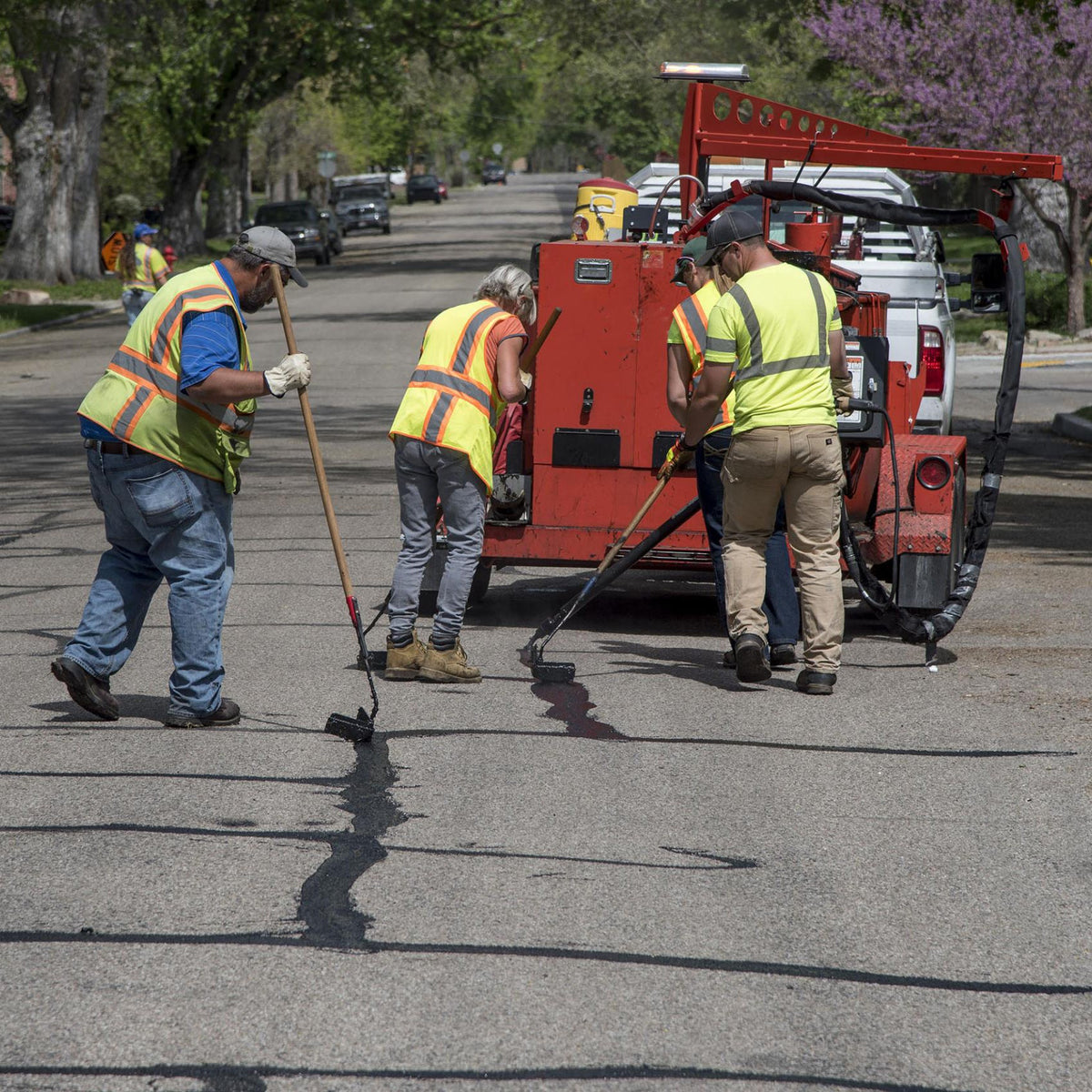
One maker of hot air lances says its Model B "can be run off a 60 to 185 cfm compressor." That is a wide range, and it tells you something about how crack sealing crews buy air: the lance is the cheap part, and the compressor behind it is the decision.
This article is for road maintenance crews, whether you work for a city street department, a county, a state DOT contractor or a private pavement preservation outfit. The air system on your truck or trailer does one job that most shops never ask of theirs. It has to leave a crack clean and dry, minutes before hot sealant goes in. If the air is wet or oily, the job fails, usually weeks later and in front of the customer.
What the air is for
A crack sealing crew uses compressed air in a few places, and they are not equal:
- Crack cleaning. After routing or sawing, an air lance blows dust, debris and loose material out of the crack so sealant can bond.
- Hot air lance. Compressed air passes through a burner to heat and dry the crack just ahead of the sealant. Crafco describes a lance with a separate valve for fuel and a separate valve for compressed air, 40 feet of hose and a 9.2 pound weight, with air velocity listed at 3,000 feet per second. LAB Manufacturing lists 1,500 feet per second for its Model B.
- Pneumatic tools. Breakers, tampers and rock drills for patching, dowel work and pothole repair.
- General jobsite air. Tires, hand tools and cleanup.
The lance is the continuous load. The breaker is the spike. A compressor sized for one will often struggle with the other.
What the lance needs
The only manufacturer figure we could verify is that LAB range of 60 to 185 CFM for its Model B. Crafco's lance listing gives velocity but no CFM or psi, and we are not going to make one up. A trade article on crack cleaning says to use "a minimum of 90 PSI" for cleaning, and notes that commercial hot air lance packages require a tow-behind compressor, which may stand alone or ride on the sealant kettle truck.
So the practical answer is to ask the lance maker for the CFM at the working pressure for your model, and then add headroom. If you also plan to run a breaker or a tamper off the same machine, add that draw too. Our air tool CFM chart and pneumatic breaker guide give the numbers for the common tools.
The spec that decides whether the work holds
Public agencies write the air requirement into the contract. The Iowa DOT crack and joint sealing specification, section 2541.03, says the compressor must supply air that is "moisture and oil free" and of "sufficient size," and that cracks must be clean and dry before sealing. It does not give a psi or CFM. The FHWA crack sealing checklist asks inspectors to confirm that the compressor has enough pressure and volume to clean the cracks, and that the oil and moisture filters and traps are working.
The same FHWA checklist limits how far ahead of the sealant the hot air blast can run: a maximum of 5 minutes or 50 meters (about 54 yards). It also says to heat only enough to darken and warm the surface, and not burn the pavement. Those are good reminders that the air is a timing problem as well as a volume problem. A compressor that cannot keep up makes the crew slow down, and then the dry crack picks up moisture again before the seal goes in.
That is why filters and traps are on the inspector's list. A compressor that has been running in a humid summer for a few hours builds a lot of condensate. If it reaches the lance, it reaches the crack. A water separator and a coalescing filter at the outlet are cheap insurance, and a drain you open every morning is cheaper still.
Towable or truck-mounted
Most crews we talk to run a tow-behind because it detaches from the truck and works on any crew vehicle. A truck-mounted unit saves the trailer hitch but ties the compressor to one truck. If your lance runs off the sealant kettle's own air supply, check the kettle's rating before you add anything else. Our towable air compressors cover the common sizes, and the tow-behind sizing guide walks through the arithmetic.
We want to be plain about one thing: we do not have a verified figure for the typical compressor size that municipal and DOT crews run, and we are not going to quote one. Ask your lance supplier and your own fleet manager. If you tell us the lance model, the other tools and the working pressure, we can match a machine to it.
Hose and fittings
A lance with a 40 foot hose that is fed by 100 feet of small-diameter supply line will starve. Use hose sized for the flow, keep the run as short as the job allows, and keep the couplers matched. Our hoses and hose reels cover the common sizes. We do not have a verified hose size spec for crack lances, so check the lance manual.
OSHA rules on a road crew
Several parts of OSHA's construction rules apply to pneumatic tools and compressed air on road work:
- 29 CFR 1926.302(b)(1) says pneumatic tools must be secured to the hose or whip by a positive means so they cannot come loose.
- Impact tools need safety clips or retainers, 1926.302(b)(2).
- Compressed air may not be used for cleaning unless it is reduced to less than 30 psi and chip guarding and personal protective equipment are used, 1926.302(b)(4). The limit does not apply to cleaning concrete forms or mill scale.
- Hoses larger than 1/2 inch inside diameter need a safety device at the supply or branch line to reduce pressure if the hose fails, 1926.302(b)(7).
That 30 psi cleaning rule is a real tension with crack cleaning, where the lance runs far above 30 psi. Read the rule carefully with your safety lead, and check the current text on OSHA's site, because we read it through a summary and not the page itself.
Breakers and chipping tools bring silica into it. OSHA's Table 1 in 1926.1153 covers handheld jackhammers and chipping tools on concrete. It calls for water at the point of impact, or a shroud with dust collection. A respirator with an assigned protection factor of 10 is required outdoors only if the tool is used more than 4 hours per shift, and always indoors. Dowel drilling rigs working in concrete outdoors need a shroud with dust collection and a HEPA vacuum for cleaning the holes. Check your own work against the full table.
The things that take a crew off the road
We could not find a published list of the leading causes of downtime on crack crews, and we will not invent one. What the FHWA checklist implies, and what we see at the counter, comes down to three items: a compressor that cannot make enough air at the working pressure, filters and traps that were never drained or changed, and tools that were bought without checking the CFM. All three are cheap to fix before the season and expensive in the middle of a job.
Service the machine before the crack sealing season starts: oil, air filter, separator, belts and the drain. Our parts catalog is built for that, and our service kits are in the towable compressor category alongside the machines.
Tell us what lance you run and what else is on the truck, and we will help you pick the compressor.


