


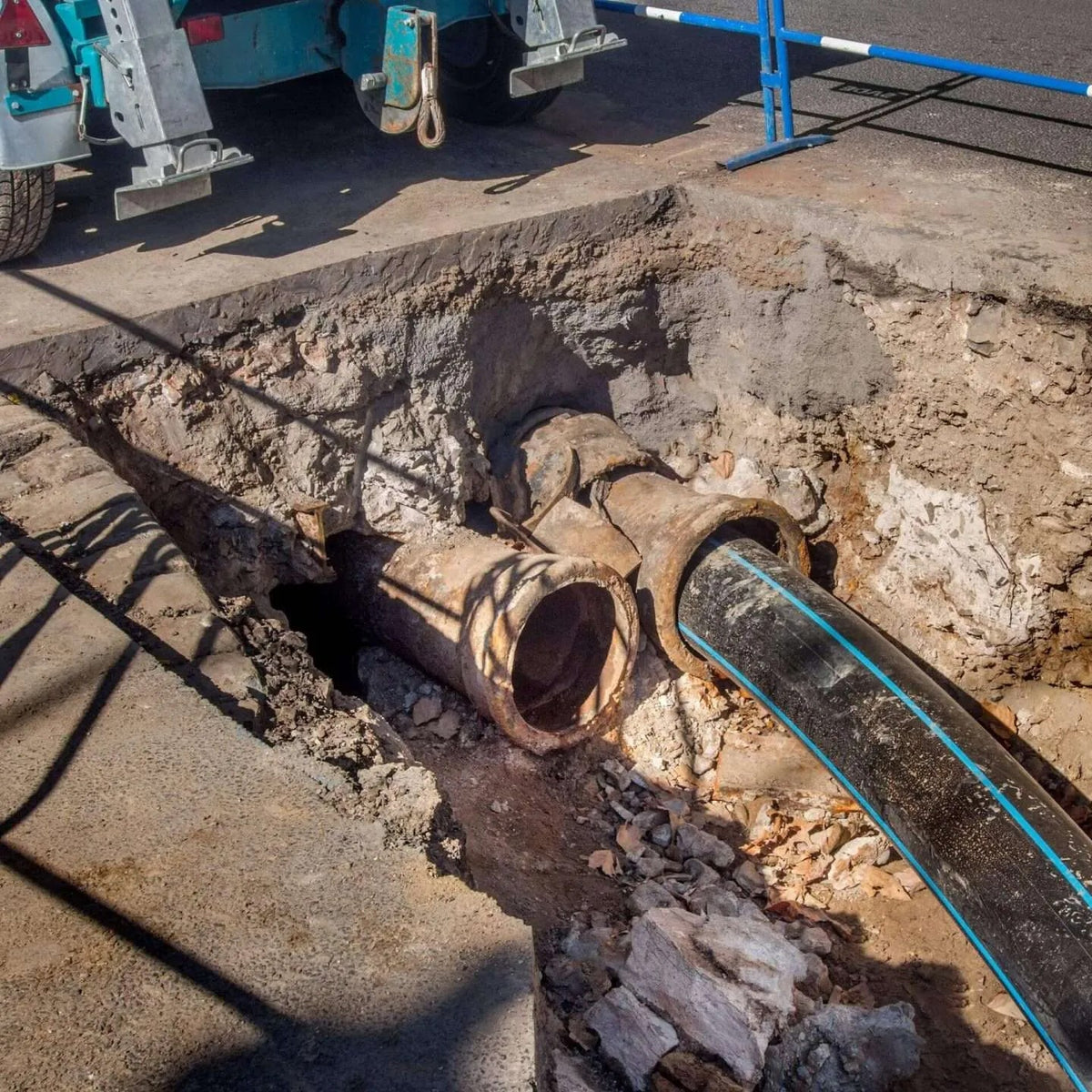
Nobody wants to dig up a street to fix a pipe, and that is the whole business model. A crew pulls up with a boring rig, a liner truck or a bursting setup, opens two small pits, and replaces or relines a line while traffic keeps moving. What gets lost in the story is how many of those machines are fed by one diesel compressor sitting out of sight on the shoulder.
This piece is about picking the air compressor for trenchless work. We will be plain about something up front: the rig maker's spec sheet and the liner supplier's procedure set the numbers, and we do not sell the boring machines, bursting heads or liners. We sell the compressor behind them, so that is the part we can speak to with confidence.
Where air actually shows up in trenchless work
Trenchless is a family of methods, and each one uses air differently. Mixing them up is how crews buy the wrong machine.
Auger boring and pipe piercing
Auger boring drives a casing through the ground with a rotating auger, and pipe piercing hammers a tool through the soil along a line. Compressed air supports ventilation, spoil removal and pneumatic tools in the pit. One portable compressor maker lists its 185 CFM class diesel unit at up to 185 CFM at 100 psi for auger boring and the same figure for pipe piercing. That is a vendor figure for one model, but it gives you the scale: the small end of this work is a 185 CFM towable.
Microtunneling
Microtunneling is the heavier cousin, with a remotely controlled boring machine. The same maker says its larger unit is capable of 425 CFM at 100 psi for that work. If you are weighing a 185 against a 375 or 400 class machine, that gap is the question.
Pipe bursting
In bursting, a tool breaks the old pipe outward while pulling the new one in. The vendor says compressed air powers the hydraulic or pneumatic bursting rings and that consistent pressure matters to avoid equipment misfires. No CFM figure is given, which is honest, because it depends entirely on the head and the pipe size.
Cured-in-place liners
CIPP means pulling or inverting a resin-saturated felt liner into the old pipe and curing it in place with hot water, steam or UV light. Compressed air is used to invert the liner and then to hold pressure while it cures. We could not find a published CFM or psi figure for liner inversion in the sources we checked, and we are not going to make one up. It varies with pipe diameter, liner thickness and whether the job uses an inversion drum or a newer gland-style setup. A 2008 industry release on one air-inversion method noted that older drum-style air inversion was limited to about 500 mm (roughly 20 inches) in diameter, and that the gland method pushed that to 1,800 mm. Get the exact air requirement from your liner supplier's installation procedure and the project spec, which will name the governing ASTM standard. ASTM F1216 covers installation by inversion and curing, and F1743 covers pulled-in-place installation.
Horizontal directional drilling
HDD crews also lean on air for support work. The maker's advice there is high CFM and consistent pressure, with no number attached. Treat it as a reminder that every rig has its own ask.
The sizing logic that holds up
Start at the tool and work backward. Here is the order we walk customers through.
- Get the CFM and psi from the machine's spec sheet or the procedure, not from a forum thread.
- Add anything that runs at the same time. A bore plus pit ventilation plus a breaker in the entry pit is a real combination.
- Derate for altitude and heat if you work in the mountains or the Gulf summer. We have a full piece on altitude derating.
- Add a margin for hose losses and wear, since long hose runs to a pit eat pressure.
- Check pressure, not just flow. Many of the published trenchless figures are at 100 psi, which a standard 100 to 125 psi towable meets but a lower-pressure machine will not.
| Work | Published figure | Compressor class |
|---|---|---|
| Auger boring | Up to 185 CFM at 100 psi (one maker's unit) | 185 CFM towable |
| Pipe piercing | 185 CFM at 100 psi (one maker's unit) | 185 CFM towable |
| Microtunneling | 425 CFM at 100 psi (one maker's unit) | 375 to 425 CFM class |
| Pipe bursting, HDD, CIPP | No figure published; consistent pressure stressed | Confirm with the rig or liner supplier |
Notice what the table cannot tell you. Those are the numbers one maker printed for its own machines, not a universal rule. Use them to know which size family to start from, then confirm.
Why contractors buy towable diesels
Trenchless sites are in alleys, easements, road shoulders and backyards. There is no plug. A diesel towable brings its own power, goes where the truck goes, and holds pressure while a liner cures or a bore advances. If you want the longer argument, our diesel air compressor guide and tow-behind compressor sizing piece cover the details. If you are already looking at the big end, the 400 CFM guide explains what a 400/150 class machine really runs.
Continuous pressure beats peak CFM
The one phrase that repeats across the maker's notes is consistent pressure. A bursting ring misfires when pressure dips. A liner can be held at the wrong pressure if the compressor hunts. A compressor sized right at the limit will cycle, and cycling shows up as pressure swings on a machine that wants a steady number. When in doubt, size one step up. You pay for it once in the purchase price and save it every time the job does not stall.
Hose, fittings and receiver tank
Pit work means long, dirty hose. Keep the supply line as short as the site allows, size it for the flow, and use a rated working pressure above what the rig sees. See our air compressor hoses for the right class. A receiver tank on the machine or at the pit helps with pulses on pneumatic tools, though it will not fix an undersized pump.
The mistakes we see
Buying on CFM alone and ignoring the pressure rating. Taking a competitor's spec for your rig. Skipping altitude derating on a mountain job. Running a long hose without checking pressure at the far end. Forgetting that a small unit that works for a bore will not start a liner job that wants a bigger drum. And treating the compressor as an afterthought when it is the thing that keeps four employees standing around if it quits.
Where to start
Find your machine's spec sheet and note the CFM and psi. Add anything running at the same time. Then look at our towable air compressors, and the 185 CFM units if that is your size. Call us with the spec and we will confirm the match before you order.
Frequently Asked Questions
How big an air compressor do I need for auger boring?
One compressor maker publishes up to 185 CFM at 100 psi for auger boring with its 185 CFM diesel unit. Treat that as the starting size and confirm with your boring machine's spec sheet.
How much air does CIPP liner inversion need?
We could not find a published CFM or psi figure, and it varies with pipe diameter, liner and method. Ask your liner supplier for the procedure and follow the project spec.
Is a diesel towable the right choice for trenchless work?
Usually, yes. Sites rarely have power, and a diesel unit carries its own. Make sure the machine delivers the pressure your rig needs, not only the CFM.
Does the pit need its own compressor?
Not always. Many crews run one towable and a hose to the pit. Add up everything running at once and size for that total.
Do you sell boring machines or liners?
No. We sell the compressor, hose and air accessories. Rigs and liners come from trenchless equipment suppliers.


