


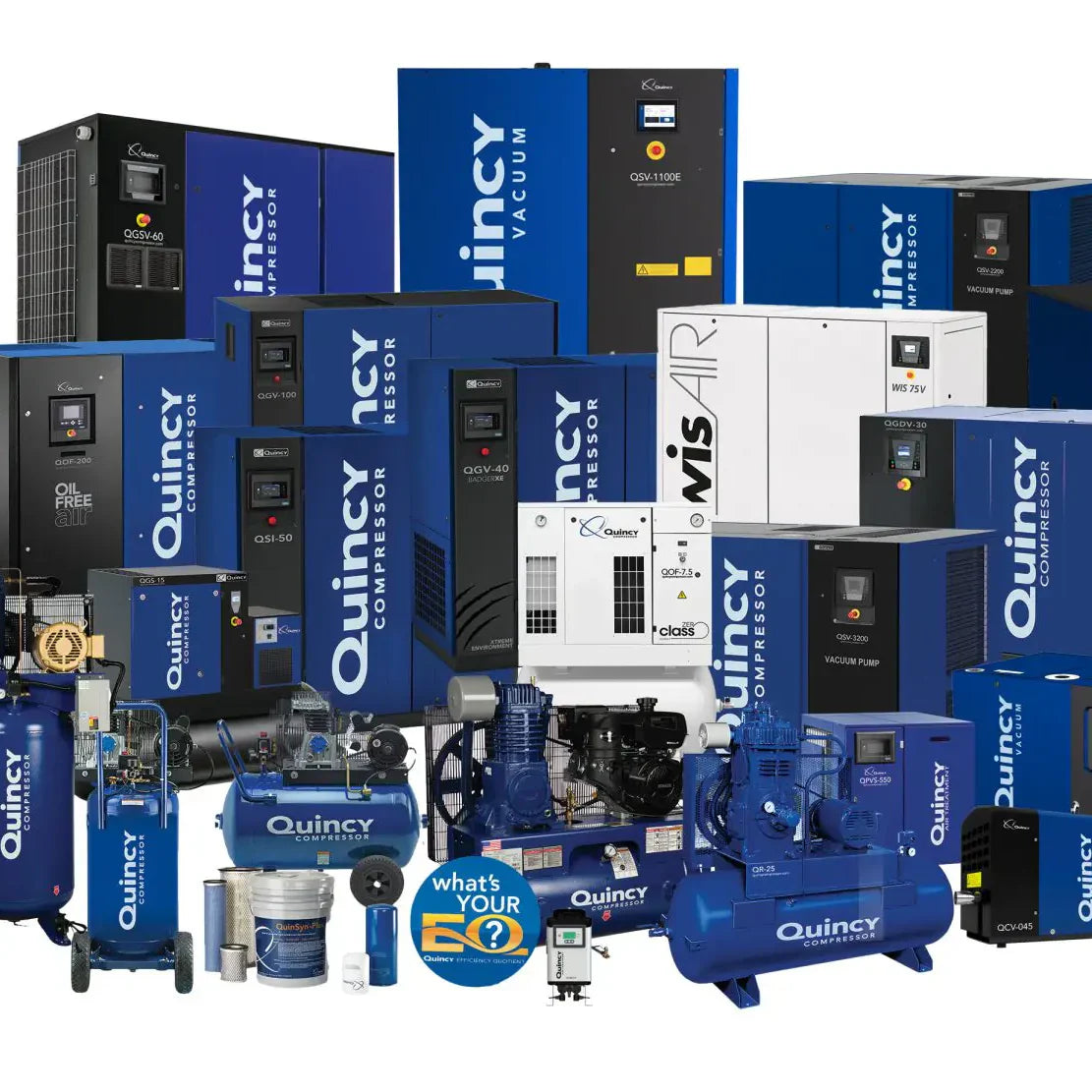
A guy called us last week ready to buy a 5 HP compressor off a big-box shelf. He runs a two-bay repair shop and figured any tank with a pump on top would do. Twenty minutes later he was looking at a Quincy instead, and he thanked us for it. That happens a lot. When someone wants a compressor that runs hard for years and does not turn into a paperweight, a Quincy air compressor is usually the name that comes up, and for good reason.
Quincy has been building compressors in the United States since 1920. They are not the cheapest thing on the market, and we will not pretend they are. What they are is dependable, and in a working shop that matters more than the sticker price. This guide walks through the lineup, who each model is built for, and how to pick the one that fits your shop without overpaying or coming up short on air.
Why people buy a Quincy air compressor in the first place
Two things drive most Quincy purchases. The first is duty. These units are built to run, not to sip air for ten minutes on a Saturday. The reciprocating pumps carry long warranties, and the rotary screws are built for full-time production. The second is parts and support. Quincy has a real dealer and service network, so when you need a valve kit, an oil filter, or an airend rebuild ten years from now, the parts still exist. Cheap import compressors rarely offer that.
The trade-off is up-front cost. You pay more for a Quincy than for a hardware-store special. But if the compressor is feeding tools your business depends on, the cost of downtime dwarfs the cost of the machine. That is the whole argument in one sentence.
The Quincy lineup, model by model
Quincy splits into two families: reciprocating piston units and rotary screw units. Which family you want depends mostly on how many hours a day the compressor will actually run.
QT reciprocating (piston)
The QT is the two-stage piston line, and it is the workhorse most small and mid-size shops end up with. Two-stage means the air gets compressed twice, so these reach higher pressure (usually around 175 PSI) and move more air per horsepower than a single-stage unit. The well-known QT-54 is a 5 HP splash-lubricated pump that has been feeding shop tools for decades. Quincy rates the QT pumps for long life, and the pressurized-lube industrial versions are built to run harder still.
Reach for a QT when you run air tools, an impact gun, a sander, a paint gun, or a small blast cabinet, and the compressor cycles on and off through the day rather than running flat out. If you are cross-shopping piston designs, our guide on rotary screw vs piston air compressors lays out the differences in plain terms.
QGS rotary screw
The QGS is Quincy's entry into rotary screw, covering roughly 5 to 50 HP. The 5 to 30 HP models are belt-driven with an automatic belt tensioner, and the 40 to 50 HP units step up to a gear drive. Flow lands somewhere in the 10 to 125 CFM range depending on horsepower and pressure. A rotary screw runs continuously without overheating, so it is the right call when your air demand is steady and the piston unit would otherwise never shut off.
The QGS is popular with body shops, machine shops, and small production lines that outgrew a piston compressor. Many come tank-mounted with a dryer already built in, which saves floor space and gives you clean, dry air out of one package. If you are weighing screw units in general, browse the full rotary screw air compressor selection to see the range.
QGV variable speed
The QGV is the big-plant answer. It is a variable speed rotary screw line running from 40 HP up past 400 HP, with flows reported from roughly 65 to over 2,000 CFM. Variable speed means the motor slows down when demand drops instead of loading and unloading, so the compressor only makes the air you are using. On a plant with swinging demand, that turndown (Quincy quotes up to 85 percent) can cut a serious chunk off the power bill. If your shop air demand rises and falls through the day, a variable speed unit often pays for itself. Our primer on variable speed drive compressors explains how that works.
How to pick the right Quincy air compressor
Forget the brand for a second and start with your air. Getting a Quincy air compressor that fits comes down to four numbers.
| What to check | Why it matters |
|---|---|
| CFM you need | Add up the air your tools use, then add 30 percent headroom. Buy for the total, not the biggest single tool. |
| PSI you need | Most air tools want 90 PSI at the tool. Two-stage QT units hit ~175 PSI so you have pressure to spare after line loss. |
| Duty cycle | On and off use points to a piston QT. Steady all-day use points to a QGS or QGV screw. |
| Power available | Confirm your voltage and phase. Bigger units want three phase, which a lot of small shops do not have. |
The most common mistake we see is buying on horsepower alone. Horsepower is not the number that runs your tools. CFM is. A 5 HP unit from one maker can move more air than a 5 HP unit from another. Always compare CFM at 90 PSI, tool for tool.
Piston or screw? A quick gut check
If the compressor will run less than about half the time it is switched on, a piston QT is usually the smarter money. If it will run more than half the time, or all day, the extra cost of a rotary screw pays back in longer life and steadier air. Piston units are cheaper to buy and simple to service. Screw units run cooler under constant load and last longer when the demand never lets up.
Living with a Quincy: upkeep and cost of ownership
A Quincy is only as good as the maintenance behind it. The good news is the routine is simple. Change the oil on schedule, keep the intake filter clean, drain the tank so it does not rust from the inside, and check the belt tension on belt-drive units. Rotary screw owners also need to change the oil separator and the air and oil filters at the intervals in the manual. None of it is hard, and our air compressor maintenance schedule spells out what to do and when.
Because Quincy parts are widely stocked, a well-kept unit can run for fifteen or twenty years and still be worth rebuilding rather than replacing. That is the part that never shows up on the price tag but shows up every year you own it.
Frequently Asked Questions
Are Quincy air compressors worth the money?
For a shop that depends on air, yes. You pay more up front than for a big-box unit, but the reciprocating pumps and rotary screw airends are built to run for years, parts are easy to get, and the resale value holds. If you only need air a few minutes a week, a cheaper compressor is fine. If downtime costs you money, a Quincy usually pays for itself.
What is the difference between the QT, QGS, and QGV?
The QT is a two-stage reciprocating piston line for on-and-off use in small and mid-size shops. The QGS is a rotary screw line, roughly 5 to 50 HP, for steady daily air demand. The QGV is a variable speed rotary screw line, 40 HP and up, for larger plants where demand swings and energy savings matter.
How many CFM do I need from a Quincy?
Add up the CFM rating of every tool you might run at once, then add about 30 percent for headroom and leaks. Match that total to the compressor's rating at 90 PSI. Do not size off horsepower alone, since CFM is what actually runs your tools.
Does a Quincy need three-phase power?
Smaller QT piston units and some small QGS models run on single-phase power. Larger rotary screw units, and most 10 HP and up models, want three-phase. Confirm the voltage and phase in your shop before you buy, because converting power after the fact gets expensive.
How often should I change the oil in a Quincy?
Follow the manual, but a common starting point is every three months or a few hundred running hours for piston units, and by hour meter for rotary screws. Use the oil Quincy specifies, not motor oil, and change the separator and filters on the screw units at their own intervals.
The bottom line
A Quincy air compressor is the right buy when you need air you can count on and you plan to keep the machine for the long haul. Start with your CFM and PSI, decide whether your duty cycle calls for a piston QT or a rotary screw QGS or QGV, and confirm your power before you order. Get those right and the brand takes care of the rest. If you are ready to look at models and pricing, browse our full Quincy lineup and match one to the numbers your shop actually needs.


