


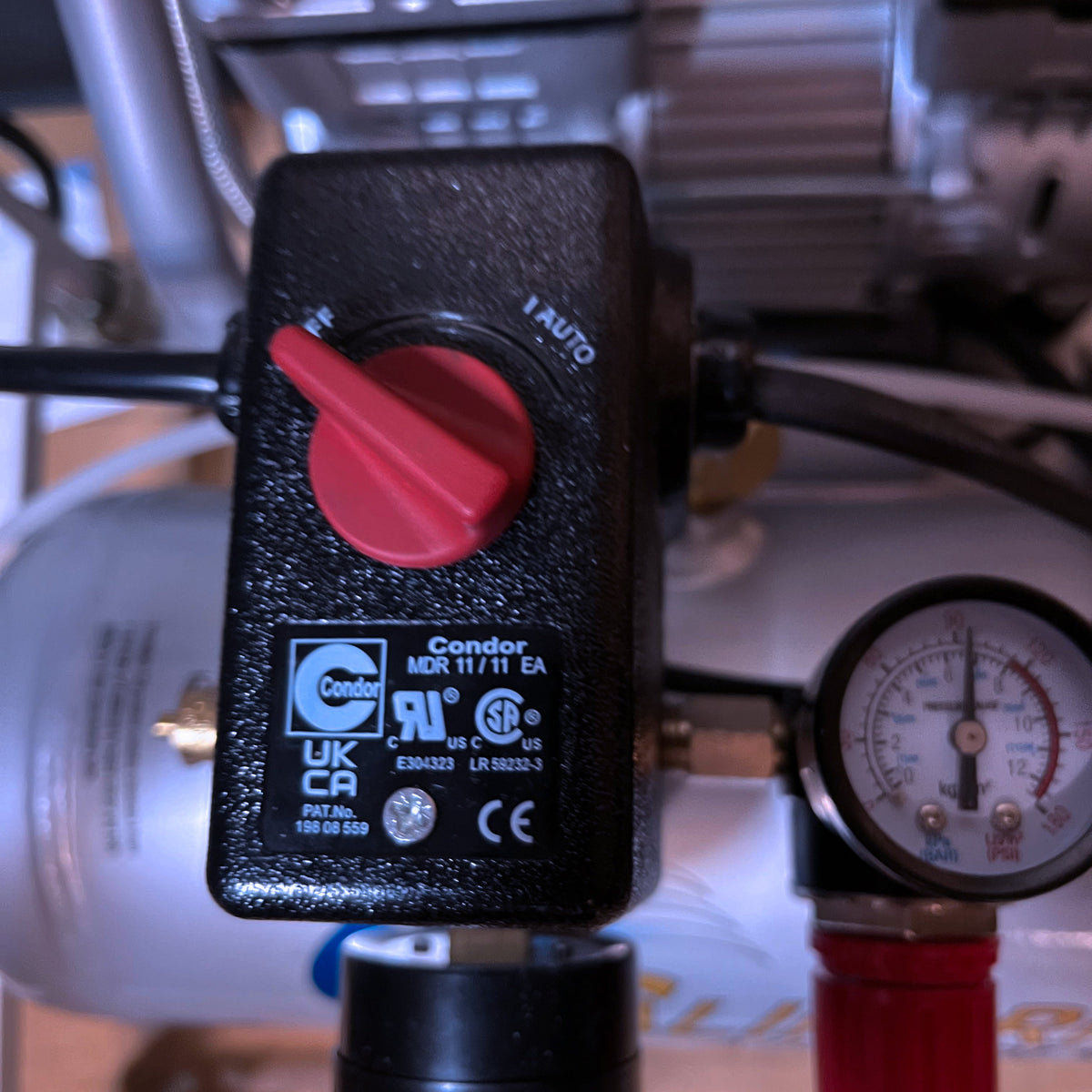
Pull the cover off a lot of American piston compressors and you'll find a gray Condor switch with "MDR" somewhere on the label. When it fails, the question is usually the same: which one do I order? The label has a string like MDR11GA2E or 31KG3EMX printed on it, and the website has forty variants that look identical in the photo.
This guide is about reading that string. We'll cover the two Condor MDR pressure switch families we carry, what each letter in the part number means, when an MDR11 is enough and when you need an MDR3 with its built-in overload, and the ordering mistakes that cause returns.
If you need the basics of how any pressure switch works, start with our pressure switch guide and come back here.
The two switches most people need
Condor MDR11
The MDR11 is a two-pole, normally closed switch for single-phase compressors. It's rated 26 amps at 240 volts under UL and CSA (20 amps under EN 60947), with motor switching capacity of 3 hp at 240 volts and 2 hp at 120 volts. It has a NEMA 1, IP44 enclosure on a steel flange, a 1/4 in. FNPT air connection, adjustable range and differential, and a maximum cut-out of 175 psi. Bursting strength is listed at more than 35 bar.
That covers the bulk of single-phase shop compressors: the 60 and 80 gallon two-stage units, a lot of contractor machines and many OEM replacements.
Condor MDR3
The MDR3 is the bigger brother, and the thing that sets it apart is the adjustable thermal overload built into the switch. It does double duty as pressure control and manual motor starter. The overload trips on excess current and protects the motor windings. Overload ranges run from 6.3 amps up to 30 amps, maximum switching capacity is 30 full-load amps at 220 volts, and it comes in two-pole and three-pole versions for single and three-phase motors. Pressure ranges go from 80 to 100 psi all the way up to 215 to 250 psi. The ones we carry are four-port with 1/4 in. FNPT connections, an on/off lever and a 90 degree compression unloader.
Reading an MDR11 part number
MDR11 part numbers follow a pattern. Using the variants in our own catalog as the key:
| Position | Example (MDR11GA2E) | What it means |
|---|---|---|
| Family | MDR11 | Single-phase, 26 A, two-pole |
| Pressure range letter | G | E = 80 to 100 psi, G = 100 to 125 psi, L = 120 to 150 psi, K = 140 to 175 psi |
| Port letter | A | A = one port, C = four-port manifold |
| Lever | 2 | 2 = on/off lever, X = no lever |
| Unloader | E | E = compression unloader, X = no unloader |
So MDR11GA2E is a 100 to 125 psi switch, one port, with a lever and an unloader. MDR11KCXX is a 140 to 175 psi, four-port switch with no lever and no unloader. Always check the letters against the label on your old switch. A switch that's been in service for fifteen years may predate the code you're reading here, and OEMs sometimes run private labels.
Reading an MDR3 part number
The MDR3 parts we carry start with 31, and the code is built differently.
| Position | Example (31KG3EMX) | What it means |
|---|---|---|
| Prefix | 31 | MDR3 family |
| Pressure range letter | K | E = 80 to 100 psi, G = 100 to 125 psi, Q = 120 to 150 psi, K = 140 to 175 psi, T = 215 to 250 psi |
| Fixed portion | G3E | Same on every MDR3 variant we carry, all of which are four-port with a lever and unloader |
| Overload range letter | M | E = 6.3 to 10 A, G = 10 to 16 A, J = 16 to 20 A, L = 20 to 24 A, M = 22 to 30 A |
| Suffix | X | Standard |
Watch the pressure letter. On the MDR11, 120 to 150 psi is L. On the MDR3, it's Q. Same psi, different letter, different family. That's the kind of thing that turns a five-minute order into a return.
MDR11 or MDR3?
It comes down to the motor and how the compressor is wired.
Use an MDR11 when the compressor is single-phase, 3 hp or under at 240 volts (2 hp at 120 volts), and the motor already has its own protection, either a built-in thermal protector or a separate starter.
Use an MDR3 when you want overload protection in the switch itself, when the motor is three-phase, or when you need pressure above 175 psi. The 215 to 250 psi range is MDR3 only in our lineup.
And use neither when the motor is past what the switch can carry. Above those ratings the pressure switch should be a pilot device driving a magnetic starter, not switching the motor current directly. If you're not sure where your motor falls, check the nameplate full-load amps and read our piece on wire and breaker sizing.
Setting the MDR3 overload
Pick the overload range that brackets your motor's nameplate full-load amps, then set the dial to that FLA. The NEC motor table puts a 7.5 hp single-phase motor at 230 volts at 40 amps, past the top of the 22 to 30 amp range, so that's a starter job, not an MDR3 job. Don't pick a bigger range just to stop nuisance trips. If it's tripping at the correct setting, something is wrong with the motor, the voltage or the capacitor. Here's how to test a start capacitor.
One port or four?
A single-port switch screws onto a fitting and everything else, the gauge, the safety valve and the unloader line, plumbs elsewhere. A four-port switch is its own small manifold. Your gauge, safety valve and tank connection all thread into the switch body.
The rule is simple: match what came off. If the old switch had four ports with stuff threaded into them, a one-port replacement means re-plumbing with a tee or manifold. It works, but it's an hour you didn't plan on.
The unloader matters more than people think
On a piston compressor with a check valve, the line between the pump and the check valve stays pressurized when the motor stops. If nothing bleeds it, the motor tries to restart against that pressure. You hear it hum, trip the breaker, or drag the capacitor down until something gives.
The unloader on the switch is the fix. When the switch opens, the unloader vents that line, and the motor restarts against no load. If your old switch had a small tube running to it and you hear a short hiss when the compressor shuts off, you need a replacement with an unloader. Condor sells an unloader conversion kit for MDR switches if you'd rather add it than replace the whole switch, and we carry it.
Leaving the unloader off a compressor that was designed for one is an easy mistake to make. The switch fits, the compressor runs, and the hard starts show up later as a tripped breaker or a burned capacitor.
Adjusting range and differential
Both MDR families are adjustable. The main spring moves cut-in and cut-out together. The differential screw changes the gap between them. Stay inside the range printed on the switch and inside your tank's rated pressure, and never set cut-out above the safety valve setting. We cover the actual turns and the safety steps in how to adjust a pressure switch.
What about the European models?
If you have imported equipment, you might see MDR switches labeled MDR 2, MDR 3 or MDR 5, often with G1/2 threads and ranges listed in bar. European distributors list three-phase models like the MDR 5 at 2 to 11 bar for 400 volts. Those are not interchangeable with the US MDR11 and MDR3 parts above just because the family name matches. Thread standard, voltage and pressure range all need to line up.
Chicago Pneumatic and other compressor makers also sell Condor switches under their own part numbers. Our catalog lists, for example, an MDR53/16 listed with a 1/2 in. size and an MDR1/11 listed with a 1/4 in. size in the Chicago Pneumatic parts line. If your compressor is a branded unit, ordering the OEM number is often the safest route.
Before you order
Get the following off the old switch and the compressor before you pick a replacement: the full part number from the switch label, the cut-in and cut-out pressures, single or three-phase, motor hp and nameplate FLA, the number of ports, whether there's a lever, and whether there's an unloader tube attached. With those seven things the right switch is usually obvious. Without them, it's a guess.
If the label is gone, send us a photo of the old switch and the compressor nameplate and we'll match it. The MDR11 and MDR3 variants, plus the unloader kit and other makes, are in our pressure switch collection.


