


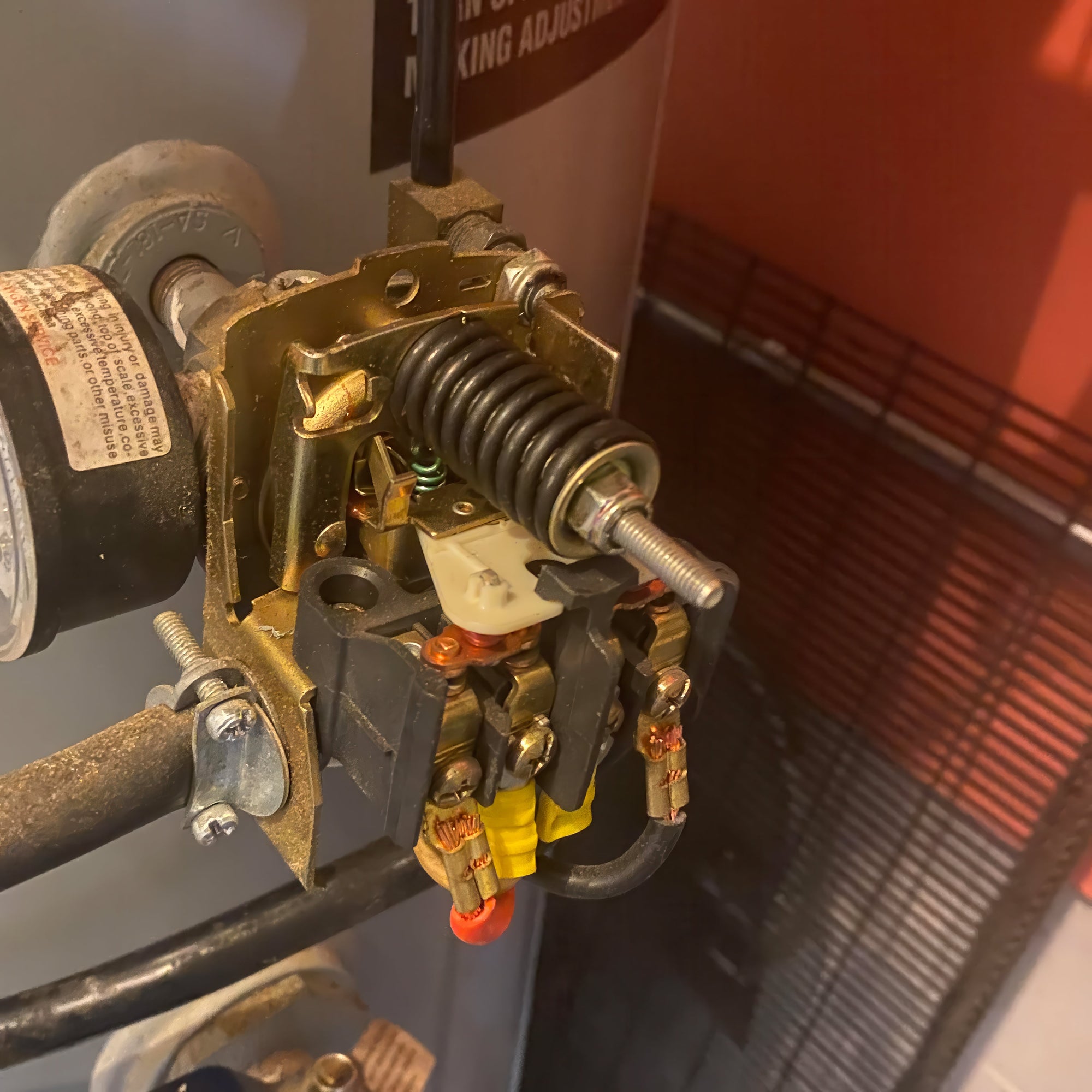
Your compressor kicks on, builds pressure, shuts off, and waits. Then you use some air, it drops, and the motor fires back up. The little part running that whole dance is the air compressor pressure switch. It is one of the smallest components on the machine and one of the most important, because it is what keeps your tank from either running dry or building pressure with nowhere to stop. When it goes bad, the whole compressor acts possessed. Let's demystify it.

What the pressure switch does
An air compressor pressure switch is a mechanical device that watches tank pressure and turns the motor on and off to match. As long as pressure sits below the target, the switch keeps the circuit closed and power flows to the motor. Once the tank hits the high setpoint, the switch opens the circuit and the motor stops. Use enough air to drop the pressure, and it closes again and restarts the motor. That is the entire job, repeated thousands of times.
Because it sits between your power supply and the motor, it is part electrical control and part safety device. It is also why a healthy switch matters so much. You will find a range of replacements in our pressure switches collection, alongside the other controls and components that keep a compressor running right.
Cut-in, cut-out, and differential
Three terms tell you everything about how a switch behaves.
| Term | What it means |
|---|---|
| Cut-out pressure | The high point where the switch stops the motor |
| Cut-in pressure | The low point where the switch restarts the motor, often about 30 psi below cut-out |
| Differential | The gap between cut-in and cut-out, also called the pressure band |
So a switch set to cut in at 95 psi and cut out at 125 psi has a 30 psi differential. A wider differential means the motor runs less often but the tank pressure swings more. A narrower one holds steadier pressure but cycles the motor more frequently. Most factory settings are a sensible middle ground, and you usually do not need to touch them.
The unloader valve, and why your compressor restarts easily
Here is a detail a lot of folks miss. When the compressor reaches cut-out and shuts off, there is still high-pressure air trapped in the line between the pump and the tank's check valve. If that air just sat there, the motor would have to start against all that back pressure, which is hard on it. So most pressure switches include an unloader valve that briefly opens at shutdown and bleeds off that trapped air. That short hiss you hear right after the motor stops is the unloader doing its job, clearing the pump head so the next start is easy. If your compressor strains or trips a breaker on restart, a failed unloader is a prime suspect.
How to adjust one (carefully)
Many switches let you fine-tune the settings with one or two screws under the cover. Before you touch anything: cut the power, drain the tank, and remember that these springs are under tension. If you are not comfortable around live wiring, this is a job for someone who is.
The larger spring is the range or pressure adjustment. Turning it clockwise raises both the cut-in and cut-out together; counterclockwise lowers them both. The smaller spring is the differential adjustment, and it changes only the cut-in point, which widens or narrows the gap. Make small moves, then run the compressor and watch the gauge to confirm where it actually cuts in and out. Never set the cut-out above the tank's or the pump's rated pressure, and never above the safety relief valve's setting. The switch controls normal operation, but the relief valve is your last line of defense, so the switch should always trip well before it.
Signs your pressure switch is failing
Switches wear out, mostly at the electrical contacts, which pit and burn over years of cycling. Watch for these symptoms:
- The motor will not start even though the tank is below cut-in.
- The compressor runs past its normal cut-out and will not shut off (dangerous, shut it down).
- It short-cycles, clicking on and off rapidly.
- You hear a constant hiss from the unloader while the compressor is running, not just at shutdown.
- Visible scorching, melted plastic, or a burnt smell at the switch.
A switch that will not shut the motor off is the one to take seriously right now. If the relief valve is the only thing stopping an overpressure, you are running on your backup. Kill the power and replace the switch before using the compressor again.
Picking the right replacement
Match four things and you will get a switch that bolts on and works. First, the pressure rating, so the cut-in and cut-out match your compressor (a common range is around 95 psi on, 125 psi off). Second, the voltage and whether your motor is single or three phase, because the switch has to handle the load. Third, the port configuration, since a four-port switch with an unloader is standard on most piston units. Fourth, whether you want a built-in on/off lever. If your motor draws more than the switch can handle directly, you may need a motor starter in the circuit, and it never hurts to confirm your motor's specs while you are at it.
Pressure switch or full controller?
On small and mid-size piston compressors, the mechanical pressure switch is the whole control system, and that simplicity is a feature. There is no software, nothing to update, and a failed switch is a quick, inexpensive swap. The downside is that it only knows two states, on and off, and the contacts wear with every cycle.
Larger rotary screw machines often move to a digital controller instead. That is the kind of display you see at the top of this page, reading out pressure, flow, run time, and service warnings, sometimes with remote monitoring built in. A controller gives you finer control and better diagnostics, but it is a more involved part to replace. Neither approach is "better" in the abstract. The mechanical switch is the right tool for a shop piston unit, and the controller earns its place on a bigger continuous-duty machine. Knowing which one your compressor uses tells you what to shop for when it acts up.
A note on wiring and safety
A pressure switch carries the full motor load through its contacts, so it has to be matched to your voltage and phase, and it has to be wired correctly. On a single-phase shop compressor the switch usually handles the motor directly. On a larger motor that draws more current than the switch is rated for, the switch instead controls a separate motor starter, which does the heavy lifting. Getting this wrong is not just a performance issue, it is a fire and shock risk, so if the wiring is at all beyond you, have an electrician handle the connections. The switch itself is cheap; a burned-up motor or a shop fire is not.
Frequently Asked Questions
What does an air compressor pressure switch do?
It senses tank pressure and starts or stops the motor to match. Below the cut-in setting it closes the circuit and runs the motor; at the cut-out setting it opens the circuit and stops it. Most also include an unloader valve to ease the next restart.
What is the difference between cut-in and cut-out?
Cut-out is the high pressure at which the switch stops the motor. Cut-in is the lower pressure, often about 30 psi below cut-out, at which it restarts the motor. The gap between them is the differential or pressure band.
Why does my compressor hiss after it shuts off?
That is the unloader valve venting the high-pressure air trapped between the pump and the check valve. It depressurizes the pump head so the motor can restart easily. A brief hiss at shutdown is normal; a constant hiss while running is not.
Can I adjust the pressure settings myself?
Often yes, using the range and differential screws under the cover, but only with the power off and the tank drained. Make small adjustments, verify on the gauge, and never set cut-out above the pump, tank, or relief valve rating.
How do I know if my pressure switch is bad?
Common signs are a motor that will not start below cut-in, a compressor that runs past cut-out and will not shut off, rapid short-cycling, a constant unloader hiss, or visible burning at the switch. A unit that will not shut off should be powered down and the switch replaced.
The air compressor pressure switch is small, cheap, and easy to overlook until the day it acts up. Now you know what it is doing, how to read its settings, and when it is time for a new one. Match the pressure, voltage, and ports, keep the cut-out below your relief valve, and your compressor goes back to that quiet, predictable rhythm. Questions on which switch fits your machine? We are glad to help.


