


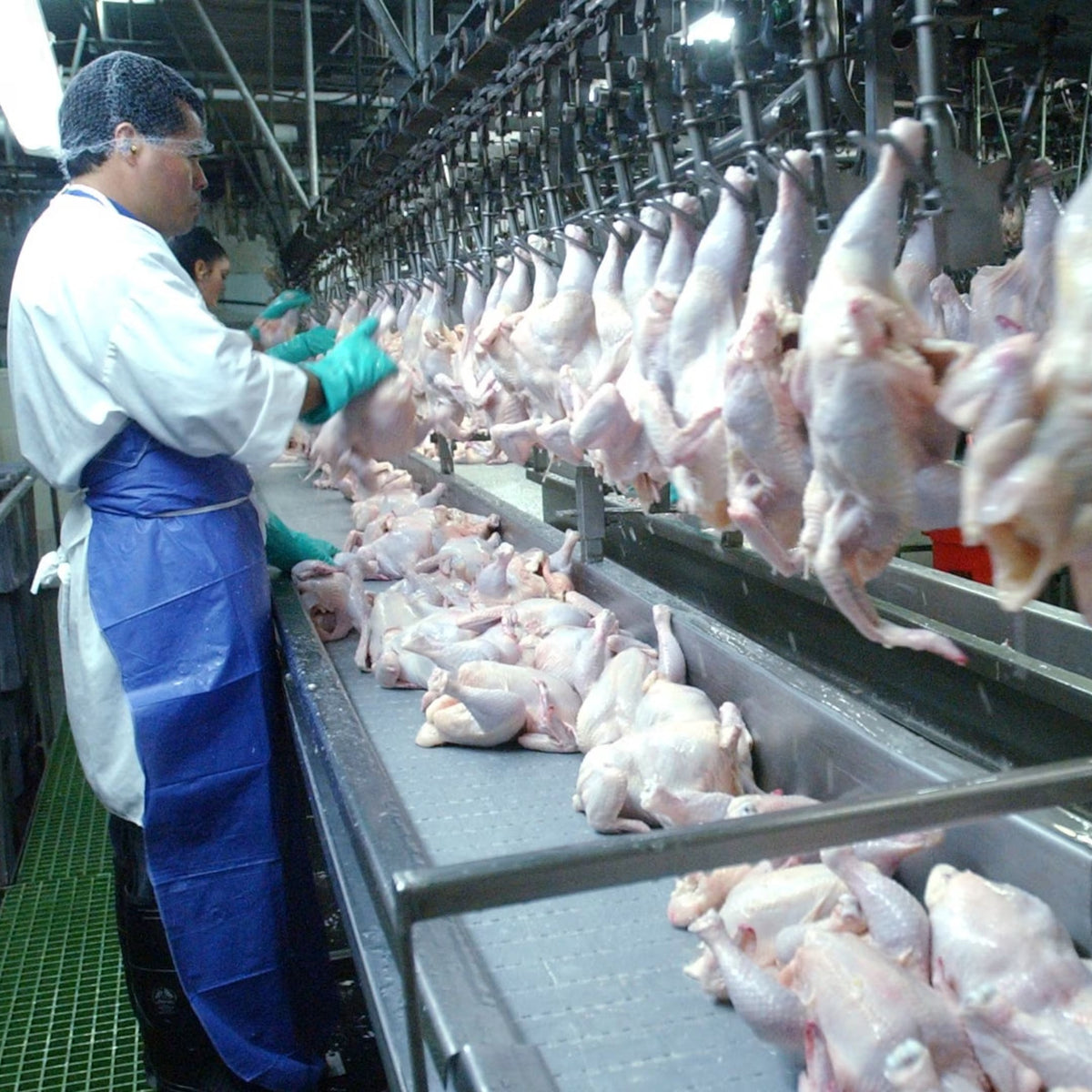
Water you cannot legally sell is the most expensive thing on a poultry line.
Under 9 CFR 441.10, raw poultry carcasses and parts are not permitted to retain water from post-evisceration processing unless the plant can demonstrate, with data collected under a written protocol, that the retained water is an unavoidable consequence of meeting food safety requirements. Whatever you cannot justify has to be declared on the label as a maximum retained water percentage. FSIS revised its retained water guideline in 2024 and 2025, so this is not a dusty corner of the regulations.
That regulatory pressure is the reason air knives for poultry processing keep showing up on capital lists. Mechanically shedding free surface water at the chiller exit, before the bird hits the weigh and pack line, is one of the few levers a plant has that does not involve changing chill chemistry or chill time.
What blow-off actually does on the line
A bird coming out of an immersion chiller carries free water in three places: on the skin surface, in the body cavity, and pooled in the crevices around the wings and legs. Drip lines and drain conveyors get some of it. Time gets more of it. Neither is fast, and floor space on a poultry line is not free.
A properly aimed air knife strips the surface film in a fraction of a second. The common installation points:
- Chiller exit and drip line. The main event. A knife pair set above and below the shackle line sheds the surface film before the bird reaches grading.
- Cavity blow-off. Directed nozzles into the body cavity to clear pooled water, usually a separate set from the skin knives.
- Before bagging or tray sealing. Free water in a bag looks like purge to a consumer and fights the seal on a tray lidder. A short blow-off here does more for pack appearance than anything else on the line.
- Parts lines and marination exits. Wherever product leaves a wet process and enters a weighing, coating or packaging step.
- Package top drying. Water on a tray or bag surface ruins label adhesion and inkjet date coding. This is the cheapest blow-off win in the plant and the one most often solved with a length of drilled pipe.
The air has to be clean, and here that is not optional
This is the part that separates a poultry plant from a machine shop, and it is where we will be direct.
Air blown onto an exposed raw product is contact air. Whatever is in it goes on the bird. If your blow-off header carries compressor oil aerosol, condensed water from a wet line, or rust and scale from an old iron pipe run, you are applying that to product under USDA inspection, in a facility with a HACCP plan and a documented sanitation program. There is no version of that conversation that goes well.
What that means practically:
| Item | What to specify | Why |
|---|---|---|
| Oil removal | Coalescing filtration plus an activated carbon stage on the contact air branch | Coalescing alone leaves oil vapor, carbon takes the vapor and the odor |
| Moisture | Dryer holding a pressure dew point well below plant ambient | Blowing condensate onto a bird you are trying to dry is self defeating |
| Particulate | Point of use filter at the knife, after the header | Catches scale picked up downstream of the main treatment |
| Piping material | Stainless on the contact branch where practical | Black iron rusts, and this line gets washed down |
| Nozzle and knife construction | Stainless, smooth, cleanable, no crevices or dead legs | Sanitary design, it gets washed down every day |
The honest note: we sell the compressors, the filtration, the dryers and the blow-off guns and nozzles that make this work. We do not build the sanitary stainless air knife assemblies that hang over a shackle line. Those come from a food equipment house that will certify the sanitary design. What we can do is make sure the air arriving at that assembly is dry, oil free and filtered, which is the part plants most often get wrong.
Drilled pipe is costing you more than you think
Walk any processing plant and you will find a length of pipe with holes drilled in it hanging over a conveyor. It works, in the sense that air comes out. It is also the single most wasteful air consumer in most food plants.
An open drilled hole entrains no surrounding air, makes a great deal of noise, and consumes far more compressed air than an engineered nozzle producing the same force on the product. Engineered nozzles and true air knives use the compressed air stream to entrain ambient air, so you get more moving air at the product for less compressed air out of the header. On a plant running blow-off across three shifts, that difference is a continuous load you are paying for in compressor horsepower.
There is also a safety and noise dimension. Open drilled pipe is loud in a room where people work all shift, and OSHA 1910.242(b) caps compressed air used for cleaning at under 30 PSI dead-ended with effective guarding and protective equipment. Engineered nozzles designed to relieve when blocked are how plants meet that while still getting the force they need.
If you want the numbers on that tradeoff, our guide to engineered air nozzles works through the consumption math, and air knives and blow-off drying covers the hardware choice in general terms.
Sizing the air behind the knives
Blow-off is a continuous load, not an intermittent one. That is the thing plants underestimate. A set of knives running across three shifts is a baseline draw on the system for every hour the line is up.
Build the number this way:
- Get the consumption of each knife or nozzle bank at your operating pressure from the manufacturer, not from a rule of thumb.
- Sum everything that runs simultaneously when the line is at full rate.
- Run the knives at the lowest pressure that actually sheds the water. Most installations are set higher than they need to be because somebody turned it up once to solve a problem that was really a nozzle aiming issue. Every 2 PSI you drop across the system is roughly 1 percent off the compressor's energy use.
- Add the rest of the plant: pneumatic valves, cylinders on the cut-up line, the CO2 or nitrogen side if you have one, and washdown.
- Put a receiver near the blow-off station so the knives are not fighting the rest of the plant for pressure.
For most plants this all lands on a rotary screw compressor sized for continuous duty, because a poultry line is a continuous duty operation and a piston machine will not survive that schedule.
Washdown, and the thing that kills the compressor
A poultry plant washes down every day with hot water and caustic, and the air in the processing rooms is saturated and chemically aggressive. If your compressor breathes that air, it is drawing moisture and cleaning chemical across the inlet filter and into the oil. Duct the compressor intake from clean outside air and keep the machine out of the wet rooms entirely. That single decision is the difference between a machine that runs for decades and one that surprises you.
Frequently Asked Questions
Does blowing off water actually help with retained water compliance?
It helps with the free surface water portion, which is the part you can physically remove. It does not change water absorbed into the tissue during chilling, which is a chill process question. Under 9 CFR 441.10 you have to demonstrate that whatever water remains is an unavoidable consequence of meeting food safety requirements, and removing free surface water mechanically is one of the defensible steps toward that. Work the specifics with your quality group and your protocol, not from an article.
What air quality do I need for blow-off that touches raw poultry?
Treat it as contact air: coalescing filtration plus an activated carbon stage to take out oil vapor, a dryer holding a dew point comfortably below plant ambient, and a point of use filter at the knife. Stainless piping on that branch where practical. Whatever is in the air ends up on the product, and that branch deserves better treatment than your general plant air.
Is an air knife better than drilled pipe?
Substantially, on every axis that matters. Engineered knives and nozzles entrain surrounding air so you get more force at the product per unit of compressed air, they are far quieter, and designs that relieve when blocked help you meet the 30 PSI dead-end limit in OSHA 1910.242(b). Drilled pipe is cheap once and expensive forever.
Can I use the same compressor for blow-off and general plant air?
Usually yes, with a split treatment train. One compressor, then branch the header: general plant air gets standard filtration and a dryer, and the contact air branch gets the additional coalescing, carbon and point of use filtration. Treating the entire plant to contact air quality is a permanent cost for no benefit.
Why does my blow-off seem to work worse on second shift?
Check pressure at the knife rather than at the compressor gauge during full line rate. Blow-off is a continuous draw, and when the whole plant is up the header may be sitting well below what the knives were set up on. A local receiver and correctly sized supply piping usually solve it without touching the compressor.
Bottom line
Blow-off is one of the few places in a poultry plant where compressed air directly touches yield, pack appearance and a labeling regulation at the same time. Do it with engineered knives rather than drilled pipe, treat the contact air branch properly, run it at the lowest pressure that sheds the water, and keep the compressor out of the washdown environment.
For the whole air system at a further processing plant, start with our guide to compressed air for meat and poultry processing. For what an auditor looks for on food contact air generally, see food grade compressed air.


