


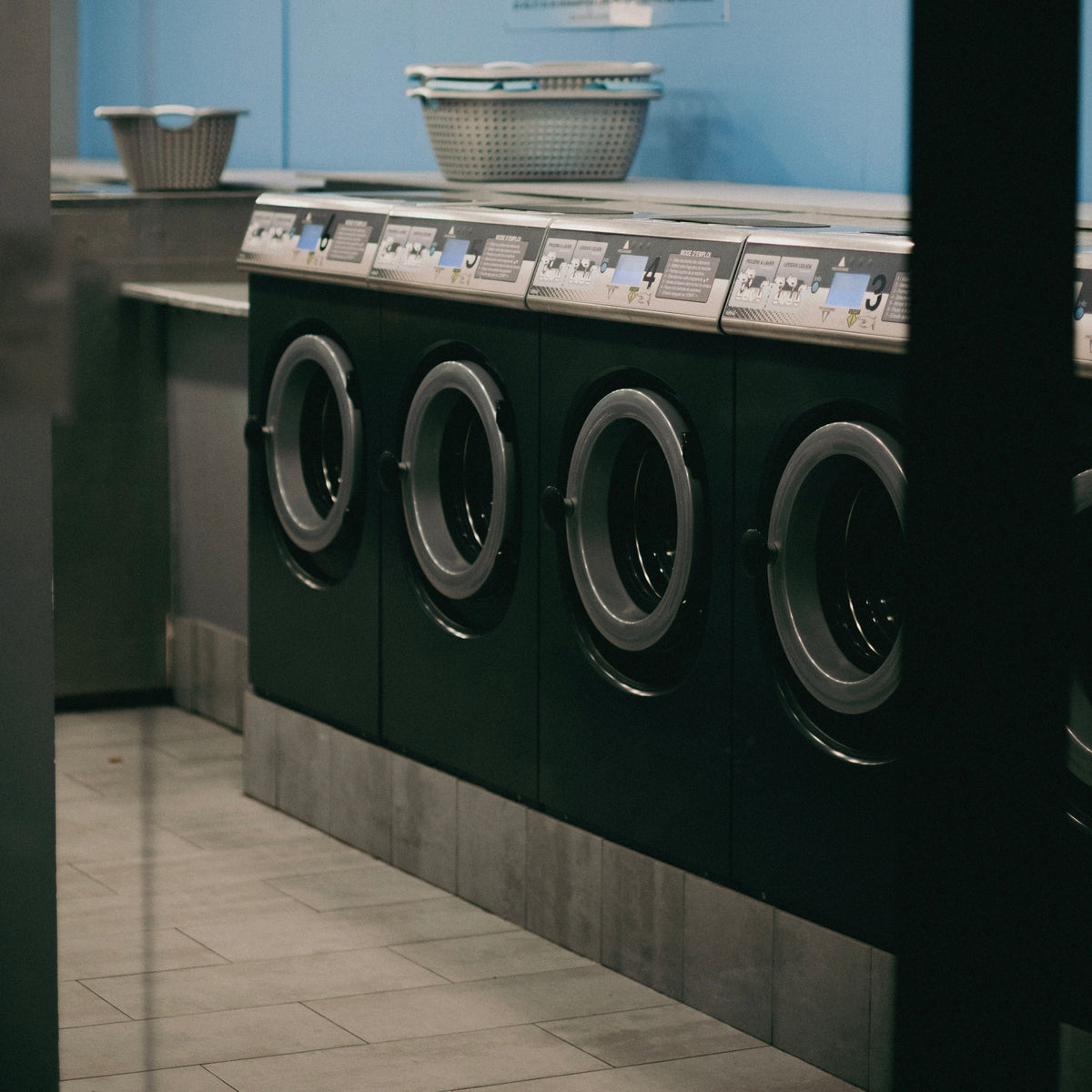
Pull the intake filter off a compressor that has been running ninety days in a commercial laundry and you will understand the whole problem in about four seconds. It is gray, it is felted solid, and it is made of the same lint that is coating every horizontal surface in the building.
That is the thing nobody tells you when you spec compressed air for commercial laundries. The air demand itself is not hard. Tunnel washers, presses and folders are well behaved loads that a competent rotary screw handles without drama. What is hard is that a laundry is one of the worst rooms in American industry to put a compressor in, and most of the failures we get calls about are environmental, not capacity.
So this guide runs in that order. Loads first, because you have to size something. Then the room, because that is what actually kills the machine.
The three things setting your air demand
Walk a plant that processes hotel or healthcare linen and the air goes to a short list.
Tunnel washer and washer extractor controls
Every transfer, every dam gate, every chemical injection valve, every drain valve and every door interlock on a modern washer runs on air. Individually these are small. What matters is that they are timed. A tunnel washer transfers on a cadence, and if the pressure sags at the wrong moment the transfer is late, the batch timing walks, and you get jams. This is why laundries want stable pressure more than they want big pressure.
Pull the machine data sheet for your actual washers rather than trusting a rule of thumb. Manufacturers publish the air consumption and the minimum inlet pressure, and those two numbers should be the backbone of your sizing.
The finishing line
Membrane presses, shirt and pant units, and the feeders, ironers and folders downstream. Presses are the heaviest air users in most plants because a press cycle is a large volume of air in a short window. A finishing line running full tilt is where the laundry finds out whether it bought enough storage.
Steam and utility valves
Actuated steam valves on the boiler header, on the ironer chests and on the tunnel heat exchangers. Small draw, but if they lose air the plant loses heat, and a laundry with no heat is a laundry that is not producing.
And one that is growing: ozone injection
Plenty of laundries have added ozone to cut hot water and chemical use. Air fed ozone generators need dry, oil free, particulate free feed air, and the flow is not trivial. Published system data puts a typical injection system in the neighborhood of 25 SCFM at 80 to 100 PSI. If you added ozone after the compressor was sized, go re-check your math. This is the single most common reason a laundry that was fine for eight years suddenly is not.
Why a laundry eats compressors
Here is the part that matters more than the sizing.
Lint. Airborne lint is fine, dry and everywhere. It blinds the compressor intake filter, it blankets the aftercooler and oil cooler fins, and it packs into the enclosure. A blinded intake filter raises the pressure drop across the inlet, which costs you capacity and raises discharge temperature. A blanketed cooler raises discharge temperature directly. Run both together long enough and you get high temperature shutdowns in July and varnished oil year round.
Heat. Between the boiler, the dryers and the ironers, laundry ambient temperatures of 90 to 100 degrees F are normal and higher is common in summer. Compressors are rated at much cooler inlet conditions. Hot inlet air is less dense, so you make less air per revolution, and every degree of inlet temperature shows up again at the discharge. We go through the heat load math and the three ways to fix it in compressor room cooling for commercial laundries.
Humidity. Washers, tunnels and open steam put a lot of water in the air. Condensate volume scales with inlet moisture, so a laundry compressor makes far more condensate than the same machine in a dry warehouse.
The fix is not a bigger compressor. The fix is:
- Duct the compressor intake from clean outside air. This one change solves more laundry compressor problems than everything else combined.
- Give the compressor room its own ventilation, with intake low and exhaust high, ducted out rather than dumped back into the plant.
- Put the machine in a dedicated room if you can. If you cannot, at minimum get it out of the lint plume from the dryers and the shakeout.
- Put the coolers on a cleaning schedule, not on a complaint schedule. Monthly with low pressure air in a plant like this, and follow the manufacturer's method so you do not bend fins.
- Size the condensate handling for the real volume and route it to an oil water separator, not the floor drain.
Sizing, and where the storage goes
Build the list from machine data sheets, then apply the two adjustments laundries always forget.
| Step | What to do | What people get wrong |
|---|---|---|
| 1. Sum the continuous loads | Washers, tunnel, steam valves, ozone if present | Leaving ozone off because it was added later |
| 2. Add the finishing line at real duty | Presses and folders at the cycle rate you actually run | Summing presses at 100 percent when they cycle |
| 3. Add leakage | 15 to 25 percent if you have never surveyed, your real number if you have | Assuming a newer plant does not leak |
| 4. Correct for inlet temperature | Use the hot summer ambient, not the spec sheet condition | Sizing on 68 degrees F in a 95 degree F room |
| 5. Size storage for the press peak | Receiver ahead of the dryer plus a local receiver at the finishing line | Buying horsepower to solve a storage problem |
Most single plant laundries land on one rotary screw air compressor in the 25 to 75 HP range, plus a backup. A piston machine is the wrong tool here. Laundry demand is steady across a full shift, and steady demand is exactly the duty cycle that grinds a reciprocating pump down.
On storage: if your pressure dips every time the press line gets busy, the answer is almost never another 25 HP. A properly placed receiver tank near the finishing line absorbs that spike for a fraction of the money and none of the energy bill.
Air quality, and what it has to be
For washers, presses and steam valves you need dry air and clean air, not exotic air. A refrigerated dryer holding a 38 to 45 degree F pressure dew point, a particulate filter and a coalescing filter is the standard build and it is enough. Water in the lines is what sticks a pneumatic valve, and a stuck valve on a tunnel is a production stoppage, not an inconvenience.
Ozone feed air is the exception. It wants oil free and very dry, and that is a separate branch with its own treatment, usually specified by the ozone vendor.
If you process healthcare textiles, you are likely accredited or pursuing accreditation through the Healthcare Laundry Accreditation Council. Be clear on what that does and does not mean here: HLAC does not publish a compressed air specification. What it does audit is your process control and your documentation. Air that sticks a valve and throws off a wash formula is a process control failure, and that is the honest connection between your compressor room and your accreditation, not some air purity clause.
Where laundries lose money without noticing
Running the whole plant at press pressure. If one press wants 110 PSI and everything else is happy at 90, you are paying to compress the entire plant to 110. A pressure regulator at the press and a lower system setpoint is free money. Every 2 PSI you drop is roughly 1 percent off the compressor's energy use.
Blowing off lint with open pipe. It is everywhere in this industry and it is the most expensive air in the building. Engineered nozzles cut the consumption and the noise, and open pipe over 30 PSI dead-ended is an OSHA problem under 1910.242(b).
Ignoring the intake filter schedule. In a normal plant you change it annually. In a laundry you may be changing it quarterly, and the filter costs less than one high temperature shutdown during a Monday morning hotel run.
Leaving the compressor loaded overnight. If the plant runs one shift and the compressor runs three, you are paying for leaks around the clock. A timer or a sequencer pays back fast.
Frequently Asked Questions
What size air compressor does a commercial laundry need?
Most single plant laundries land between 25 and 75 HP, but that is a range, not an answer. Build it from your machine data sheets: tunnel or washer extractor air consumption, finishing line at real cycle rate, steam valve actuators, ozone if you have it, plus 15 to 25 percent for leaks, then correct for your hot summer inlet temperature. If you are close to a size break, add storage before you add horsepower.
Is a commercial laundry the same as a dry cleaner for compressed air?
No, and the difference is scale and duty. A retail dry cleaner is a small intermittent load, mostly presses and puffers, and often runs fine on a good piston machine or a small oil free unit. An industrial laundry runs a full shift of continuous demand with a tunnel, a finishing line and steam actuation, which is rotary screw territory. We cover the smaller operation separately in our guide to compressed air for dry cleaners.
Why does my compressor keep shutting down on high temperature in the summer?
In a laundry, three things stacked: a lint blinded intake filter, lint packed cooler fins, and a room ambient in the nineties. Clean the coolers, change the intake filter, and then fix the root cause by ducting the intake from outside air and giving the compressor room real ventilation. If it still trips after that, you have a genuine cooling or thermal valve problem worth chasing.
Do I need an oil free compressor for a laundry?
For washers, presses and valve actuation, no. A lubricated rotary screw with proper coalescing filtration is the normal and correct build. Oil free becomes the right call if you are feeding an ozone generator, and even then most plants treat that as a separate branch rather than converting the whole plant.
Where should the compressor go in a laundry building?
In its own room if at all possible, away from the dryer and shakeout lint plume, with intake air ducted from outside and exhaust ducted out of the building rather than into the plant. If a dedicated room is not realistic, ducting the intake is the single highest value thing you can do. A compressor breathing clean outside air in a laundry will outlast one breathing plant air by years.
The short version
Size from data sheets, not rules of thumb. Buy a screw machine, not a piston. Put storage at the finishing line. Then spend your remaining attention on the room, because in this industry the compressor almost never dies of overwork. It dies of lint and heat.
If you are working out which dryer belongs on the system, our comparison of refrigerated versus desiccant air dryers covers the decision, air compressor room requirements goes deeper on ventilation and clearances, and compressor room cooling for commercial laundries has the heat load numbers for sizing a fan, a duct or a chiller.


