


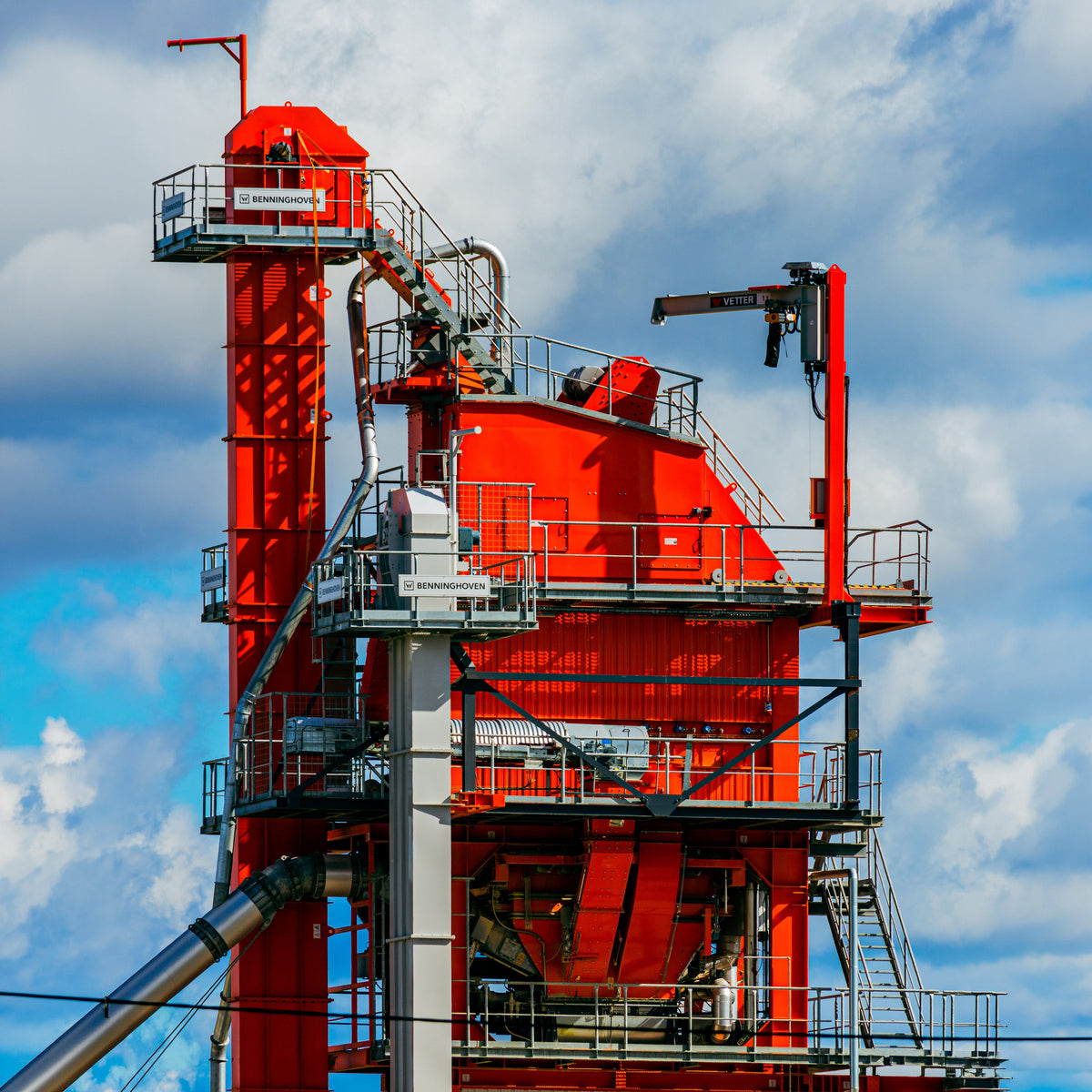
Nobody at an asphalt plant calls about the air compressor in July. They call in the second week of November, when the nights are dropping below freezing, the crew is chasing a paving deadline, and the baghouse differential is climbing because half the pulse solenoids on the roof are iced.
That is the seasonal rhythm of compressed air for asphalt plants, and it explains most of what makes this industry different. You have a big pulsed load, a burner that will not run right without stable pressure, equipment that sits outdoors in whatever weather the season brings, and a production window that makes any unplanned downtime unusually expensive.
Two loads carry the plant, and a dozen small ones ride along
Baghouse pulse jet cleaning
This is the largest and most demanding load at almost every hot mix plant. The dryer drum pulls an enormous volume of gas through the baghouse, and the bags stay usable only because compressed air fires back through them on a cycle to knock the filter cake loose. Blowpipes direct short bursts into each bag row, and the shock and momentary reverse flow expand the bag and shed the dust.
Size for this first, because everything else is rounding error. Get the diaphragm valve count, the free air volume per pulse and the cleaning cycle interval from the baghouse manufacturer, then:
SCFM = (number of valves x cubic feet per pulse) / (cycle time in seconds) x 60
Do that math for your actual collector rather than trusting the horsepower number on the plant spec sheet. Plants that run high RAP percentages or wet aggregate load the bags harder, which means more frequent cleaning, which means more air than the original design assumed.
Burner atomizing air
If you fire the dryer on recycled fuel oil or any of the heavier fuels, the burner uses compressed air to atomize it into the combustion chamber. Low pressure blower air is not always enough to fully atomize a heavy oil, which is exactly why compressed air atomization exists. Nobody thinks about this load until pressure sags and the burner starts making smoke, at which point you have a stack opacity problem and a permit conversation on your hands.
That is the important point about burner air: it is not a large CFM number, but it is the one where pressure stability matters most, and the consequence of losing it shows up on your air permit rather than in your production rate.
Everything else
- Batcher and weigh hopper gate cylinders, which cycle on every batch
- Silo discharge gates, and the inflatable bladder seals that keep the silo gate sealed against the opening
- Bin gates, RAP gates, and diverter chutes
- Pneumatic conveying and transfer of mineral filler and returned baghouse fines
- AC tank and line valve actuation
- Shop air for maintenance, truck tires and the loader
Individually small. Collectively they cycle constantly during production, and they are the loads that strand a truck under the silo when pressure drops.
The cold weather problem, which is the real subject
Almost every air consuming device at an asphalt plant is outdoors and unheated. The baghouse is on the roof. The silo gates are out in the yard. The header runs across the plant in open air. That single fact should drive your entire air treatment decision.
Saturated air at 90 PSI in a header at 20 degrees F makes ice. An iced pulse solenoid does not fire at all, and a bank of them not firing is how a baghouse blinds over in one shift. Worse, you find out from the differential gauge, which means you find out after the damage has started.
So for an asphalt plant the honest answer is: run a desiccant dryer and get the pressure dew point below the lowest ambient the plant will ever see. Minus 40 degrees F is the standard spec and it is cheap compared to a set of bags. A refrigerated dryer holding 38 degrees F is fine for a heated control house and completely inadequate for a header on the roof in January.
Two more cold weather items that matter more here than almost anywhere:
- Drains. Every condensate drain on the property is outdoors. A frozen drain is invisible until the water it should have removed shows up somewhere expensive. Heat trace them, insulate them, and put them on the winterization checklist.
- Drip legs and low points. A long outdoor header collects water at every sag. Take drops off the top of the line and put a drip leg with a drain at every low point, not just at the end.
Sizing, and the seasonal question nobody asks
| Plant | Typical air load | Practical machine | Note |
|---|---|---|---|
| Small portable drum plant | 50 to 100 SCFM | 25 to 40 HP rotary screw | Often skid mounted with the plant |
| Mid-size stationary drum plant | 100 to 200 SCFM | 40 to 60 HP rotary screw | Baghouse dominates the number |
| Large plant, high RAP, big baghouse | 200 SCFM and up | 75 HP and up, often two machines | Consider N+1, downtime is costly in season |
These are starting points from what we ship, not a substitute for the valve math. Do the valve math.
Now the seasonal question. An asphalt plant in most of the country runs hard for six to eight months and sits for the rest. A fixed speed rotary screw compressor that spends the off season running unloaded burns 25 to 35 percent of full load power to produce nothing at all. If you keep the plant energized through winter for maintenance and loadout, either shut the compressor down properly between uses or look hard at a variable speed machine. The payback on this is better at a seasonal plant than at a plant that runs flat out year round, which is the opposite of what most people assume.
On storage: pulse cleaning is the most peaked load in industry, because every valve wants its full slug of air in a fraction of a second. Put a wet receiver tank at the compressor ahead of the dryer, and a dry receiver out near the baghouse sized so one full cleaning cycle does not drop local pressure more than about 10 PSI. That local receiver does more for pulse quality than another 25 HP ever will.
Mistakes we see at hot mix plants
Blaming the bags. When differential climbs, the bags get replaced. Often the bags were fine and the pulse was weak because the header was at 65 PSI, or wet, or a diaphragm had failed. Check the air before you buy bags.
One failed diaphragm valve eating the whole compressor. A stuck three quarter inch diaphragm can pass 200 to 250 CFM continuously, and a larger one far more. If your machine went from cycling normally to never unloading, walk the collector with the cleaning cycle off and listen for the one that will not stop hissing before you price a bigger compressor.
Feeding the burner and the baghouse off the same undersized drop. The baghouse pulses, the header dips, the burner atomization goes soft, the stack darkens. Give dust collection its own line off the receiver.
Putting the compressor where the dust is. Aggregate dust and drum exhaust into an intake filter shortens element life to weeks and cooks the machine. Duct intake air from the cleanest side of the plant and change intake elements on a schedule.
Sizing off last season. Add a silo, add a RAP system, raise your RAP percentage, and you have added air demand. Every change to the plant is a claim on the same compressor.
Frequently Asked Questions
How big an air compressor does an asphalt plant need?
Size it off the baghouse. Count the diaphragm valves, multiply by the free air per pulse, divide by the cleaning cycle time in seconds and multiply by 60 to get SCFM. Most mid-size drum plants land between 100 and 200 SCFM, which is a 40 to 60 HP rotary screw, but a large plant running high RAP with a big collector can easily exceed that. Add burner atomizing air, gates and shop use on top.
Do I need a desiccant dryer at an asphalt plant?
In any climate that freezes, yes. Your pulse solenoids, header and drains are all outdoors, and saturated air in a cold line makes ice that stops valves from firing. Get the pressure dew point below your lowest ambient, which usually means a desiccant dryer specified around minus 40 degrees F. A refrigerated dryer is only adequate if everything it feeds stays inside a heated building.
Why does my baghouse differential keep climbing even after new bags?
Usually the pulse, not the bags. Check header pressure at the collector during a cleaning cycle rather than at the compressor gauge, look for wet air or ice at the solenoids, and hunt for a failed diaphragm valve that is bleeding continuously. A weak or wet pulse cannot shed the cake no matter how new the bags are.
Should a seasonal plant run a variable speed compressor?
It is worth pricing. A fixed speed screw left running unloaded still draws roughly 25 to 35 percent of full load power while producing nothing, and a plant that idles for months accumulates a lot of that. The simpler answer, if your operation allows it, is to shut the compressor down properly when the plant is not producing and keep a small unit for maintenance air.
Is an asphalt plant the same as a ready-mix plant for compressed air?
They overlap on gates, silo aeration and bin vents, but the differences matter. An asphalt plant adds burner atomizing air and a much larger baghouse pulse load, and it runs hot and seasonally. A concrete plant runs colder, wetter and more year round. We cover the concrete side separately in our guide to compressed air for ready-mix and concrete plants.
Where to start
Get the valve count and pulse volume for your baghouse, add the burner and the gates, and compare that total against what your compressor actually delivers at operating pressure. Then look at your dryer and ask one question: what is the coldest temperature any part of my air system sees, and is my pressure dew point below it? Those two checks catch most of what goes wrong at a hot mix plant, and both of them are cheaper than a set of bags in November.


