


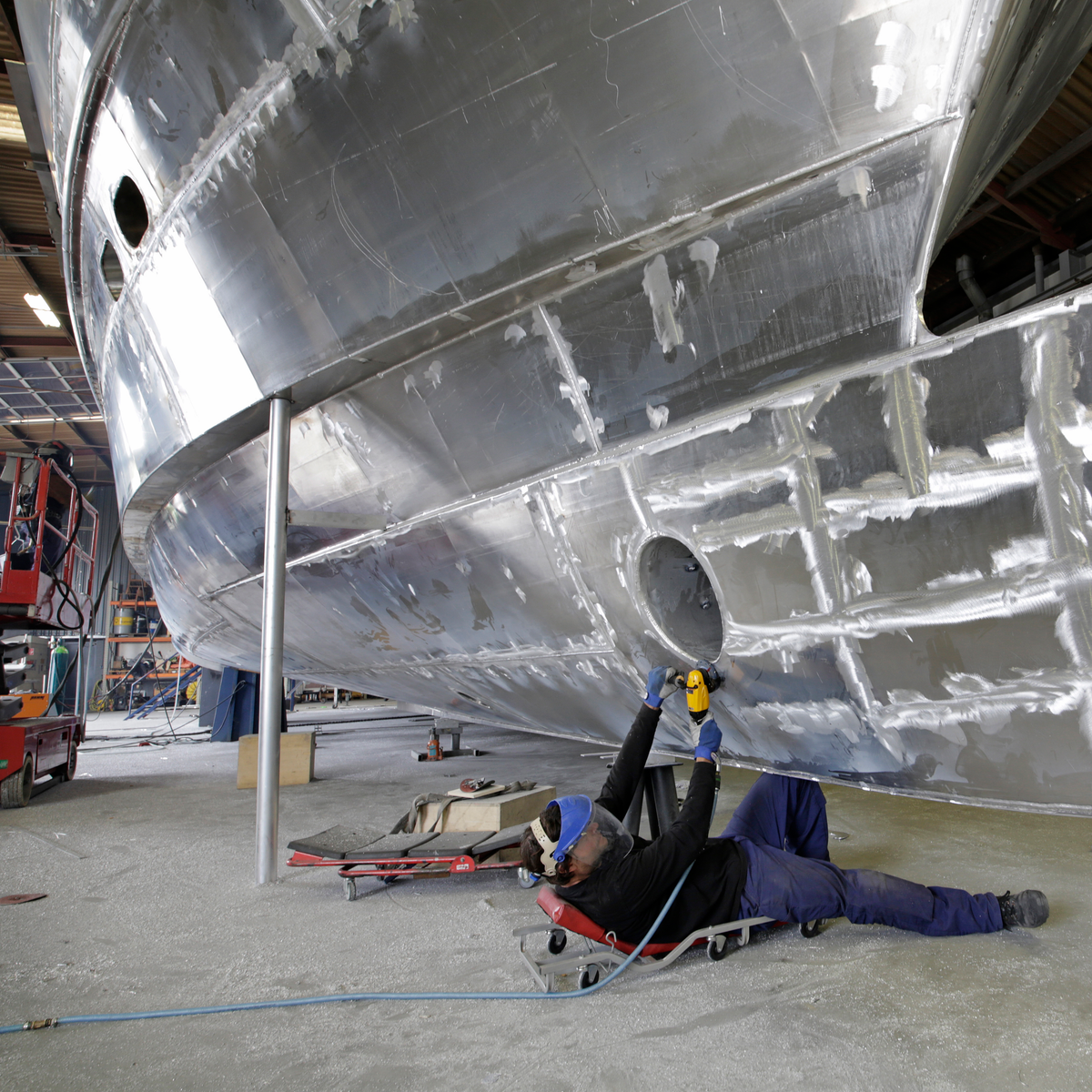
Spring haul-out season and you have six boats on stands, four guys with DA sanders working bottoms, one crew fairing a hull, and somebody in the shed shooting Awlgrip. By ten in the morning the compressor has not unloaded once and the guy farthest from the shop is complaining his sander has gone soft.
Every yard we talk to has some version of that morning. Compressed air for boatyards is a volume problem first, an air quality problem second, and a corrosion problem that never stops. Most yards undersize on the first one because nobody counts what a sander actually eats.
Sanders are the whole sizing problem
Here is the number that surprises people. A 6 inch dual action sander pulls roughly 11 to 17 CFM at 90 psi, and unlike an impact wrench it runs continuously. A guy sanding a bottom is not pulsing the trigger, he is holding it down for four hours.
| Tool | CFM at 90 psi | Duty |
|---|---|---|
| 6 inch DA sander | 11 to 17 | Near continuous |
| Inline or board sander | 12 to 20 | Near continuous on fairing work |
| HVLP gravity gun | 10 to 14 | Continuous during a coat |
| Gelcoat or chopper gun | 10 to 20 | Continuous, varies by tip |
| Die grinder | 4 to 8 | Intermittent |
| Blow gun | 3 to 8 | Short bursts, constantly |
| Supplied-air hood, per painter | 6 to 15 | Continuous while in the booth |
Four sanders running at once is 50 to 70 CFM on its own. Add a painter and a couple of blow guns and you are at 90 to 100 before anything else happens. That is a 25 to 30 HP machine minimum, and plenty of yards are trying to do it with a 7.5 HP piston in the corner of the shop.
Count your actual peak crew, not your average. A yard is seasonal, and the system has to survive April, not November. Our air tool CFM chart covers the rest of what is on your bench.
Getting air to boats that move
Yards have a distribution problem nobody else has: the work is outside, spread across a yard, and it moves every week. A hull on stands in the back corner needs the same pressure as the shop.
- Run a real header, not hose. Two hundred feet of half inch hose daisy chained across the yard will kill 25 psi before the tool sees it. Run a properly sized hard line out to drop points and use hose only for the last run.
- Loop it if you can. A loop feeds the far end from two directions and halves the effective run length. In a yard with a shop, a shed and outside stands, this is worth doing.
- Put drops where the boats actually go. Cheap to plan, expensive to retrofit.
- Drain legs at every low point. Outdoor header in a marine climate collects water fast.
- Size hose up. A lot of yards run 3/8 inch hose to a sander that wants 1/2 inch. That alone is often the difference between a sander that cuts and one that bogs.
Look through our air piping and hose ranges when you lay it out, and see compressed air pipe sizing for the math on run length versus diameter.
For the boats that sit well beyond any practical drop, or for dock and mooring work, a machine that travels is the answer instead. We go through sizing, gas versus electric and what salt air does to them in portable air compressors for boatyards.
Air quality: gelcoat and paint do not forgive
Fisheyes in a topcoat on a 45 foot hull is not a buff-out, it is a redo, and the customer is standing right there. Two contaminants cause it and both come out of the air line.
Water. A boatyard is by definition a humid place. Air compressed on an August morning on the water carries an enormous amount of moisture, and a water trap at the gun catches almost none of it because the water has not condensed yet at that point. You need actual drying. A refrigerated dryer at roughly a 38 to 40 degree F pressure dew point covers indoor work. If your header runs outside across the yard, which it does, and you paint in the shoulder seasons, you want desiccant. Our refrigerated versus desiccant comparison lays out where the line falls, and dew point explained covers why the ambient temperature of the pipe matters more than the temperature at the dryer.
Oil. Carryover from a lubricated compressor, or from a tired separator, puts an invisible film in the line that shows up as a crater in the finish. A coalescing filter followed by a carbon filter on the paint leg is the standard answer. See coalescing filters and our guide to ISO 8573-1 classes if you want to spec it properly rather than guess.
Treat the paint and gelcoat leg to a higher standard than the rest of the yard. It is far cheaper than treating everything.
Breathing air in the shed
Two-part polyurethanes contain isocyanates. Anybody spraying them needs supplied-air respiratory protection, and the moment you feed a hood from your compressor you are on the hook for Grade D breathing air under OSHA, which includes limits on oil mist and carbon monoxide and requires monitoring, not just filtration. Our writeup on Grade D breathing air requirements covers what the panel needs and what has to be documented.
The practical setup in most yards: one dedicated branch off the cleanest point in the system, its own filtration panel and CO monitor, and nothing else on that branch.
Salt air eats everything
This is the part that is specific to marine work and it is why yard compressors have shorter lives than shop compressors of the same age.
- Do not put the compressor intake where it pulls salt spray. Duct it from a sheltered side of the building, inland-facing if you have a choice.
- Coated or stainless cooler cores are worth the money. Standard aluminum fin stock in a salt environment corrodes and loses cooling capacity, which is how a yard compressor starts running hot in its fourth summer.
- Black iron pipe outdoors in a yard is a mistake. Between salt and internal condensate it rusts from both sides. Aluminum or stainless pays for itself. Our comparison of pipe materials covers the options.
- Check the drains constantly. A seized drain in a marine climate fills a tank fast. Our note on tank rust explains what to look for before it becomes a safety issue.
- Winterize if you shut down. A yard that goes quiet in January still has water sitting in the low points. See how to winterize an air compressor.
What to buy
For a yard running more than two sanders at once, a rotary screw is the right machine. Sanding load is continuous duty, and a piston machine will spend the whole spring running at 95 percent duty and cooking itself.
Practical guidance:
- Count your peak simultaneous tools in April, add 25 percent, and buy that.
- Put in real storage. A big receiver keeps pressure stable when everybody triggers at once.
- Consider variable speed if your season swings hard, because a fixed speed machine idling through the winter still burns real power.
- Two smaller machines beats one big one in a seasonal business. Run one in the off season.
- Treat the paint branch separately and properly.
- Add a portable for the far corner rather than oversizing the shop machine to feed a hose run that will never work anyway.
If you are sizing from scratch, browse air compressors or send us your tool list and crew count and we will work it out with you.
Frequently Asked Questions
What size air compressor does a boatyard need?
Count simultaneous sanders first, because they dominate everything else. Four DA sanders is 50 to 70 CFM by itself, which is a 25 to 30 HP rotary screw once you add spray work and blow guns. A small yard running two sanders and occasional spray can live on 10 to 15 HP. Size for your busiest week in spring, not your annual average.
Why do my sanders bog down at the far end of the yard?
Usually hose and distribution, not the compressor. Long runs of 3/8 inch hose daisy chained across a yard drop far more pressure than people expect. Run hard pipe to drop points near where boats sit, use 1/2 inch hose for the last run, and keep that run short.
Do I need a desiccant dryer for gelcoat and topcoat work?
If your header runs outdoors, which it does at almost every yard, and you spray in cool weather, yes. A refrigerated dryer holds roughly a 38 to 40 degree pressure dew point, and any pipe colder than that will make liquid water again. Indoors and heated, refrigerated is enough.
What do I need for spraying two-part polyurethane?
Supplied-air respiratory protection because of the isocyanates, fed by Grade D breathing air. That means a dedicated filtration panel, carbon monoxide monitoring and records. Build it as its own branch rather than trying to certify the whole yard system.
How do I keep salt air from destroying the compressor?
Duct the intake to the most sheltered air you can reach, specify corrosion resistant cooler cores if the machine will live near the water, use aluminum or stainless for outdoor piping instead of black iron, and stay on top of the drains. Those four cover most of the difference between a yard compressor that lasts five years and one that lasts fifteen.
Size for the sanders, pipe the yard properly, treat the paint branch to a higher standard, and plan for salt. Do that and compressed air for boatyards stops being the reason haul-out season runs behind.


