


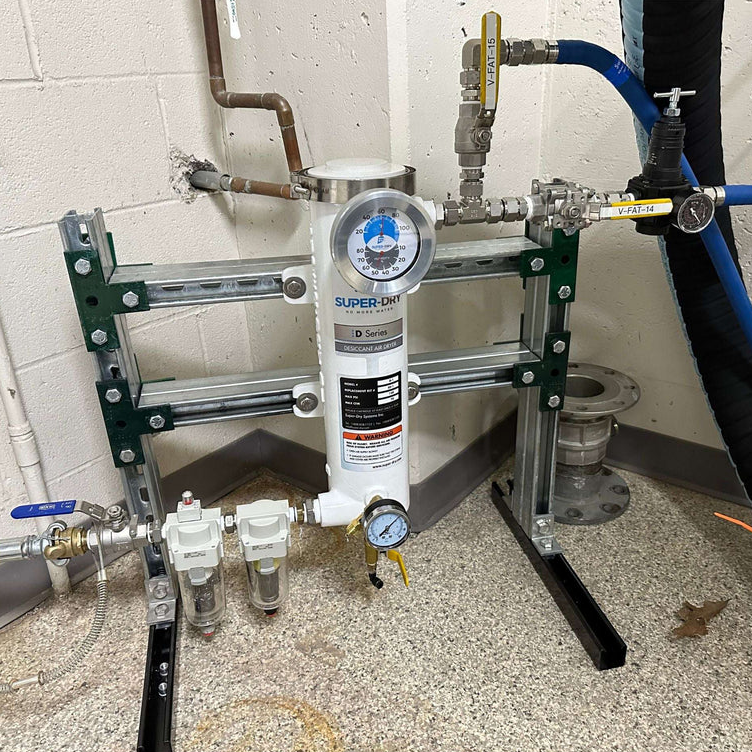
Somebody always asks us the same question: "Can I just stick one of those little blue canisters on my hose and be done with the water problem?" Sometimes the answer is yes. More often it is "for that one job, yes, for your whole shop, no." An inline desiccant air dryer is a handy, cheap tool, and it gets blamed every week for jobs it was never built to do. Here is how to tell the difference.
What an Inline Desiccant Dryer Is
It is a small canister, usually clear plastic or a metal body with a sight window, filled with desiccant beads. Air goes in one end and out the other. The beads soak up water vapor as the air passes through. Most use indicating beads that change color as they load up, commonly blue when dry and pink when spent.
Specs vary, but a typical 1/4 inch unit is rated around 10 SCFM at 125 psi with a top temperature around 130 degrees F, and many are disposable. That is a tiny flow. A single air sander or a spray gun can use most of it, and a 1 inch impact wrench uses more than the dryer is even rated for.
What It Does Well
An inline dryer is a point of use device. It belongs at the very end of the line, right before the one thing you are trying to protect.
- HVLP or touch-up spray guns. A single gun at the end of a hose, fed by a small compressor, is the classic fit. It keeps vapor out of the last few feet of air.
- Airbrushes and small paint jobs. Low flow, high sensitivity to moisture.
- Plasma cutters on a small compressor. Wet air hurts consumables, and plasma uses modest flow.
- Blow-off and cleaning on delicate parts. Short duty, low CFM.
- Remote or portable work. No power, no plumbing, nothing to wire.
If you spray, read our piece on airbrush compressors and the shop guide to filtering oil out of the finish.
What It Does Not Do
This is where people get burned.
- It does not remove liquid water. Desiccant is built for vapor. Slugs of liquid water, which a small compressor and a hot hose will happily deliver, soak the beads in minutes. Put a coalescing filter or a water separator ahead of it.
- It does not remove oil. Oil coats desiccant and kills it. If your compressor carries over oil, the canister will be dead long before the color says so. Our coalescing filter guide covers how to fix that.
- It cannot keep up with a shop. At 10 SCFM it is not a shop dryer. If you size a dryer for a whole shop, you want a real air dryer rated for your compressor's full flow.
- It is not a fix for a hot compressor. Hot air carries more water. Cool it first with an aftercooler or a long run of pipe.
Inline Dryer vs Real Dryer
| Inline desiccant canister | Refrigerated dryer | Desiccant dryer (regenerative) | |
|---|---|---|---|
| Flow | A few SCFM to roughly 20 | Sized to the compressor | Sized to the compressor |
| Dew point | Low when fresh, drifts as it loads | About 35 to 40 degrees F | Minus 40 degrees F typical |
| Power | None | Electric | Electric, plus purge air on heatless models |
| Maintenance | Replace beads or the whole unit | Clean condenser, drain | Change desiccant on a schedule |
| Best for | One tool or one gun | General shop air | Cold lines, instruments, tight dew point |
Our dew point primer explains why the number matters more than the type.
How to Use One Properly
- Put the dryer last. After the receiver, the filter regulator and the hose, as close to the tool as you can.
- Put a water separator ahead of it. A filter regulator or inline separator takes out liquid before it reaches the beads.
- Mind the flow rating. Pick a unit rated above your tool's CFM at the working pressure, not at the top of the label.
- Keep it upright and sealed. Cap or plug the ends when it is not in use so the beads do not pull moisture from the room.
- Watch the color. When the indicator changes, replace the beads or the unit. Do not wait for water to show up in the paint.
Mistakes We See
- Using one as the only dryer on a shop system. It is a bandage, not a plan.
- Running it hot. Most are rated to about 130 degrees F. A black hose lying in the sun is hotter than that.
- Putting it before the filter. Oil and water hit the beads first and ruin them.
- Trying to dry the whole line with several. Three canisters on three hoses is still a leaking system. Dry the air at the source.
When to Step Up
If you find yourself replacing canisters every week, or you have more than one or two places that need dry air, you are past the inline dryer. A small refrigerated dryer on the main line is the first step for most shops, and a desiccant dryer is the answer when lines run cold or instruments need a very low dew point. Our ISO 8573-1 explainer helps if you need to pick a target class.
Shop Air Dryers
Browse our full range of air dryers, or look at desiccant air dryers if you need a lower dew point than a refrigerated unit gives. If you are unsure whether a canister or a full dryer is right, call us with your compressor and your tools and we will tell you straight.
Frequently Asked Questions
Does an inline desiccant dryer remove oil?
No. Oil coats the beads and ruins them. Use a coalescing filter ahead of the dryer to take out oil and liquid water first.
How long does an inline desiccant dryer last?
It depends on how wet the air is and how much flow passes through. The color indicator tells you when it is spent. With a good filter ahead of it, a canister lasts far longer than with raw compressor air.
Can I recharge the desiccant beads?
Some canisters are refillable and some are disposable. Check the unit. Many beads can be dried in an oven according to the maker's instructions, but follow the manufacturer's guidance.
Where do I install an inline air dryer?
As close to the tool as possible, after the filter regulator. It protects the last section of line, not the whole system.
Is an inline dryer enough for a paint gun?
For a single gun on a small compressor, with a separator ahead of it, often yes. For a production paint booth, you want a real dryer on the compressor.


