


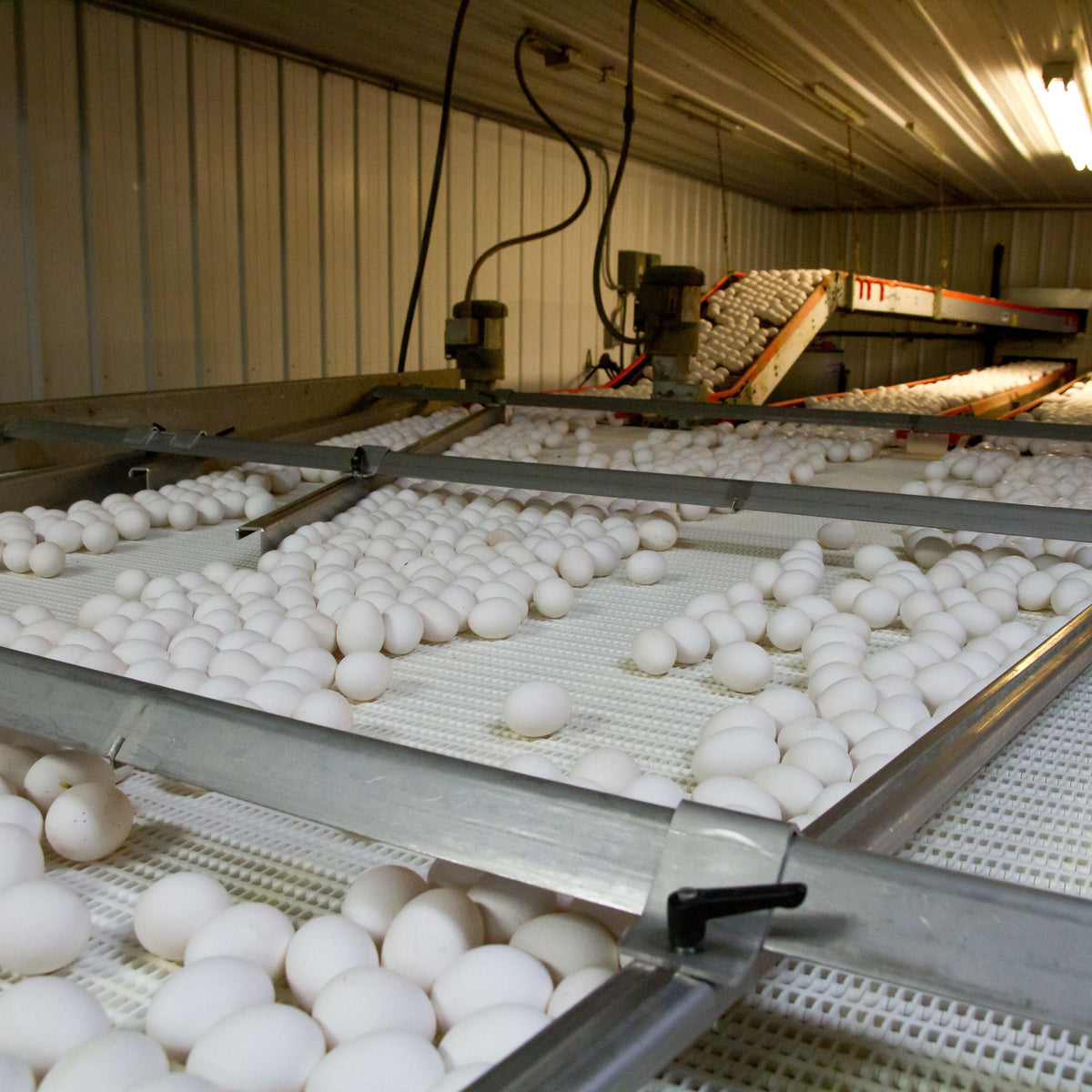
An egg plant has a funny relationship with compressed air. Nobody wants it touching the egg, and yet air is blowing across the shell, driving the packer, and running the pumps on the liquid side every minute of every shift. If you manage a shell egg grading and packing house, or an egg breaking plant, the compressor is the one utility you have probably never read a spec sheet for.
This guide is about compressed air for egg processing plants: where the air actually goes, what has to be clean and what doesn't, and how to size a system without guessing. I'll be straight about one thing up front. We don't sell grading machines, washers or packers. We sell the air behind them: compressors, dryers, filters, receivers and pipe. Everything below is about that side.
Follow the egg, find the air
Walk the line from the dock and you can mark where compressed air shows up.
- Washer and sanitizer. The machine itself is mostly water and brushes, but air operates the valves, the spray controls and the dryer section that follows. Drying after the wash is usually done with blowers, not compressed air, and that matters, see below.
- Candling and grading. Large graders move a serious number of eggs. Moba lists high-capacity models at 216,000 to 255,000 eggs an hour. The pneumatic parts are the diverts, the gates and any lifting or transfer heads. Ask the manufacturer for the air consumption, because I'm not going to guess one for your machine.
- Packing. Case packers and carton fillers run cylinders, grippers and often vacuum cups. A vacuum cup fed by a venturi generator burns compressed air constantly while it holds, which is a hidden cost that a vacuum pump avoids. We wrote a comparison on venturi vacuum generators vs electric vacuum pumps if you want the math.
- Breaking and liquid egg. At a breaking plant, air operated diaphragm pumps and pneumatic valves move liquid egg and run pasteurizing and filling equipment. This is the air that comes closest to product.
- Utility. A maintenance shop, wash-down hoses with air attachments, a pallet wrapper, and the tools your crew uses to keep the line running.
What has to be clean and what doesn't
This is the part people get wrong in both directions. Not every air point needs a food contact specification, and paying for it everywhere wastes money. But a few do.
Sort every point into one of three buckets. Direct contact: air that blows on an egg, on a packaging surface the egg touches, or into liquid egg. Indirect contact: air that runs a cylinder or valve in the food zone, where an exhaust or a failed seal could put oil or water near product. No contact: a tool in the maintenance room, a door actuator in the dock.
Your auditor, whether the scheme is SQF, BRCGS, FSSC 22000 or a customer's own, will want to see that you've done that exercise and that the air quality at each point matches the risk. Shell eggs are not ready-to-eat, which gives you a bit more flexibility than a plant making cooked product, but liquid egg is a different story and usually has the tighter expectations. For the actual ISO 8573-1 targets, see our guide to food grade compressed air, and confirm them against your own audit scheme and your USDA or state inspector.
The practical consequence is a split system. Treat all the air to a good general standard at the compressor room: a coalescing filter, a dryer, and a particulate filter. Then add point of use filtration and, where the risk assessment calls for it, extra polishing at the direct contact points. Oil-free compressors are the lowest-risk answer where air touches product, and oil-injected machines with proper filtration are common on the indirect side. Our coalescing air filters cover the first stage.
The drying question
Washed eggs come out wet and need to be dry before they are packed. Plants often reach for compressed air knives because they're easy to install. That's an expensive way to do it. Compressed air is the most expensive utility in the building, and a low pressure blower moves the same water for a fraction of the energy. If you have drilled pipe or loose blow guns drying eggs, put a blower on your capital list.
For the air you do keep, moisture control matters more here than in a dry shop. Wash-down means wet floors, humidity in the room, and cold storage nearby. A refrigerated dryer gives a pressure dew point around 38°F and is the right choice for most of the plant, as long as no air line runs through a space colder than that. Where it does, such as a line passing through or into a cooler, you either move the pipe, insulate and trace it, or step up to a desiccant dryer. Our refrigerated air dryers and desiccant air dryers are both stocked.
Where the compressor goes, and what it breathes
Intake air quality gets less attention than it should at egg plants, because the plant often sits right beside the houses or on a farm. Dust, feathers, ammonia and humid exhaust from fans can all be sucked into a compressor intake if you put it in the wrong place. Pull intake air from the cleanest side of the building, away from house exhaust and the manure and loading areas, and keep it out of wash-down spray. Give the room enough ventilation to carry off the heat; a compressor puts nearly all of its input power into the room as heat.
Sizing, without making up numbers
Here's how I would size an egg plant, and it's the same process we walk customers through.
- Get the pneumatic consumption from the data plate or manual of every machine: washer, grader, packer, case handling, breaking equipment.
- Mark which ones run together at peak. A grader and packer almost always do.
- Add the utility load, the shop and any air blow-offs you plan to keep.
- Add 15 to 20 percent for leaks and growth.
- Pick the operating pressure from the highest-pressure machine, then add friction loss across the filters and dryer, usually 5 to 10 PSI in total.
A rotary screw with a variable speed drive is a good fit for a plant whose demand moves with the number of lines running, and a second compressor gives you backup so a failure doesn't stop packing mid-shift. Eggs on a line have a clock on them. Add a receiver to give the packer something to draw on during peaks; our air compressor tanks range from small vertical tanks to big units for the compressor room.
Mistakes egg plants make with air
- Using compressed air to dry eggs when a blower would do the job for much less.
- Treating all air as food contact and over-spending, or treating none of it that way and failing the audit.
- Leaving the compressor intake near house exhaust fans.
- Running a line through the cooler without checking its dew point.
- Skipping a compressed air leak survey. A plant with hundreds of fittings and hoses on wash-down lines leaks.
Frequently Asked Questions
Does compressed air in an egg plant need to be food grade?
Only where it touches eggs, packaging surfaces they touch, or liquid egg. Air in the maintenance room doesn't. Do a contact risk assessment and match the filtration to each point, then confirm targets against your audit scheme.
Should I dry washed eggs with compressed air?
You can, but it's the costly option. A blower dries with far less energy. Keep compressed air for the places that need it.
Refrigerated or desiccant dryer for an egg plant?
Refrigerated works for most indoor lines, with a dew point near 38°F. If any line crosses a space colder than that, such as a cooler wall, use a desiccant dryer or reroute the pipe.
Do I need an oil-free compressor?
It's the lowest-risk choice where air touches product, especially liquid egg. Many plants use oil-free machines for those points and oil-injected machines with coalescing filtration elsewhere. Your risk assessment decides.


