


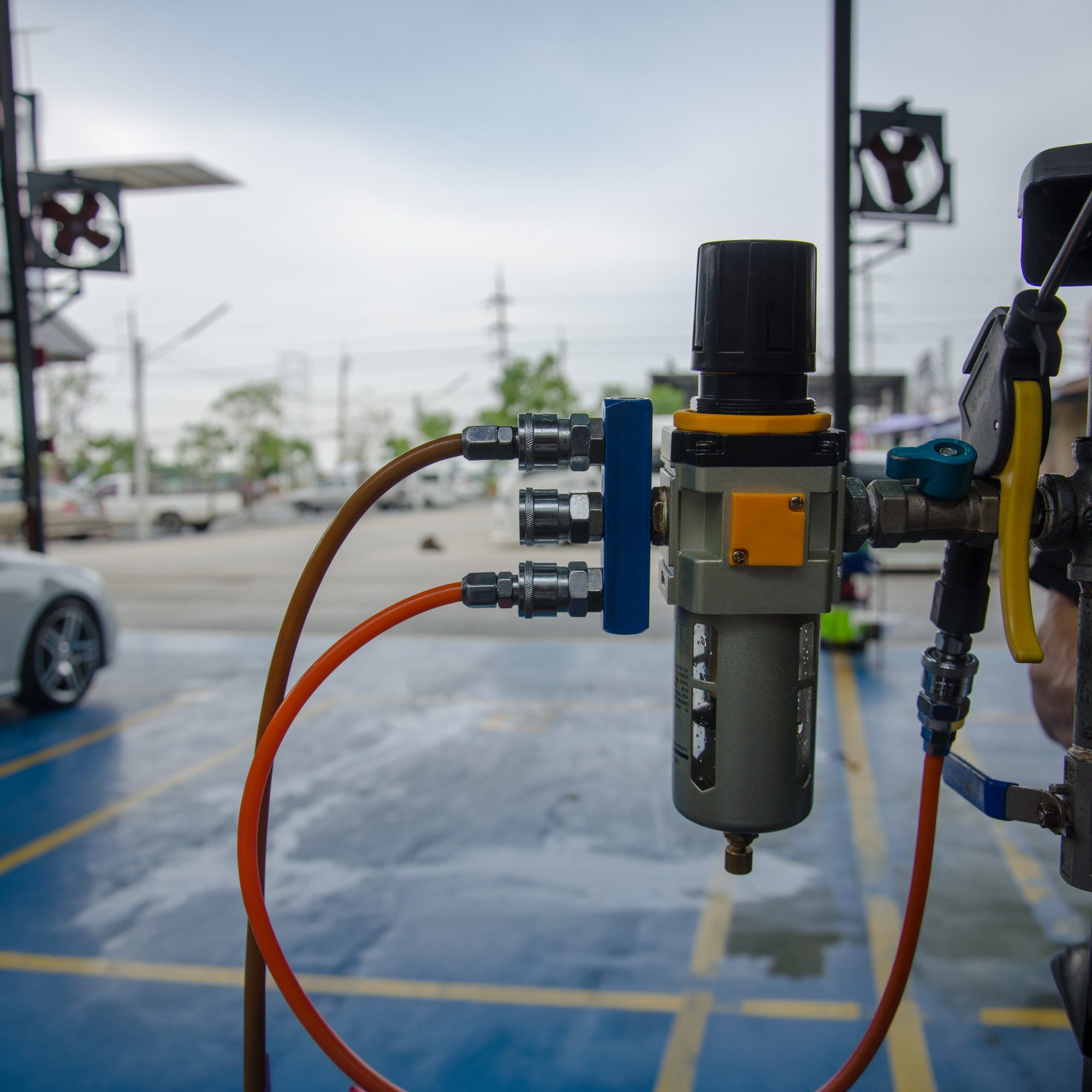
The first cold snap of the year is when car wash operators call us. Not because the compressor died. Because the tunnel stopped mid-cycle, the entry gate froze half open, and a rinse arch that worked fine all summer is now sitting there doing nothing while cars back up onto the road.
Nine times out of ten that is not a compressor problem. It is a water problem, and it was building all year. Which is the thing to understand about an air compressor for a car wash: the machine itself is usually the easy part. What separates a wash that runs and a wash that limps is everything downstream of the compressor.
What compressed air actually does in a wash
Walk a tunnel and count the air. Most operators are surprised how long the list gets.
- Entry and exit gate cylinders, and roll-up door actuators
- Rinse arch and applicator arch actuators
- Chemical and soap injection, and the metering solenoids that dose it
- Wheel and tire applicator arms
- Mitter and wrap positioning cylinders
- Blow-off nozzles for mirrors, grilles, and door jambs at the exit
- Vacuum island tire inflators and blow guns
- Detail bay air tools, and pneumatic pumps on the chemical room drums
Notice the pattern. Almost every item on that list is a solenoid feeding a small cylinder, cycling constantly, all day. A single pneumatic door takes well under 1 SCFM. Individually these are tiny loads. Collectively, on a busy Saturday at 120 cars an hour, they are cycling thousands of times a shift.
That duty pattern is what makes a car wash different from a machine shop. A shop has a few big intermittent draws. A wash has dozens of small constant ones, and the whole tunnel stops if any one of them misses.
Water is the enemy, not pressure
Here is the mechanism, because it explains most car wash air failures.
Your compressor pulls in humid ambient air. In a car wash mechanical room the ambient air is very humid, because you are standing next to a building where thousands of gallons of warm water get sprayed every day. Compress that air and the moisture condenses out. If nothing removes it, liquid water travels down the line to your solenoid valves and cylinders.
In summer that water washes lubricant out of the cylinders, rusts valve bodies from the inside, and shows up as sluggish arches and gates that need a nudge. In winter it freezes in the small orifices of a solenoid and the tunnel stops. Same root cause, two seasons, two symptoms.
So a car wash air system needs real drying, not a drip leg and good intentions. A refrigerated air dryer is the right baseline for most washes. It pulls the pressure dew point down to roughly 35 to 40 F, which is dry enough to stop water spotting and sluggish cylinders. If any part of your air line runs through an unheated space, an equipment room that drops below freezing, or an outdoor conduit run to a vacuum island, a refrigerated dryer alone will not save you. Air at a 38 F dew point put into a 20 F pipe will condense and then freeze. That situation calls for a desiccant dryer on that leg, or heat trace on the pipe, or both.
Sizing that dryer is its own subject, because a wash equipment room is hot and the inlet air is wet, and a dryer bought off its nameplate CFM will come up short. We wrote a separate guide to picking a refrigerated air dryer for a car wash that walks through the correction factors, placement, and drains.
Ahead of the dryer you want a water separator and a general purpose filter. Behind it, a coalescing filter before anything sensitive. Our walkthrough of compressed air dew point covers why the dew point number is the one to specify, and the air filters collection covers the elements.
Sizing the compressor
Do not size a car wash compressor off a chart. Do it off your own equipment list, because tunnel configurations vary enormously.
| Step | What to do |
|---|---|
| 1 | List every air-actuated device in the tunnel, the equipment room, the vacuum islands, and the detail bay. |
| 2 | Get the SCFM per actuation and the cycles per car from the equipment manuals. Multiply by your peak cars per hour. |
| 3 | Add continuous loads at full value. Blow-off nozzles and pneumatic chemical pumps run steadily, not in bursts, and they usually dominate the total. |
| 4 | Add the detail bay and vacuum island tools at realistic simultaneous use, not worst case. |
| 5 | Add 30 percent. You will add equipment, and leaks grow over time whether you plan for them or not. |
A few rules of thumb that hold up. Blow-off is almost always the biggest single consumer, and if you are running open copper tube or plain nozzles at the exit you are burning far more air than you need to. Swapping to engineered nozzles is the cheapest capacity you will ever buy. And pneumatic diaphragm pumps in the chemical room can quietly eat a large share of your compressor, so put them on the list before you conclude you need a bigger machine.
Rotary screw or piston?
For an express tunnel or any wash running most of the day, a rotary screw compressor is the answer. The duty cycle in a car wash is close to continuous, and that is exactly where a screw machine belongs. Screws are built for 100 percent duty, they run cooler, they are quieter, and they hold discharge pressure steady instead of swinging between cut-in and cut-out.
A two-stage piston unit can serve a small self-serve or a low-volume in-bay automatic where the air demand is genuinely intermittent. Just be honest about the duty cycle. A piston compressor asked to run 70 percent of an open shift is a compressor on a short clock.
Whichever you pick, put a properly sized receiver tank downstream. Storage is what absorbs the spiky cycling load of a tunnel full of solenoids, and it lets a screw machine unload instead of hunting. It also gives condensate somewhere to drop out before it reaches the dryer.
The pipe run people regret
Car wash environments are wet, chemical-heavy, and often partly outdoors. Black iron looks like the cheap answer and then rusts from the inside within a few years, and the rust scale it sheds goes straight into your solenoid valves. In a wash, corrosion-resistant pipe pays for itself. Aluminum air pipe installs faster, will not scale, and can be reconfigured when you change out equipment, which you will.
Slope the mains back toward drip legs, put drops off the top of the main rather than the bottom, and give every drop a drain. If a run crosses an unheated area, keep it as short as possible and treat that leg as its own freeze problem. Our guide to installing compressed air lines covers the layout details.
Mistakes specific to car washes
Every trade has its own list. Here is the wash version.
Treating a freeze-up as a heat problem. Operators buy space heaters for the equipment room when the real fix is getting the water out of the air upstream. Heat helps, but dry air does not freeze regardless of what the room temperature is doing.
Skipping the dryer on a new build. It gets value-engineered out at the last minute to save a few thousand dollars, and then costs that back in the first winter in downtime and solenoid replacements.
Ignoring leaks because the compressor keeps up. A wash has hundreds of fittings in a wet, vibrating, chemical environment. Leaks are guaranteed and they compound. Walking the tunnel with an ultrasonic detector during a slow hour is one of the highest return maintenance tasks in the building.
Undersizing for the detail bay. The tunnel gets designed carefully, then somebody adds two DA sanders and a spray gun in the detail bay and the arches start getting slow at exactly the wrong moment.
Never draining the tank. A car wash makes more condensate than almost any other small commercial application. If you do not have an automatic drain, you have a rusting tank.
A reasonable starting spec
| Wash type | Compressor | Treatment | Storage |
|---|---|---|---|
| Self-serve bays | Two-stage piston, sized to actual bay count | Water separator plus refrigerated dryer | Vertical receiver, generous |
| In-bay automatic | Small rotary screw or heavy two-stage piston | Refrigerated dryer, coalescing filter | Sized to smooth solenoid cycling |
| Express tunnel | Rotary screw, continuous duty | Refrigerated dryer plus filtration, desiccant on any cold leg | Large receiver, plus dry storage if blow-off is heavy |
| Any wash in a freezing climate | As above | Add desiccant drying or heat trace on exposed runs | As above |
Get those four columns right and compressed air becomes the part of the building you stop thinking about. If you are speccing a new tunnel or fixing one that keeps freezing, start with the air compressors collection and tell us your peak cars per hour and your equipment list. Those two things size an air compressor for a car wash better than any rule of thumb.
Frequently Asked Questions
What size air compressor does a car wash need?
It depends far more on your equipment list than on your wash type. Total the SCFM of every actuator, blow-off nozzle, and pneumatic pump, weight the continuous loads at full value, then add 30 percent. Blow-off and chemical pumps usually dominate the number, not the gates and arches everyone thinks of first.
Why do my car wash air lines freeze in winter?
Because there is liquid water in them. Compressed air carries moisture that condenses as it cools, and a solenoid orifice is the first place it freezes solid. The fix is drying the air to a dew point below the coldest temperature the pipe will ever see, not heating the equipment room.
Do I need a refrigerated dryer or a desiccant dryer for a car wash?
A refrigerated dryer handles most washes, giving roughly a 35 to 40 F dew point, which stops water spotting and sluggish cylinders. If any line runs through space that drops below freezing, that leg needs desiccant drying or heat trace, because a 38 F dew point still condenses in a 20 F pipe.
Should a car wash use a rotary screw or a piston compressor?
Tunnels and busy in-bay automatics should run a rotary screw, because the demand is close to continuous and screws are designed for that. A two-stage piston can serve a small self-serve where demand is genuinely intermittent, but do not ask a piston unit to run most of an open shift.
How much can leaks cost a car wash?
More than most operators expect, because a wash has hundreds of fittings in a wet, vibrating environment and leaks grow steadily. The practical answer is to walk the tunnel during a slow hour, tag what you hear, and fix it, before you conclude you need a bigger compressor.


