


"My guy says it needs a 4,000 hour service. What is that, and why does it cost more than the 2,000?"
That question comes across the counter constantly, usually from a maintenance manager holding a quote he does not fully trust. Fair enough. The answer is not complicated, and once you understand how the intervals stack, you can order parts yourself and stop guessing.
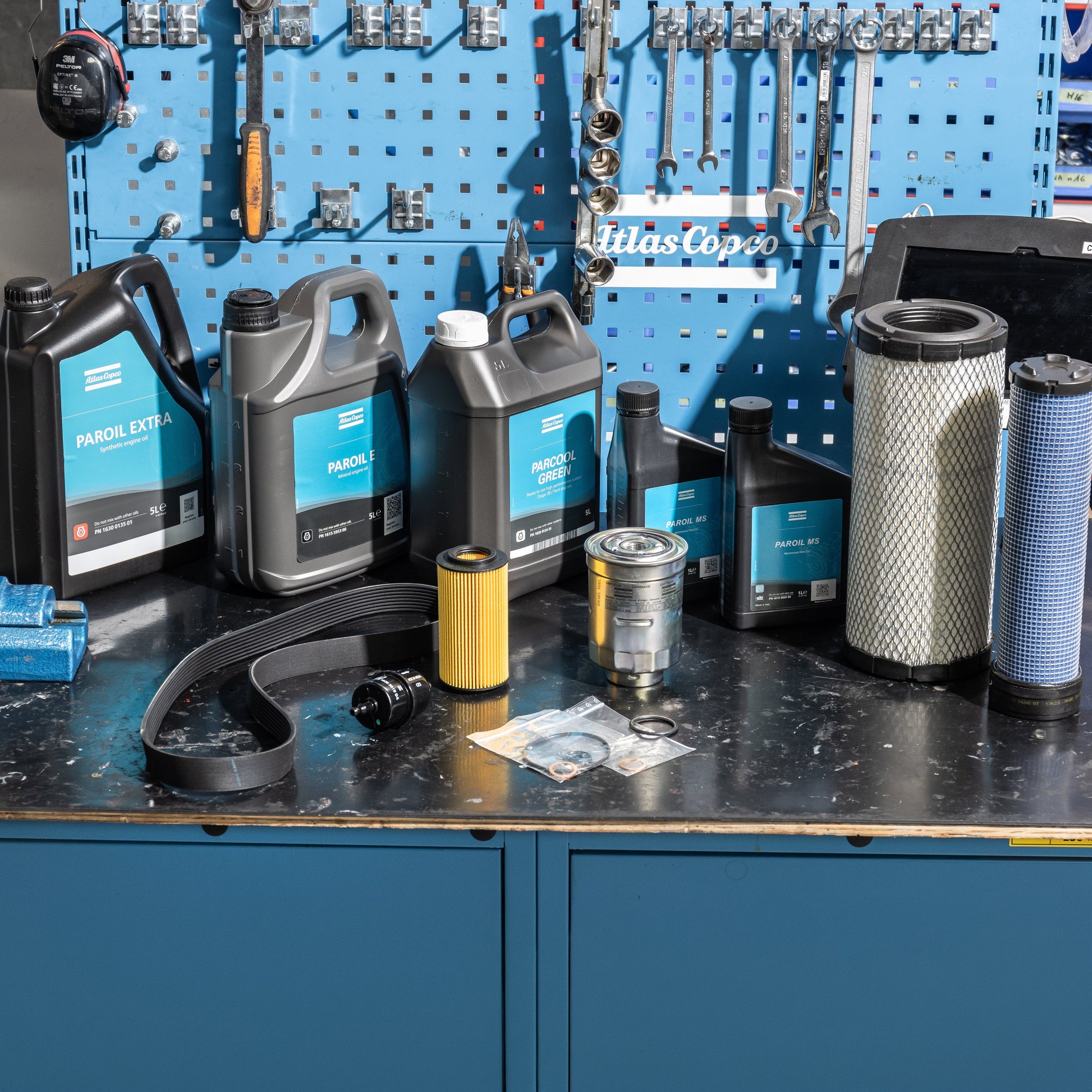
An air compressor service kit is a bundled set of the wear parts your machine needs at one specific hour mark, packed together with the right gaskets and O-rings so you are not chasing a seal at 6 p.m. That is really all it is. The value is in the bundling and in not ordering the wrong part number, which on a rotary screw is easy to do.
How the intervals stack
Rotary screw service is built around running hours, not calendar months, with an annual backstop for machines that sit. The intervals nest inside each other: an 8,000 hour service includes everything in the 4,000, which includes everything in the 2,000. You are not paying three times for the same air filter, you are paying once at the interval where it comes due.
| Interval | Typically included | Notes |
|---|---|---|
| 500 to 1,000 hours | Inspection, oil level, belt tension, drain function, cooler cleaning | Mostly labor, few parts. Belts get checked around every 500 hours. |
| 2,000 hours (or annually) | Air inlet filter, oil filter, oil, panel filter, gaskets and O-rings | The basic PM. Most shops running one shift hit this once a year. |
| 4,000 hours | Everything above, plus oil (if on mineral), belts, some valve kits | Common interval for two shift operations. |
| 8,000 hours | Everything above, plus the air/oil separator element, unloader and thermostatic valve kits, synthetic oil change | The big one. Separator element is usually the largest line item. |
Your machine's manual overrides everything in that table. Manufacturers differ, and the environment moves the numbers hard. A compressor in a dusty foundry running 100 degree ambient will chew through inlet filters at half the published interval. One in a climate controlled clean room may stretch past it. Hours on the counter are a starting point, not gospel.
The parts, and why each one is in there
Air inlet filter
The cheapest part in the kit and the one with the most leverage. Every particle it misses goes into the airend, the oil, and eventually the separator. Change it around 2,000 hours, and more often if you can write your name in the dust on the cabinet. If you are not sure whether yours is due, pull it and hold it up to a light. If you cannot see light through it, it has been due for a while. We stock replacement filter elements for most major brands.
Oil filter
Full flow spin-on or cartridge, usually 1,000 to 2,000 hours. Rotary screw oil filters are not automotive filters even when they look identical, because the bypass pressure and the media are different. Do not substitute from the parts store shelf.
Air/oil separator element
This is the part that makes an 8,000 hour kit expensive, and it is the part people skip. The separator element strips oil out of the discharge air before it leaves the machine. As it loads up, differential pressure across it climbs, and that pressure is work your motor is doing for nothing. A separator running 12 PSI of differential instead of 2 is costing you roughly 6 percent more energy for the same air. Meanwhile, once it is bad enough, oil starts carrying over into your air lines and downstream into your filters, dryer, and tools.
Track the differential if your machine has the gauge for it. Most manufacturers call for replacement somewhere around 8 to 12 PSID or at the hour interval, whichever comes first.
Compressor oil
Mineral oils generally want changing at 2,000 to 4,000 hours. Full synthetic will usually go 8,000. Oil analysis is worth doing on anything 50 HP and up, because it lets you extend intervals with evidence rather than optimism, and it catches coolant contamination and bearing wear before they cost you an airend. Use the oil the manufacturer specifies, and do not mix types. We carry the correct compressor lubricants by brand and spec.
Belts
Belt driven units need tension checked every few hundred hours and replacement in the 4,000 hour neighborhood. A loose belt slips and robs capacity so gradually that nobody notices until output feels soft. Replace them as a matched set, never one out of a pair.
Valve and gasket kits
Unloader valves, minimum pressure valves, thermostatic bypass valves. These are the parts nobody thinks about until the machine will not load, will not unload, or runs hot with a clean cooler. They show up in the longer interval kits because they are cheap relative to the labor of getting in there twice.
Kit or loose parts?
Buy the kit when you are doing a scheduled interval service on a machine you intend to keep. You get the gaskets and seals that go with the parts, the part numbers are already matched to your model, and it is one line item on a PO instead of nine.
Buy loose parts when you are replacing one thing that failed early, when your environment has thrown the intervals out of sync (inlet filters every 800 hours, separator on schedule), or when you have already got half the kit sitting on the shelf from last time.
What we would not do is skip the interval to save money in a given quarter. The math is unkind. A separator element and oil change on a mid-size screw is a small fraction of an airend rebuild, and an airend rebuild is a large fraction of a new machine. Every failure we see traced back to deferred maintenance was cheaper to prevent than to fix, without exception.
Ordering the right kit
Kits are matched to a model and often to a serial number range, because manufacturers change filter housings and valve bodies mid-production without changing the model name. To get it right the first time, have this in hand:
- Brand and full model number, exactly as it reads on the data plate
- Serial number
- Current hour meter reading
- Which interval you are doing, or when the last one was done
- Whether the unit is on mineral or synthetic oil
The data plate is the authority, not the sales literature and not what the last guy wrote on the wall. If the plate is unreadable, the serial number usually still is, and we can work back from that.
A note on piston compressors
Reciprocating machines do not use service kits the same way, because there is no separator element and no oil filter on most of them. Their maintenance is valve plates, rings, gaskets, filters, belts, and oil, and the parts get ordered individually or as a rebuild kit for the pump. If you have a piston unit and somebody quotes you an 8,000 hour kit, ask what is in it, because the interval language got borrowed from the rotary screw world and does not always mean anything on your machine.
Frequently Asked Questions
How often should I service a rotary screw air compressor?
A full PM every 2,000 to 4,000 running hours or annually, whichever comes first, with the larger separator and valve service around 8,000 hours. Dusty or hot environments pull those numbers in. Your manual is the final word.
What is in an 8,000 hour service kit?
Typically the air inlet filter, oil filter, air/oil separator element, panel or cabinet filter, unloader and thermostatic valve kits, and all associated gaskets and O-rings. Oil is sometimes bundled and sometimes ordered separately depending on the brand.
Can I use an aftermarket service kit instead of OEM?
Often yes, and good aftermarket kits from established manufacturers perform on par with OEM at a lower price. What matters is that the filtration efficiency and the separator element construction actually match the original spec. Bargain separator elements are a bad place to save money, since a failure sends oil straight into your air system.
What happens if I skip the separator element?
Two things, and both cost money. Differential pressure across a loaded element makes your motor work harder for the same output, and eventually the element passes oil downstream into your lines, filters, dryer, and tools. Replace it on interval or on differential pressure, whichever hits first.
Does the hour meter or the calendar decide?
Whichever comes first. A machine running 60 hours a week hits 2,000 hours in about eight months. A backup compressor running 200 hours a year still needs annual oil and filter service, because oil degrades sitting still and condensate accumulates whether the machine runs or not.
Where to start
Pull the data plate reading and the hour meter, then work out which interval you are actually due for rather than which one somebody quoted. If you tell us the brand, model, serial, and hours, we will tell you exactly which air compressor service kit fits and what is in it, and we will tell you if you do not need one yet.


