


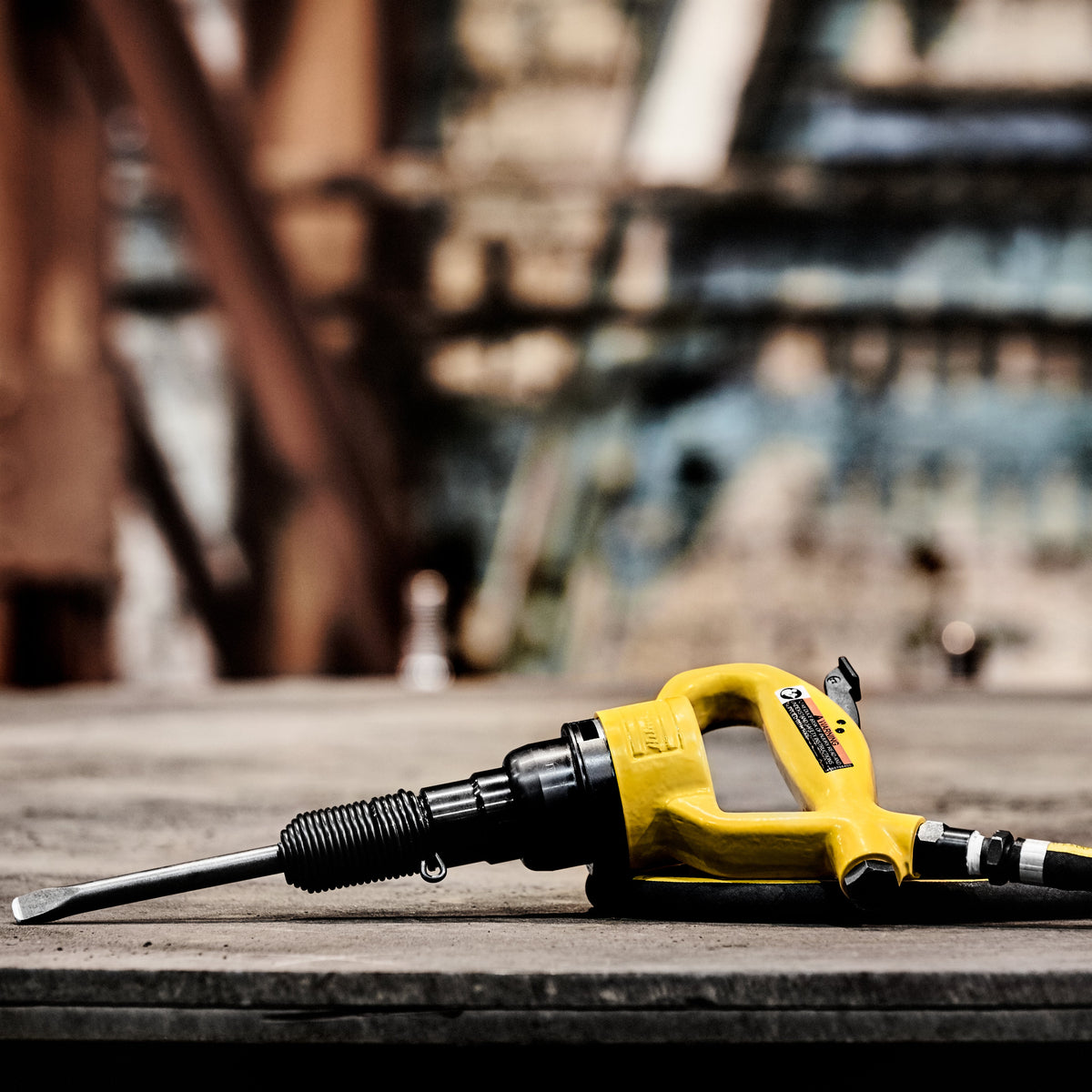
A guy calls us about once a month with the same complaint. He bought a chipping hammer, it hit like a champ for the first ten seconds, and then it turned into a buzzing paperweight. He wants to know if the tool is junk. It usually is not. His compressor just cannot keep up with it.
A pneumatic chipping hammer is one of the hungriest tools in the catalog relative to its size. A 13 pound hammer you can hold in one hand will eat more air than a half inch impact wrench running continuously, and unlike the impact, you are going to hold the trigger down for minutes at a stretch. Get the air right and these tools are unkillable. Get it wrong and you will replace the compressor, not the hammer.
What a chipping hammer is, and what it is not
A chipping hammer is a percussion tool. A piston inside the barrel is driven back and forth by air and strikes the end of a steel chisel that you hold against the work. There is no rotation, no hydraulics, and almost nothing to go wrong that is not a wear part.
People blur three tools together, so let us separate them:
- Air hammer or scaler. The little pistol grip tool, usually a .401 round shank, 2,000 to 3,500 blows per minute, 4 to 10 CFM. Body shop work, cutting exhaust bolts, separating ball joints.
- Chipping hammer. The middle tier and the subject of this guide. Typically .580 hex or .680 round shank, 1,500 to 2,500 blows per minute, 20 to 36 CFM. Concrete cleanup, weld slag, refractory, casting cleaning, scaling.
- Paving breaker. The 60 to 90 pound machine you stand behind. Different tool entirely, and we cover those in our pneumatic breaker guide.
The confusion matters because a .401 shank air hammer and a .580 hex chipping hammer are not remotely the same purchase, and the steel does not interchange.
Stroke length is the spec that decides the tool
Forget weight for a second. On a chipping hammer, piston stroke is the number that tells you what the tool does. Longer stroke means a heavier, slower blow. Shorter stroke means a faster, lighter blow.
| Stroke | Typical blow rate | What it is for |
|---|---|---|
| 2 inch | 2,000 to 2,500 BPM | Scaling, weld slag, light concrete chipping, foundry flash |
| 3 inch | 1,700 to 2,000 BPM | General purpose. Concrete removal, refractory, the one most shops buy |
| 4 inch | 1,300 to 1,600 BPM | Heavy concrete, thick refractory, hard material where you need the hit |
Real numbers from tools people actually own: a Chicago Pneumatic CP4123 with a 3 inch stroke runs about 1,920 blows per minute and consumes roughly 26 CFM at 90 psi at 15 pounds. The bigger CP4130 at 18 pounds with the same 3 inch stroke pulls about 28 CFM at 1,900 BPM, and the 4 inch stroke version of that tool slows to around 1,500 BPM at about 27 CFM. Notice the air consumption barely moves while the character of the tool changes completely.
Shank size, and why the steel you own may not fit
The chuck on the hammer has to match the shank on the chisel. There is no adapter that makes this work properly.
| Shank | Class of tool | Notes |
|---|---|---|
| .401 round | Air hammer | Automotive and light maintenance. Spring retainer or quick change |
| .498 round | Heavy duty air hammer | Step up from .401, common in heavy truck and rail work |
| .580 hex | Chipping hammer | The industrial standard. Hex resists rotation in the chuck |
| .680 round | Chipping hammer | Same class as .580 hex, different retention. Check before ordering steel |
Some hammers come as a combo chuck that takes both .580 hex and .680 round. If you are buying into a shop that already has a drawer full of steel, match the existing shank and save yourself a second inventory. Our air tool steel is sorted by shank for exactly that reason, and there is more detail in our guide to chisels, moils and shanks.
Sizing the compressor, which is where people go wrong
Here is the part that costs money. A chipping hammer is a continuous duty tool. You do not pulse the trigger the way you do with an impact wrench, you lean on it for a minute or two at a time. So you cannot use the 25 percent duty assumption that the CFM charts quietly build in for other air tools.
Size for the hammer running continuously, at the pressure it is rated for, which is almost always 90 psi at the tool.
A 26 CFM hammer wants a compressor that delivers at least 26 CFM at 90 psi continuously, and 30 to 35 CFM is where you want to be so the machine is not pegged at 100 percent duty all day. In practical terms:
- One 3 inch stroke chipping hammer: 7.5 to 10 hp rotary screw, or a well sized two stage piston compressor with a big tank and a tolerance for heat.
- Two hammers running at once: 15 to 20 hp. Do not assume diversity. In a foundry cleaning room they run at the same time.
- Jobsite, no power: a 185 CFM towable compressor will run four hammers comfortably, which is why that size dominates rental fleets.
Pressure at the tool matters as much as volume. A chipping hammer loses power fast below 90 psi because the piston does not get a full charge behind it. Measure at the tool, not at the tank gauge.
Hose is not a detail
This is the single most common reason a correctly sized compressor still starves a hammer. A 3/8 inch hose is too small for a 26 CFM tool over any real distance. Run 1/2 inch minimum, 3/4 inch if you are past 50 feet, and get rid of the undersized quick couplers. A standard 1/4 inch body industrial coupler chokes flow badly at this volume. Our air hose pages list inside diameter, which is the number that matters, not the fitting size stamped on the end.
Lubrication, or the fastest way to kill one
Chipping hammers are lubricated tools. The piston is steel sliding in a steel bore with no bearings and no seals that hold oil. Run it dry and you will gall the bore.
Put a few drops of air tool oil down the inlet at the start of every shift, or run an inline lubricator on the drop. If the tool goes into a paint booth or anywhere oil carryover is unacceptable, you will need a different plan, because a chipping hammer without oil has a short and unhappy life.
Wet air is the other killer. Water washes the oil off the piston and rusts the bore between shifts. If your shop air is not dried, at minimum put a water separator at the drop.
Choosing the right one, in order
- Match the shank to the steel you already own, or pick .580 hex if you are starting clean.
- Pick the stroke by the work. 2 inch for scaling and slag, 3 inch for general concrete and refractory, 4 inch when you need the heavy blow.
- Check the CFM against what your compressor really delivers at 90 psi, not the nameplate SCFM at 0 psi.
- Pick the handle. Pistol grip for overhead and awkward positions, D handle for pushing down into concrete, inline for tight access.
- Decide on the retainer. Spring retainers are cheap and universal. Beehive and oval collar retainers hold better in heavy work. Quick change costs more and saves real time when you swap steel often.
Frequently Asked Questions
How much CFM does a pneumatic chipping hammer use?
Most industrial chipping hammers consume 20 to 36 CFM at 90 psi. A common 3 inch stroke model lands around 26 to 28 CFM. Smaller .401 shank air hammers are far lighter on air, often 4 to 10 CFM. Size your compressor for continuous consumption, because unlike an impact wrench you will hold the trigger down.
What size air compressor do I need for a chipping hammer?
For one 3 inch stroke hammer at roughly 26 CFM, plan on 7.5 to 10 hp with real delivered capacity of 30 CFM or more at 90 psi. Two hammers at once puts you at 15 to 20 hp. On a jobsite with no power, a 185 CFM towable unit handles several hammers at once.
What is the difference between a chipping hammer and an air hammer?
Size, shank, and intent. An air hammer is the light pistol grip tool with a .401 or .498 shank used for automotive and maintenance work at 4 to 10 CFM. A chipping hammer is the industrial tool with a .580 hex or .680 round shank, built for concrete, refractory and weld slag, drawing 20 to 36 CFM.
Why does my chipping hammer lose power after a few seconds?
Almost always an air supply problem rather than a tool problem. Check pressure at the tool while it is running. If it drops well below 90 psi you are either short on compressor capacity, running hose that is too small, or choking flow through undersized couplers. Undersized hose is the most common culprit.
Do chipping hammers need oil?
Yes. A few drops of air tool oil into the inlet at the start of each shift, or an inline lubricator on the drop. The piston runs steel on steel with no bearings, so running it dry will score the bore. Keeping water out of the supply matters just as much, since water strips the oil film and rusts the bore between uses.
Can I use .401 chisels in a .580 hex hammer?
No. The chuck and retainer are specific to the shank, and there is no sound way to adapt between them. Match your steel to the tool, or match the tool to the steel drawer you already have.
Bottom line
A pneumatic chipping hammer is a simple, durable tool that almost never disappoints on its own merits. Pick the stroke for the work, match the shank to your steel, feed it 90 psi through hose that is one size bigger than you think, and oil it. Do that and the tool will outlast several of the compressors you run it on.


