


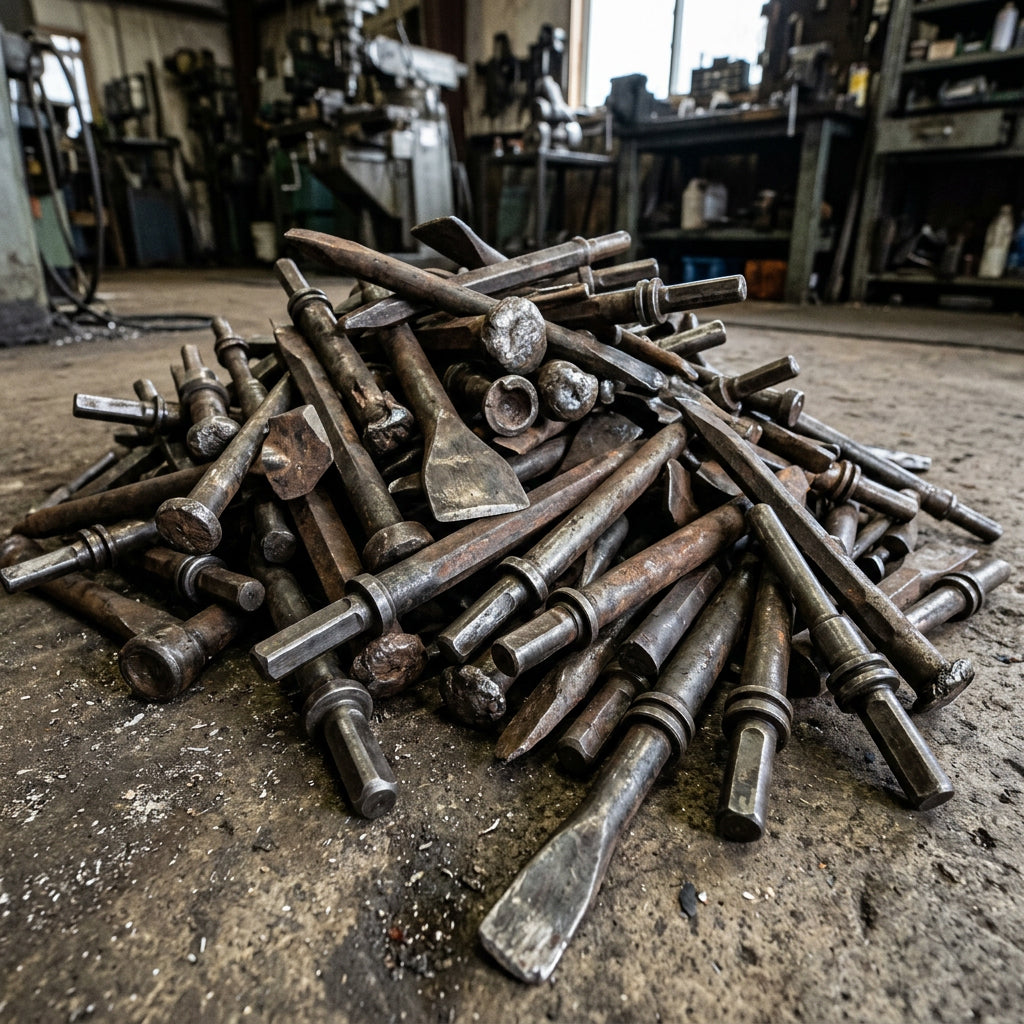
A contractor ordered a box of moil points from us last fall, and when they showed up on site nothing fit. He had measured the working end. Nobody ever needs to measure the working end.
Buying air tool steel comes down to three questions in a specific order: what shank does my tool take, what shape do I need on the business end, and how long does it need to be. Get the first one wrong and the other two do not matter, because the steel will not go in the tool.
Start with the shank, always
The shank is the end that goes into the hammer. It is the only dimension that determines whether a piece of steel physically fits your tool, and it is the number that belongs on the purchase order.
| Shank | Shape | Typical tool |
|---|---|---|
| .401 | Round | Standard automotive and shop air hammers |
| .498 | Round | Heavier air hammers and light chipping hammers |
| 7/16 hex | Hex | Some air hammers and needle scalers |
| 3/4 hex | Hex | Chipping hammers |
| 7/8 x 3-1/4 hex | Hex | Common pavement breaker size |
| 1-1/8 x 6 hex | Hex | Heavy 60 to 90 pound breakers |
| 1-1/4 x 6 hex | Hex | Largest pavement breakers |
Two things about that table trip people up. First, the .401 is by far the most common shank on shop air hammers in North America, so if somebody hands you a chisel with no markings, that is the safe first guess. Second, on hex breaker steel the two numbers are the flat-to-flat dimension and the collar length, and both have to match. A 7/8 by 3-1/4 will not seat correctly in a tool that wants 7/8 by 4-1/4.
If your tool is unmarked, pull a piece of the steel that came with it and measure the shank with calipers. Do not measure the hole in the tool, since it is worn and belled.
Working ends and what each one actually does
Once the shank is settled, pick the end for the job. Using the wrong shape is the fastest way to make a good tool feel weak.
Moil point
A tapered spike. This is the demolition workhorse. It concentrates all the energy into a single point, so it cracks concrete, breaks up slab, and starts holes. It does not cut a line and it does not finish a surface. Most people use a moil for about eighty percent of breaker work.
Chisel and flat
A straight cutting edge. Use it when you need to follow a line: trimming a slab edge, cutting out a section, removing tile or coating. In an air hammer, the flat chisel is what you reach for on exhaust work and separating rusted joints.
Spade and clay spade
A wide, shovel-shaped end for digging in clay and hardpan, cutting asphalt, and stripping. The wide face spreads the blow, so it moves material instead of shattering it.
Asphalt cutter
A very wide flat blade made specifically for slicing asphalt. It looks like a spade but the geometry and the heat treat are different, and swapping one for the other tends to bend something.
Tamper and backfill pad
A flat plate that turns your breaker into a compactor for backfilling a trench. Cheap, and it saves renting a jumping jack for a small job.
Scaling and needle
For rust, weld slag, and paint removal on steel. A needle scaler uses a bundle of loose rods instead of a single tool, so it conforms to irregular surfaces.
Bushing tool
A grid of teeth for texturing concrete and roughing a surface for a bonded overlay. Specialty, but there is no substitute when you need it.
Retainers keep the steel in the tool
The retainer is the part that stops the chisel from launching out of the hammer on the return stroke. Three common styles:
- Beehive spring. A tapered coil spring that threads onto the nose of an air hammer. Cheap, universal, and it wears out. Keep spares.
- Quick change. A spring-loaded collar you pull back to swap chisels in a second. Worth the money if you change ends constantly.
- Latch or lock retainer. Standard on pavement breakers, a hinged latch that swings over the collar. Inspect the pin, since a worn latch is how steel gets thrown.
A worn retainer is a genuine hazard, not a nuisance. If the steel rattles loose in the nose, stop and replace the retainer before you finish the shift.
Why cheap steel is expensive
All air tool steel looks about the same in a bin. The difference is in the alloy and the heat treatment, and it shows up in two places.
The shank mushrooms. Soft steel deforms where the piston strikes it. Once the shank swells, it binds in the tool bore, wears the bushing, and eventually you are replacing the front end of a hammer that costs many times what the chisel did. This is the real cost of a bargain chisel.
The tip rolls over or chips. Too soft and the point mushrooms and stops penetrating. Too hard and it snaps. Good breaker steel is heat treated differently along its length, harder at the working end and tougher through the body, so it takes the impact without becoming brittle.
You can usually tell within an hour of use. If the point is visibly flattening on the first slab, you bought the wrong steel. Our air tool steel category sticks to properly heat treated stock for exactly this reason.
Length, and the mistake of buying long
Longer steel flexes more and delivers less energy to the work. It also fatigues faster. Buy the shortest tool that reaches what you are breaking.
Where extra length genuinely helps is overhead work, trench bottoms, and anywhere your body position is the limiting factor. A 24 inch moil in a trench beats a 12 inch moil and a bent back. Just do not run the long one as your everyday tool.
Keeping steel and tools alive
- Never run a hammer without the steel against the work. Dry firing hammers the retainer and the anvil, and it will destroy a breaker faster than any amount of concrete.
- Oil the shank. A few drops of air tool oil on the shank before you seat it cuts wear in the bore dramatically.
- Dress mushroomed shanks or scrap them. A swollen shank ruins the tool it goes into. Grind it back or throw it out.
- Never use a moil as a pry bar. The steel is hard, and hard steel snaps sideways. People lose eyes this way.
- Keep the air clean and dry. Water in the line rusts the internals of a breaker just as fast as it rusts anything else.
Matching steel to the tool and the compressor
One last thing worth saying, because it comes up constantly. Steel does not fix an air supply problem. If your 90 pound breaker is not hitting hard, a new moil point will not change that. A big breaker wants serious volume, and if the compressor cannot feed it the tool will bog no matter what is in the nose. Size the air first, then buy the steel. You can compare machines under breakers and the compressors that feed them under air tools.
The short version
Measure the shank, not the tip. Match both numbers on hex breaker steel, flat-to-flat and collar length. Run a moil for general demolition and switch to a flat or a spade when the job needs a line or a wide face. Inspect your retainer. And buy properly heat treated air tool steel, because a cheap chisel that mushrooms will cost you a hammer.
Frequently Asked Questions
What shank size does a standard air hammer use?
Most shop and automotive air hammers in North America use a .401 round shank. Heavier hammers and light chipping hammers often use .498, and some tools use a 7/16 hex. If your tool is unmarked, measure the shank on a chisel that came with it rather than measuring the worn bore in the tool.
Are air hammer chisels interchangeable between brands?
Within the same shank size, generally yes. A .401 chisel from one maker will fit another maker's .401 hammer. What is not interchangeable is shank size, and that catches people because the working ends look identical across sizes.
What is the difference between a moil point and a chisel?
A moil point is a tapered spike that concentrates energy into one spot, which is what you want for breaking up concrete and starting holes. A chisel has a straight cutting edge for following a line, trimming an edge, or cutting out a defined section. Most demolition work is done with a moil.
Why does my chisel keep mushrooming?
Almost always soft steel or a poor heat treat. It can also happen if you dry fire the hammer, since the piston is then striking the shank with nothing absorbing the blow at the other end. Either way, stop using a mushroomed shank, because it wears out the bore of the tool.
How long should breaker steel be?
The shortest length that reaches the work. Longer steel flexes, delivers less energy, and fatigues sooner. Keep a longer tool on hand for trench bottoms and overhead work, but do not make it your everyday piece.


