


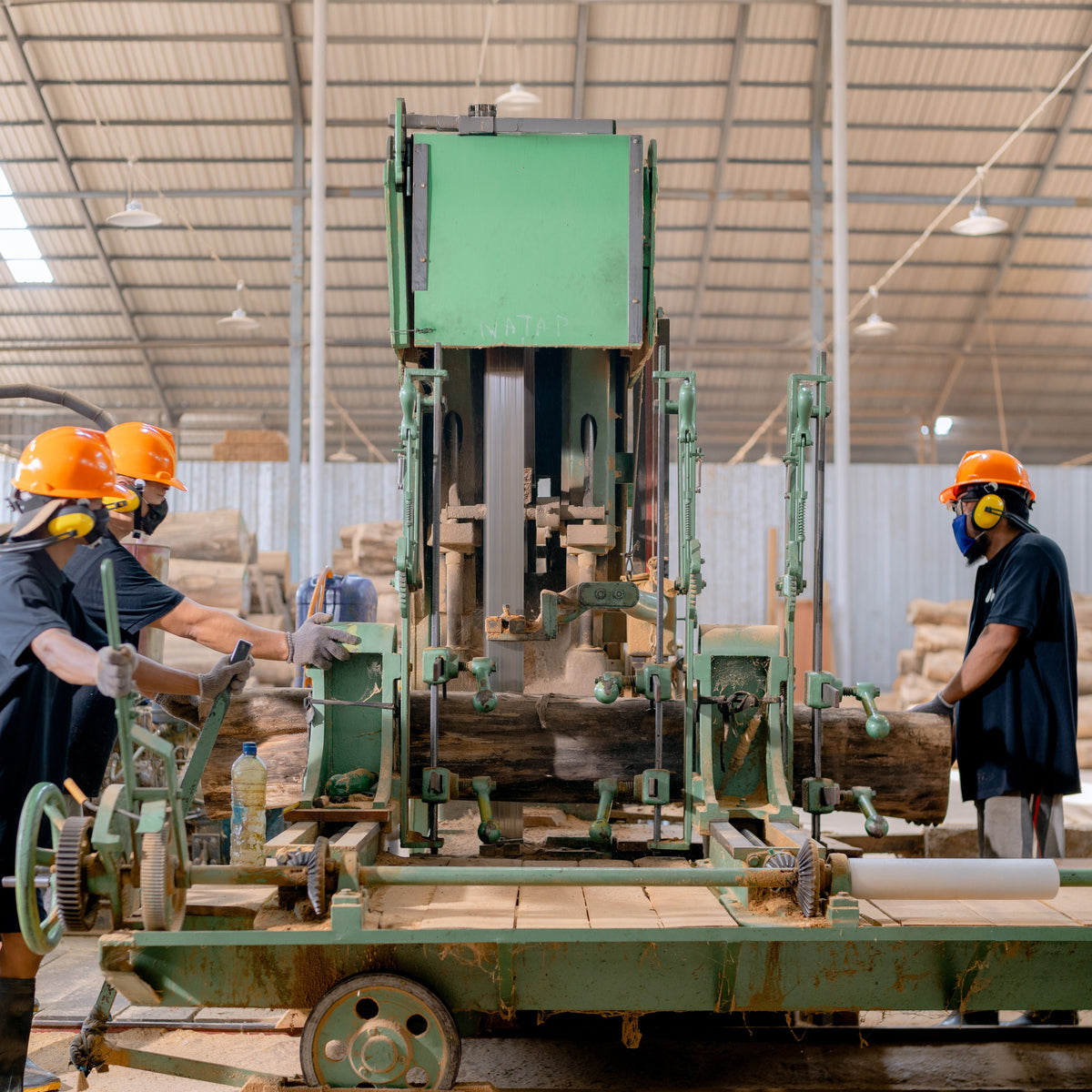
Stand at the headrig of a working mill and count the things that move. The log turner slaps the log over. The knees index. The carriage runs. The board drops to the green chain, the edger takes it, the trimmer squares it, and somewhere down the line a cylinder kicks it into the right bin. Every one of those motions is air, and they all happen again in about four seconds.
That is the thing that makes compressed air for sawmills different from air in a cabinet shop or a general plant. It is not the total volume. It is that the volume arrives as a few hundred short, hard pulls a minute, in a building full of sawdust, and if pressure sags the mill does not slow down gracefully. It misfeeds, and then somebody is clearing a jam instead of cutting lumber.
If you run a cabinet or millwork shop rather than a breakdown mill, our guide to compressed air for woodworking shops is the one you want. This is about primary breakdown and the planer mill.
What the Air Actually Runs
A mill is essentially a long line of pneumatic cylinders with saws in between. The usual population:
- Log handling. Log turners with slapper bars and dogs, hold-down rolls, log kickers and stops on the deck, and the cut-off saw feeding the deck
- Carriage and setworks. Pneumatic setworks driving the knees to index the log into each successive sawing position
- Breakdown and optimization. Cant optimizer positioning, board flipping, chipping head engagement
- Edger and trimmer. Saw positioning, hold-downs, trim saw drops
- Sorting. Sorter bin drops, length and grade kickers, stacker and stick placer
- Blow-off. Sawdust clearing off boards, scanners, laser lenses and optimizer windows, which is the one that quietly eats the most air in the whole mill
- Kiln and planer. Kiln damper actuators, planer hold-downs and setworks, moulder air
- Shop and maintenance. Saw filing room, impact tools, blow guns
Almost all of it is intermittent and almost none of it is negotiable. A mill running 24 hours on two shifts is a continuous-duty air customer even though every individual device is firing in bursts.
Separate the Compressor Work From the Blower Work
This is where mills waste the most money, and it is worth settling before you price anything.
An air knife or a wide blow-off bar can be fed by either a compressor or an industrial blower. For a narrow, intermittent blast at a scanner window, compressed air through an engineered nozzle is right. For continuous wide drying or sawdust clearing across a belt, a blower does the same work for a fraction of the energy, because you are paying for volume and velocity rather than pressure.
The mistake is the open pipe. A one inch open tube at 90 psi eats roughly 30 cfm and never stops. Mills accumulate these: somebody drills a line to keep dust off a scanner, it works, and five years later there are fifteen of them running three shifts. That is a 50 hp compressor doing nothing but blowing sawdust. Engineered nozzles cut it substantially, and moving the continuous ones to a blower cuts it further. Our piece on engineered nozzles has the numbers.
Sizing: The Transient Is the Whole Problem
Average demand in a mill is a misleading number. What matters is what happens when the log turner, two hold-downs and a bin drop all fire inside the same second.
Practical approach:
- Meter, do not estimate. Cylinder counts in a mill are large and nobody has an accurate list. A week of logged flow data tells you the real average and, more importantly, the shape of the peaks. A flow meter pays for itself on the first sizing decision.
- Buy storage before you buy horsepower. This is the single most useful thing in this article. Mill demand is spiky by nature, and spikes are a storage problem. Four to six gallons of receiver per cfm is a starting point, and mills with big simultaneous events want more. Put a wet receiver ahead of the dryer and a dry receiver near the heaviest cylinder group. Receiver tanks are far cheaper per usable cfm than another machine. Our companion guide to air receivers for sawmills works the sizing formula and covers where to put the tanks.
- Base load plus trim. One or two fixed speed machines carrying the steady load with a variable speed machine trimming the swing keeps the fixed units fully loaded where they are efficient, instead of having the whole plant load and unload all shift.
- Rotary screw, not piston. A mill runs continuous. Rotary screw is the design built for 100 percent duty, and it is the standard answer for sawmills for that reason. Browse rotary screw compressors by capacity.
- Do not lift plant pressure to fix one machine. If the setworks wants 110 psi and everything else is happy at 90, give the setworks local storage or a booster. Every 2 psi across the plant is roughly 1 percent on the power bill, and at mill horsepower that is real money.
The Intake Is Where Mills Kill Compressors
Here is the failure we see most often in wood products, and it is entirely preventable.
A mill is full of fine airborne dust. Put a compressor intake inside that building and the inlet filter loads fast. A loaded inlet filter raises discharge temperature, pushes oil carryover up, and drags efficiency down long before anything trips. Then the dust that gets past goes into the airend.
What to do about it:
- Duct the intake to clean outside air, sited away from the dust collector discharge, the chip loadout and the burner. Outside air is also cooler, which buys you capacity.
- Fit a proper inlet filter silencer sized for the machine, and treat elements as a consumable on a shortened interval rather than a manual-schedule item. Check differential, not the calendar.
- Keep the compressor room positively pressurized with filtered make-up air if it has to sit inside the mill.
- Watch discharge temperature as your early warning. A creeping discharge temp in a dusty plant is usually the intake, not the cooler.
Our intake filter guide covers what the element is actually doing and when to change it.
Water, Cold, and the Kiln Yard
Two moisture problems show up in mills, and they have different answers.
Inside the mill, a refrigerated dryer at a 35 to 38F pressure dew point handles cylinder and valve air fine. Water in a cylinder means sticky seals and a misfeed, and a refrigerated dryer plus decent filtration prevents it.
Outside, it is a different question. Most mills have air running to the log deck, the chip loadout, the kiln yard or an outbuilding, and in a northern mill that line will freeze. The rule to work to is a pressure dew point at least 18F below the coldest temperature any part of that piping will ever see, which in practice means a desiccant dryer at -40F on the legs that go outdoors. You do not need to dry the whole mill to -40F to protect one outdoor run, and you should not, because desiccant costs purge air. Dry the leg, not the plant.
| Where the air goes | Target | Treatment |
|---|---|---|
| Cylinders, valves, setworks | ISO 8573-1 Class 3.4.4 or better | Refrigerated dryer, particulate and coalescing filtration |
| Scanner and optimizer blow-off | Class 2.4.2 | Coalescing filter at the drop, because oil film on a lens is worse than dust |
| Outdoor runs, log deck, kiln yard | Dew point 18F below coldest metal temperature | Desiccant on that leg only |
| Filing room and shop tools | Class 4.4.4 | FRL at the tool |
| Planer and moulder | Class 3.4.3 | Refrigerated plus coalescing, finish matters here |
What Mills Get Wrong
Adding a compressor when the real problem is storage. If pressure sags during events but the machines are unloading between them, you do not need more air. You need somewhere to keep it.
Leaving the open blow-off pipes alone. They are invisible because they have always been there. Walk the line on a Sunday with everything down but the compressor and listen. In a mill with thousands of fittings and constant vibration, 20 to 30 percent of production lost to leaks and open blow-offs is normal, and it is the cheapest capacity you will ever recover.
Sizing on horsepower instead of delivered cfm. Two 100 hp machines from different builders differ meaningfully in cfm at 110 psig. Compare the CAGI data sheet, not the nameplate.
Ignoring the filing room. Saw filing wants clean dry air and it is usually the last drop on the longest run. Give it its own filter and regulator.
Running one machine with no backup. A mill down for air is a mill down. Two machines sized so either one can carry the critical line is not luxury in a plant where an hour of downtime is measured in truckloads.
Frequently Asked Questions
What size air compressor does a sawmill need?
There is no useful rule of thumb, because the spread between a small portable mill and an optimized breakdown line is enormous. Meter the actual demand for a week before you buy. What is consistent is the shape: high peak-to-average ratio, which means storage matters as much as compressor capacity, and rotary screw machines rather than pistons because the duty is continuous.
Should sawmill blow-off run on a compressor or a blower?
Short intermittent blasts at a scanner or lens are fine on compressed air through an engineered nozzle. Wide continuous clearing across a belt or a chain should be blower work, because you are buying volume rather than pressure and a blower does it for a fraction of the energy. Open pipes should not be either.
Where should the compressor intake go in a mill?
Outside, ducted, and away from the dust collector discharge, the chip loadout and any burner. Mill air is full of fine dust, and an intake pulling from inside the building loads the inlet filter fast, raises discharge temperature and pushes oil carryover up. Outside air is also cooler, which gains you a little capacity.
Do I need a desiccant dryer for a sawmill?
Usually only on the legs that leave the heated building. A refrigerated dryer at a 35 to 38F dew point covers cylinder and valve air inside the mill. For lines running to a log deck, chip loadout or kiln yard in a cold climate, target a dew point at least 18F below the coldest temperature that pipe will see, which generally means desiccant on that leg only.
Why does pressure drop every time the log turner fires?
Almost always insufficient local storage, occasionally an undersized branch line. A large cylinder firing pulls a lot of air in a fraction of a second, and if the nearest receiver is back in the compressor room the pipe cannot deliver it fast enough. A dry receiver near that cylinder group fixes it far more cheaply than more horsepower.
Where to Start
Meter for a week, walk the line for open blow-offs and leaks, add storage near the heaviest cylinder groups, get the intake outside and filtered, and dry the outdoor legs rather than the whole plant. Most of what goes wrong with compressed air for sawmills is a system sized on averages trying to serve a process that only exists in peaks.


