


A rink manager in Michigan sent us a quote last August for a 50 horsepower rotary screw. Someone had walked his building, counted his air drops, and sold him a machine that would run a small manufacturing plant.
His actual continuous air load was under 5 CFM. What he genuinely needed was a reliable 10 horsepower machine, a dryer, and a plan for the two weeks a year when the load is twenty times normal.
That is the useful thing to understand about compressed air for ice rinks and arenas. Your building is not a factory. The air load is small, lumpy, and seasonal, and almost all of it is maintenance rather than production. But there is one job the air does that you cannot afford to lose, and most of the money should go into making that one reliable instead of making the compressor big.
Be Clear About What Air Does Not Do
Let us get the overselling out of the way first, because three of the biggest systems in your building are not compressed air at all and we are not going to pretend otherwise.
- Your dehumidifier is not a compressed air dryer. Arena dehumidification runs on a silica gel desiccant wheel reactivated with gas or electric heat, moving thousands of CFM of building air at near atmospheric pressure. It is an air handling unit. It has nothing to do with your compressor, and anyone quoting you a compressed air dryer to fix fog over the ice is selling you the wrong machine.
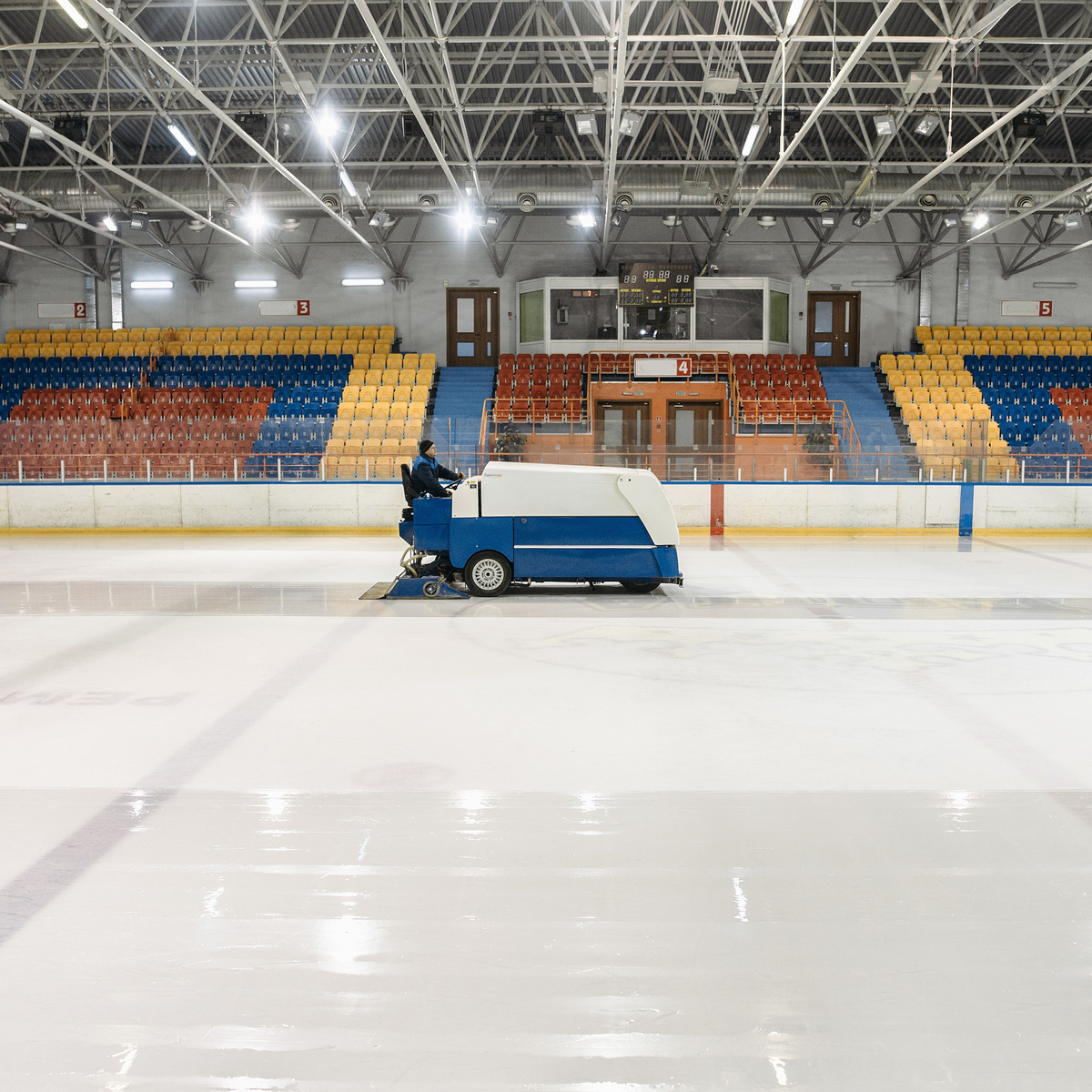
- Your ice resurfacer is hydraulic. The auger, the conditioner, the board brush and the dump are hydraulics driven off the engine. Air comes into it for tire inflation and for blowing the thing out at the end of the night, which matters, but the machine is not pneumatic.
- Most modern refrigeration plants actuate electrically. Newer packaged plants use electric valve actuators and solenoids. Pneumatic actuation on the plant is common on older systems and on some larger central plants, and if you have it, read the next section carefully.
Knowing what is not on the list is how you avoid the 50 horsepower quote.
The One Job That Actually Matters
If your refrigeration plant uses pneumatic valve actuation or pneumatic controls, that air is not shop air. It is instrument air, and it belongs on its own branch with its own storage and its own protection.
Ice plants chill brine or glycol down to roughly 25 to 30 degrees and circulate it through the floor. The valves that manage suction, liquid feed, hot gas and defrost are what keep that loop where it needs to be. If a technician in the shop hooks an impact gun to the same header on a Saturday morning and drags the pressure below what those actuators need, you have a refrigeration problem that will not look like an air problem to anyone troubleshooting it.
The fix is cheap and we recommend it in every rink we quote:
- Give the plant its own receiver downstream of the dryer, with a check valve isolating it from the rest of the building.
- Put a regulator and a gauge at the plant so you can see what it is actually getting.
- Run that branch in its own pipe, not teed off a shop drop.
That is one tank, one check valve and one regulator, and it means nothing that happens in the maintenance shop can affect the ice.
For the receiver sizing arithmetic, exactly where the check valve goes relative to the tank, and why documenting what each valve does on loss of air matters more than any of the hardware, see instrument air for ice plant valve actuation.
The Ammonia Question, Said Carefully
Most ice plants in North America run on ammonia, and ammonia at a rink has killed people. This is the part of your building that deserves real respect rather than a vendor's reassurance.
Two thresholds matter. If your system holds 10,000 pounds of ammonia or more, OSHA's process safety management standard at 1910.119 applies and so does EPA's risk management program. Most community rinks sit well under that, often in the hundreds to low thousands of pounds, which means PSM does not apply to you. That is not the same as having no obligation. OSHA's General Duty Clause still applies, and ANSI/IIAR Standard 2 is the recognized standard for safe installation and operation of ammonia refrigeration whether or not you are PSM covered.
Where compressed air touches this: if your plant's safety-relevant valves are air actuated, your dryer and your air quality are part of keeping that plant controllable, and they belong in your maintenance records alongside everything else on the plant. Dew point readings, filter changes and drain checks are worth writing down.
We sell compressors, dryers and filtration. We are not ammonia refrigeration contractors and we do not write safety programs. Get an IIAR qualified contractor for the plant itself, and treat anyone who tells you a compressor package makes you compliant as someone to stop talking to.
Where the Air Actually Goes
| Use | Demand | When |
|---|---|---|
| Instrument air to a pneumatic refrigeration plant | 1 to 5 CFM, continuous | Always. The critical one |
| Dasher board and glass installation or removal | 15 to 40 CFM while running impacts | Ice in and ice out, plus event changeovers |
| Blowing out floor header loops and the snow melt pit | 20 to 60 CFM in bursts | Shutdown, repair, and seasonal drain down |
| Resurfacer tires, blow down, shop maintenance | 5 to 20 CFM, intermittent | Daily to weekly |
| Skate sharpening and pro shop | Small | Daily |
| Floor loop pressure testing and leak hunting | Varies, usually rented equipment | Rarely, and it is a big day when it happens |
Read down that column on the right and the pattern is obvious. One small continuous load and several large occasional ones. That is the opposite of how a factory looks, and it is why sizing a rink off peak demand produces a machine that short cycles itself to death for 50 weeks a year.
Sizing It Honestly
| Facility | Sensible setup |
|---|---|
| Single sheet community rink, electric plant actuation | 5 to 7.5 HP two stage piston or small screw, 80 to 120 gallon, refrigerated dryer |
| Single sheet with pneumatic plant actuation | 7.5 to 10 HP, 120 gallon, refrigerated dryer, plus a dedicated plant receiver and check valve |
| Twin pad or arena with event changeovers | 10 to 15 HP, 240 gallon, refrigerated dryer, consider a second small machine for redundancy |
Those are starting points. Two principles matter more than the numbers.
Size for the continuous load, and solve the seasonal peak with storage and patience. Dasher board changeover is two people with impact guns for a day or two. A 120 or 240 gallon receiver plus a 10 horsepower machine handles that fine if the crew accepts the compressor running hard. Buying 40 horsepower so two guns never hesitate is an expensive way to save nobody any time.
Rent for the once-a-decade jobs. Blowing down an entire floor header or pressure testing the slab is a job for a rented towable, not a reason to own a machine you use once. We will tell you that rather than sell you the machine.
If you want the general sizing method, what size air compressor do I need walks it, and air receiver tanks covers why storage beats horsepower for intermittent loads.
Dry Air, and the Thing About Cold Rooms
You run a building with a refrigeration room, a slab at 15 to 22 degrees, and often a compressor tucked in a mechanical space that swings with the seasons. Wet air in that environment ends up as water in a valve actuator or ice in a line that runs somewhere cold.
For most rinks a refrigerated dryer holding roughly a 38 to 45 degree pressure dew point is enough, because the air stays in heated or tempered space. You need a desiccant dryer only if a line runs outdoors, through an unheated service corridor, or into the floor trench in a cold climate. The refrigerated vs desiccant comparison walks that decision, and if you do have cold runs, the piping detail in our cold storage piping guide applies directly.
Put a drain on the tank that actually works. A rink compressor that runs a few minutes a day will sit full of condensate between uses, and a rusted tank in a public assembly building is a problem nobody wants to explain.
What Rinks Get Wrong
- Buying the compressor a vendor sized off drop count. Count loads, not outlets.
- Plant air and shop air on the same header. One Saturday impact gun and the valves go hungry.
- No dryer at all. Common in older rinks, and the water shows up in the actuators eventually.
- Never draining the tank. Low duty cycle makes this worse, not better.
- Using the compressor as the plan for the floor blowdown. Rent it.
- Nobody knows the pressure the plant actuators need. Find the number, write it on the regulator, and set an alarm point if you can.
- Treating the compressor as out of scope during plant maintenance. If it feeds the plant, it is part of the plant.
Frequently Asked Questions
What size air compressor does an ice rink need?
Most single sheet community rinks are served well by 5 to 10 horsepower with an 80 to 120 gallon tank and a refrigerated dryer. A twin pad or an arena with frequent event changeovers usually lands at 10 to 15. The continuous load in a rink is tiny, often under 5 CFM, so size on that and handle the dasher board and blowdown peaks with storage rather than horsepower.
Does my ice plant need instrument air?
Only if the plant uses pneumatic valve actuation or pneumatic controls, which is common on older and larger central plants and less common on new packaged systems. If it does, that air is critical and should have its own receiver, check valve, regulator and gauge, separated from shop air so nothing in the maintenance shop can pull the plant below its minimum pressure.
Will a compressed air dryer fix fog over the ice?
No, and this one comes up a lot. Fog and ceiling condensation are building humidity problems handled by a desiccant dehumidification unit that moves large volumes of building air. A compressed air dryer treats the air inside your pipes. They are unrelated machines solving unrelated problems, and buying one will not help the other.
Does OSHA process safety management apply to our rink?
It applies if your ammonia charge is 10,000 pounds or more. Many community rinks are well under that and are therefore not PSM covered, though the General Duty Clause still applies and ANSI/IIAR Standard 2 remains the recognized standard for ammonia refrigeration regardless. Confirm your actual charge with your refrigeration contractor rather than guessing, and get a qualified ammonia contractor for anything touching the plant.
Can we use shop air to blow out the floor header loops?
For a small section or a single loop, sometimes. For draining and blowing down an entire floor, no. That is a high volume job that calls for a rented portable unit, and trying to do it with a 10 horsepower shop compressor takes days and risks leaving water in loops you thought were clear.
Where to Start
Find out two things this week. Does your refrigeration plant use air to actuate anything, and if so, what pressure does it need? If the answer to the first is yes, put a receiver and a check valve on that branch before you spend money on anything else in this article. It is a few hundred dollars and it removes the only way your compressor can cause an ice problem.
Browse air compressors, or the refrigerated air dryers and receiver tanks that belong with them. Tell us whether your plant is pneumatic and how often you pull boards, and we will size it without padding it.


