


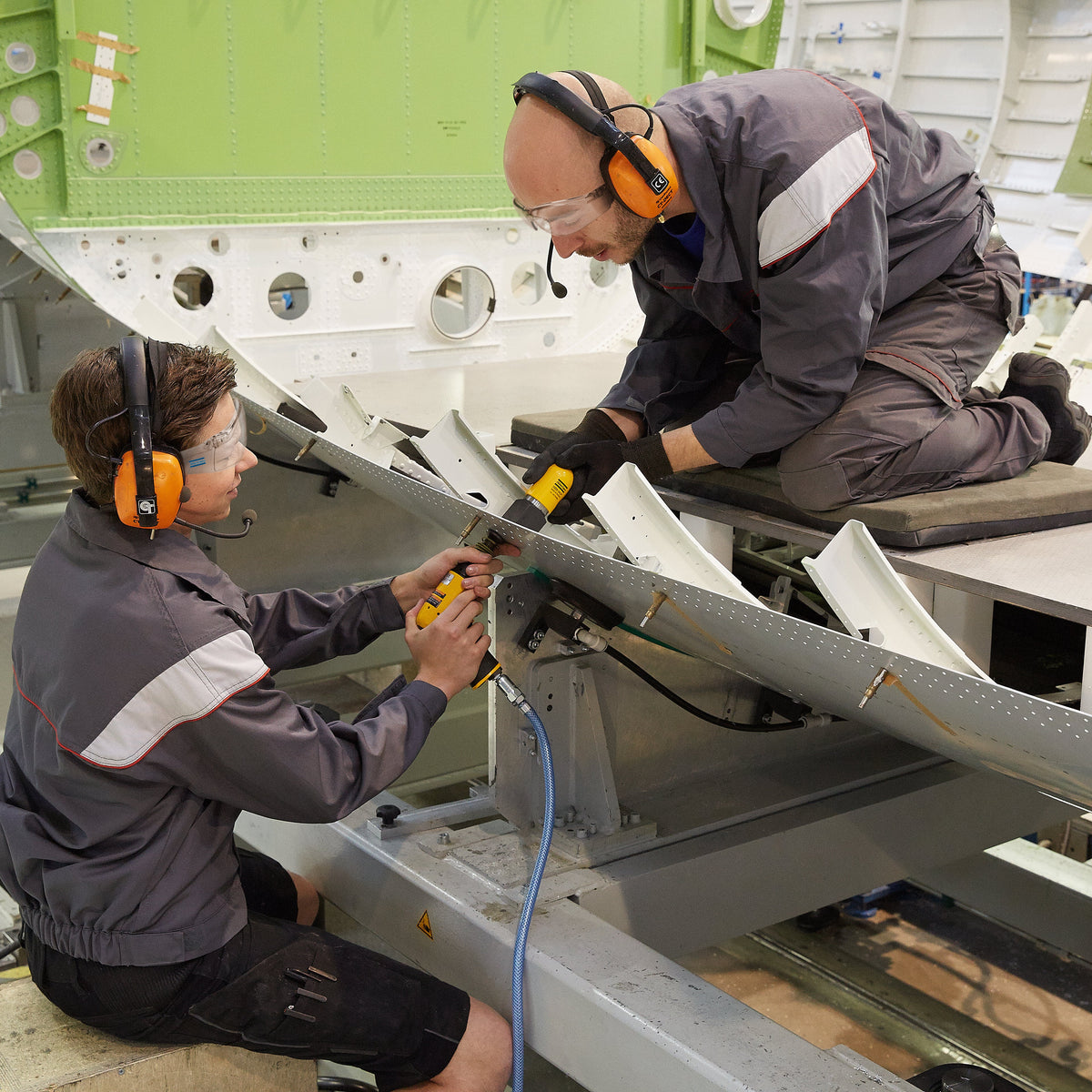
An airframe comes into the hangar for a heavy check and within a day there are twelve people on it with air tools. Drills, rivet guns, angle grinders, die grinders, DA sanders, and a couple of guys in supplied-air hoods stripping paint. Every one of them is pulling from the same header, and when the guy at the far end of the hangar squeezes the trigger and gets 72 psi instead of 90, the rivet does not set right.
That is the first thing to understand about compressed air for aerospace work. It is not a quality problem or a volume problem. It is both, at the same time, in a building the size of a football field. Your tools want a lot of air, your finishing work wants air clean enough to not contaminate a bonded joint or a topcoat, and your people in respirators want air that meets a federal standard. Those are three different specs coming off one machine.
The load: why hangars run out of air
Aerospace tool loads are brutal because the tools run continuously and there are a lot of them. A DA sander does not pulse the way an impact wrench does. It just draws.
| Tool | CFM at 90 psi | Notes |
|---|---|---|
| Pneumatic drill, 90 degree | 4 to 6 | Continuous while drilling out fasteners |
| Rivet gun, 3X to 4X | 3 to 6 | Bursty but constant on a skin job |
| Dual action sander, 6 inch | 11 to 17 | The real hog, and nobody counts them |
| Die grinder | 4 to 8 | Continuous |
| HVLP spray gun | 10 to 14 | Continuous during a coat |
| Supplied-air respirator, per user | 6 to 15 | Depends on hood vs half mask |
Add it up honestly. Six sanders on a wing strip is 70 to 100 CFM by itself. Two painters with hoods adds 20 to 30 more. Put a heavy check crew on the floor and you are past 200 CFM before you count the nitrogen cart and the shop drops. Our air tool CFM chart has the rest of the common ones.
The other mistake is sizing off the compressor and forgetting the hangar. A 400 foot run of undersized header to the tail dock will eat 15 to 20 psi and no amount of compressor fixes it. In a big building, the distribution is half the system.
Air quality: three specs, one system
Aerospace finishing is where generic shop air stops being good enough.
Structures, sealant and bonding
Oil or water on a faying surface before you shoot sealant or lay adhesive is a rework item, and sometimes a repeat one that nobody traces back to the air. Blow-off air used on a prepped surface has to be dry and oil-free. Most aerospace quality systems spec this in ISO 8573-1 terms, and a class 1.4.1 or better on the finishing legs is a common target. Our breakdown of the ISO 8573-1 class system explains how to read the three numbers so you can spec it rather than argue about it.
Paint
Aerospace topcoats and primers are less forgiving than automotive and a lot more expensive to redo. Water in the line puts fisheyes in a $40,000 paint job on an airliner. That means real drying, not a water trap at the gun. If any part of your header runs through an unheated hangar bay or outdoors between buildings, a refrigerated dryer is not enough and you want desiccant. Our comparison of refrigerated versus desiccant dryers covers where that line falls.
Breathing air
This one is a legal requirement, not a preference. Anybody in a supplied-air respirator stripping or spraying is on Grade D breathing air per OSHA, which sets limits including oil mist at no more than 5 mg per cubic meter and specific limits on carbon monoxide and carbon dioxide. You need the filtration panel, a CO monitor, and documentation. Read our full writeup on Grade D breathing air requirements before you put anybody in a hood, because the rules are specific about the monitoring, not just the hardware.
A practical note that saves arguments: put the breathing air panel on a dedicated leg with its own filtration, fed from the cleanest point in your system. Do not try to certify the whole plant header to breathing air quality. Treat one branch properly and document it.
Nitrogen, and why MRO shops end up generating it
Aircraft tires get serviced with nitrogen. So do accumulators and oleo struts. Most shops start out buying cylinders, and the cylinder program quietly turns into a real line item once you count rental, delivery, the cage, the handling, and the half-full bottles that come back.
A membrane or PSA nitrogen generator runs off your existing compressed air and makes N2 at whatever purity you set it to. Tire and strut service usually does not need the extreme purity that laser cutting does, which makes the economics friendlier. The tradeoff is that nitrogen generation eats compressed air, so it goes into your CFM budget as another load. Our nitrogen generator guide walks the sizing and the purity math, and we go through the aviation side specifically in nitrogen generators for aircraft tire and strut servicing, including the FAR 25.733 oxygen limit and why the purity you actually need is lower than most shops assume.
What to buy
For a hangar or a component shop with real tool load, a rotary screw compressor is the right machine. Aerospace loads run for hours, and a piston machine cycling against that duty will not last. Sizing guidance that holds up:
- Size on realistic simultaneous tool use, not the sum of every tool you own. Count what actually runs at once during a check, then add 25 percent.
- Buy storage. A big receiver is what keeps hangar pressure stable when a crew all triggers at once. Treat storage as part of the system, not an accessory.
- Consider variable speed if your load swings hard. A hangar between checks is near zero and during a check is flat out. That swing is exactly what VSD is for.
- Two smaller machines often beat one big one. You get redundancy, and you get to run one during light periods instead of unloading a monster.
- Treat the finishing leg separately. Add desiccant drying and a proper filtration train on the branches that feed paint, sealant prep and breathing air, rather than over-treating the whole plant.
The mistakes we see in aviation shops
- Counting sanders as small tools. A 6 inch DA is the single biggest air consumer in most hangars and it is treated like a hand tool. Six of them is a compressor.
- One header, one spec. Trying to make plant air good enough for breathing air is expensive and hard to document. Branch it.
- No CO monitor on the breathing air panel. The filtration gets bought and the monitoring gets skipped. That is the part an inspector asks about.
- Undersized distribution in a big building. Hangars are enormous. Size the main generously and loop it so the far dock sees the same pressure as the compressor room.
- Compressor intake near the paint booth exhaust or the ramp. Solvent vapor and jet exhaust pulled into the intake ends up in your air and, if you feed breathing air off it, in somebody's lungs. Duct the intake to genuinely clean air.
- Nitrogen budgeted as free. Generating N2 consumes compressed air. If you add a generator to a system that was already tight, you will feel it at the tools.
Frequently Asked Questions
How much CFM does an aircraft MRO hangar need?
It depends entirely on crew size and whether you do paint and strip work. A component shop might live on 50 CFM. A hangar running a heavy check with six sanders, drills, rivet guns and two painters in supplied-air hoods will pass 200 CFM. Count simultaneous tool use during your busiest realistic day and add 25 percent, rather than adding up every tool in the crib.
Does aerospace compressed air have to be oil-free?
Not necessarily at the compressor. A well maintained oil-lubricated rotary screw with a proper separator and a coalescing and carbon filtration train will hit the air quality classes most aerospace finishing specs call for. Oil-free is the simpler path if you have the budget and it removes a variable from your quality documentation, which matters when you are audited.
What standard applies to breathing air for paint and strip work?
OSHA requires Grade D breathing air for supplied-air respirators, which sets limits on oil mist, carbon monoxide, carbon dioxide and water vapor. Meeting it takes a dedicated filtration panel, carbon monoxide monitoring and records. It is a compliance item, not a best practice, so build the branch properly and document it.
Should we generate our own nitrogen for tire and strut servicing?
Usually yes, once cylinder volume gets meaningful. Tire and strut work does not demand the extreme purity that laser cutting does, so a membrane or PSA generator is straightforward. Just remember it runs on your compressed air, so add it to the CFM budget before you buy.
Why does pressure drop at the far end of the hangar?
Almost always distribution, not the compressor. Long runs of undersized pipe, too many elbows, and a dead-end layout instead of a loop. Measure pressure at the tool during a busy shift and compare it to the compressor discharge. If the gap is more than about 10 psi, the piping is the problem.
Get the volume, the distribution and the branch treatment right and compressed air for aerospace work stops being something the crew complains about. Call us before you size it if you are building a new hangar, because the piping decisions are much cheaper to make on paper than in a finished building.


