


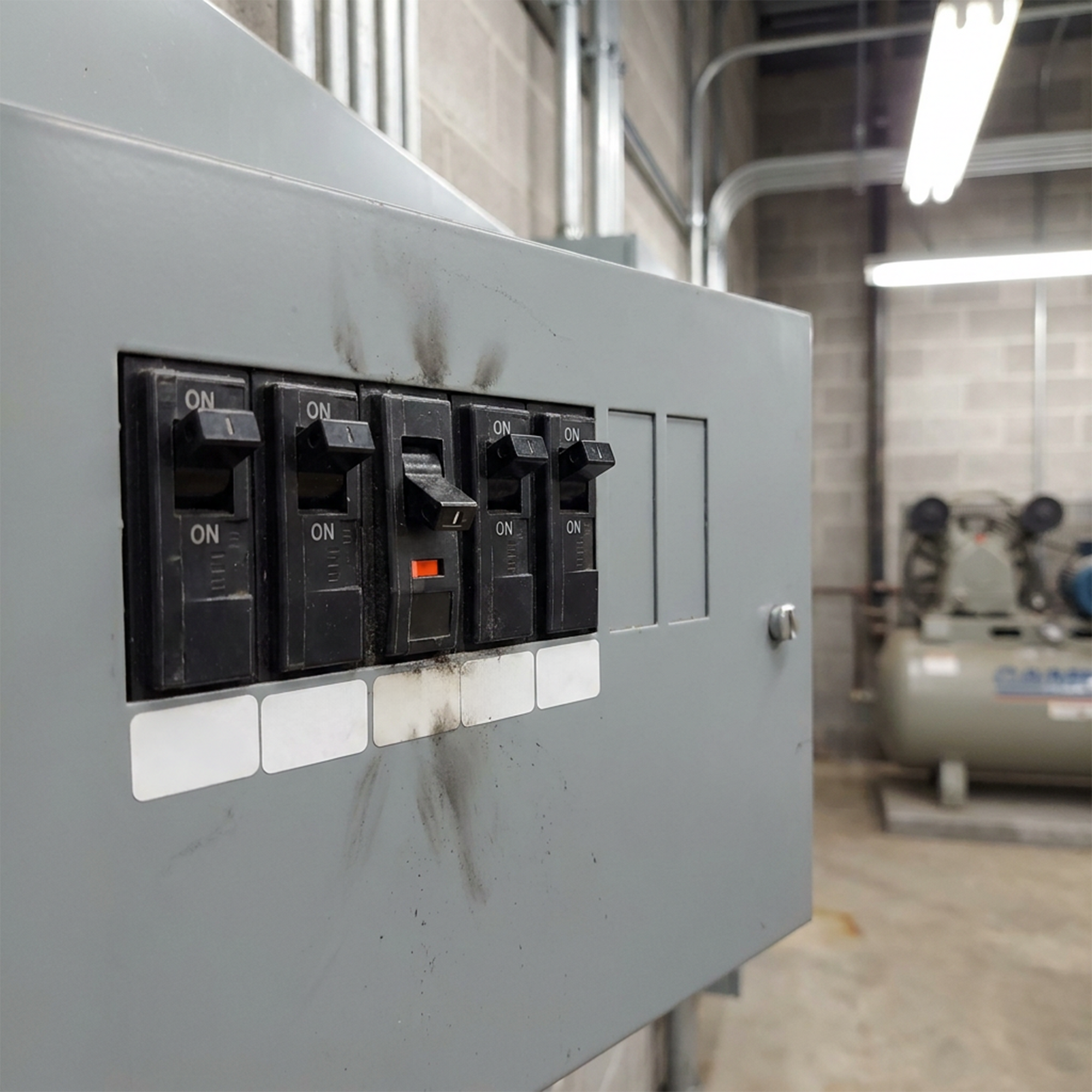
Flip the breaker back on, hit the switch, bang, dark again. An air compressor tripping the breaker is one of the most common calls we get, and the good news is the cause list is short and most of the fixes are cheap. The trick is reading the clue the compressor is giving you: when it trips tells you why it trips. Let's work through it the way we would over the phone.
First, the One-Minute Safety Check
Before any diagnosis: unplug the machine before opening anything, and drain the tank before touching valves or fittings. Capacitors hold a charge after unplugging, so if you're not comfortable discharging one, hand that step to someone who is. And never solve a tripping problem by installing a bigger breaker. The breaker is protecting the wire in your wall; oversizing it trades a nuisance for a fire risk.
The Clue: When Does It Trip?
| When it trips | Most likely causes | First thing to check |
|---|---|---|
| Instantly at startup | Failed start capacitor, seized pump, dead short | Does the motor hum without spinning? |
| Startup with a full or partly full tank | Unloader valve not venting head pressure | Do you hear the pssst when it stops? |
| A few seconds after starting | Low voltage, extension cord, weak capacitor | Cord length and gauge |
| Mid-cycle after running a while | Motor overload: clogged filter, low oil, worn pump, heat | Intake filter and oil level |
| Randomly, even at idle | Failing pressure switch, damaged cord, weak breaker | Burn marks and wire condition |
Trips Instantly: Think Capacitor
A failing start capacitor is the single most common reason a compressor slams the breaker the moment you switch it on. The capacitor gives the motor its kick to start spinning; when it dies, the motor sits there humming and pulling locked-rotor current, several times its normal draw, until the breaker gives up. The telltale is that hum with no rotation, sometimes with a capacitor that's visibly bulged or leaking. The part costs little and swaps in minutes, but match the microfarad rating and voltage printed on the old one. While you're in there, spin the pump by hand (unplugged) to make sure it isn't seized; a locked pump produces the exact same symptom with a healthy capacitor.
Trips Starting Against a Full Tank: The Unloader
Here's the failure that fools the most people. When a compressor shuts off, the unloader valve vents the trapped pressure in the head and discharge line with that short pssst you hear at every stop. If the unloader sticks, the motor has to start against that trapped pressure, and starting under load pulls enough extra current to trip the breaker. The pattern: starts fine with an empty tank, trips with a full one. The fix is cleaning or replacing the unloader, which usually lives on or beside the pressure switch. Since the two work as a pair, inspect both; our pressure switch collection covers most common replacements, many with the unloader built in.
Trips a Few Seconds In: Check the Cord
Compressor motors are voltage-sensitive at startup, and every foot of skinny extension cord starves them. Low voltage means high amps, and high amps means a tripped breaker or, over time, a cooked motor. If your compressor lives on a 50 or 100 foot cord of unknown gauge, that's suspect number one: plug the machine directly into the wall and test. If it must sit far from the panel, run a longer air hose instead of a longer cord. Air doesn't mind the trip; electrons do. A dedicated circuit matching the nameplate amp draw is the right long-term answer for any stationary machine.
Trips Mid-Cycle: The Motor Is Working Too Hard
When the breaker holds through startup but lets go partway through a fill, the motor is drawing too much for too long, and something is loading it down. Work this list in order, cheapest first:
- Clogged intake filter. A choked filter makes the pump fight for every breath. Pull it and look; if you can't see light through it, replace it. Elements are in our intake filter collection.
- Low or wrong oil. On oil-lubed pumps, low oil raises friction and amp draw together. Top up with proper compressor oil from our compressor oil collection, never motor oil.
- Heat. A compressor jammed in a hot corner with no airflow runs high amps all afternoon. Give it room to breathe and clean the dust blanket off the pump fins.
- Belt and pump condition. An over-tightened belt or a pump with dying bearings loads the motor mechanically. Spin it by hand (unplugged): it should turn smoothly with light compression resistance, no grinding, no tight spots.
- The motor itself. If everything above checks out and the trips continue, the motor windings may be breaking down. A motor that trips breakers, smells hot, or hums loudly is telling you its future. Match HP, RPM, frame, and voltage from our air compressor motor collection and swap it before it strands you mid-job.
Random Trips: The Boring Suspects
If there's no pattern at all, look at the boring stuff. A pressure switch with burned contacts can arc and spike current at any moment; look for browned terminals or a switch that clicks erratically. A pinched or abraded power cord shorts intermittently. And breakers themselves wear out: one that's tripped a hundred times gets weaker each round, until it trips at well under its rating. If the compressor runs clean on a different circuit but trips on its home circuit, suspect the breaker, and have an electrician confirm and swap it.
The Prevention Habit
Almost everything on this page announces itself early. A capacitor that starts slow before it fails, a filter that chokes gradually, an unloader that gets lazy. Thirty seconds of listening at startup each week, plus filter and oil checks on schedule, catches nearly all of it before the lights go out. If you want the full routine, we've laid it out in our maintenance schedule guide on this blog.
Frequently Asked Questions
Why does my air compressor trip the breaker immediately at startup?
Most often a failed start capacitor: the motor hums, can't spin, and pulls locked-rotor current until the breaker trips. A seized pump causes the same symptom, so spin the pump by hand with the machine unplugged to rule it out.
Why does it only trip when the tank is full?
The unloader valve isn't venting head pressure after shutdown, so the motor is starting under load. Clean or replace the unloader; it's usually part of or next to the pressure switch.
Can I run my air compressor on an extension cord?
It's the most common self-inflicted cause of trips. If you must, keep it short and heavy gauge per the manual. The better answer is to plug into the wall and run a longer air hose instead.
Is it OK to put in a bigger breaker so it stops tripping?
No. The breaker is sized to protect the circuit wiring, not the compressor. Oversizing it can let the wire overheat inside your walls. Fix the cause of the overcurrent instead.
How do I know if the motor itself is bad?
If the capacitor, unloader, filter, oil, belt, and supply voltage all check out and it still trips, especially with a hot smell or loud hum, the windings are likely failing. Replace the motor, matching HP, RPM, frame, and voltage off the nameplate.
Work the table from the top and you'll find your answer in an afternoon; an air compressor tripping the breaker is almost always a capacitor, an unloader, a cord, or a tired motor, in roughly that order of likelihood. And when the diagnosis points at hardware, we stock the fix, from switches to a full replacement motor.


