


It is 6 AM in April, the planter is in the shop with a wheel motor off, and the 3 HP compressor in the corner has been running solid for eleven minutes trying to get enough air behind a 3/4 inch impact to break one axle nut loose. The nut is not moving. The compressor is going to lose.
Every farm shop we talk to has a version of this story. Compressed air for farms gets bought once, usually for tires, and then twenty years of equipment gets heavier while the compressor stays the same size. Here is how to size it for the work you actually do, and, just as usefully, which farm jobs a compressor has nothing to do with.
What the Air Is Really For
Four jobs cover almost everything:
- Equipment repair in the shop. Impacts, air hammers, die grinders, cutoff wheels, blow-off. This is the load that decides your compressor size.
- Tire inflation. Far bigger than people expect. More on this below.
- Cleaning. Blowing chaff out of a combine, dust off radiator screens and rotary air cleaners, seed out of meter boxes at the end of the season.
- Odd jobs. Pneumatic fence staplers, paint and primer on implements, blowing out irrigation lines before freeze-up, clearing feed lines.
Notice what is not on that list. Grain bin aeration runs on centrifugal or axial fans, not a compressor. The fan on an air seeder or air drill is driven hydraulically off the tractor, not by shop air. Milking systems run on vacuum pumps and, where compressed air is involved, on their own dedicated setup, which we cover in compressed air for dairy farms and milk plants. We do not sell bin fans or seeder fans, and you should not size a shop compressor as if you were going to run them.
Tire Inflation Is the Job Everybody Undersizes
Ag tires run at low pressure and enormous volume, which is backwards from how most people think about air. A 480/80R42 rear tractor tire holds somewhere in the neighborhood of 40 to 50 cubic feet of air at working pressure. A pickup tire holds about 2.
So when you need to take a set of duals from 6 PSI back up to 18 PSI for road transport, you are not moving a little air, you are moving a lot of it at a pressure your compressor barely notices. The limit is pure volume, and a small compressor will run continuously for twenty or thirty minutes and still be behind you.
Two consequences worth acting on. First, buy more CFM than the tool chart suggests, because tires do not appear on tool charts. Second, watch duty cycle. A single-stage piston rated for maybe 50 percent duty will cook itself filling a set of duals, and this is exactly how farm compressors die. Our piece on duty cycle explains what that rating actually commits you to.
Sizing the Shop Compressor
Start from the biggest tool you run, not the sum of everything you own.
| Job | CFM at 90 PSI | Duty |
|---|---|---|
| 1/2 in impact wrench | 4 to 5 | Short bursts |
| 3/4 in impact wrench | 7 to 9 | Short bursts, but long ones on seized hardware |
| 1 in impact wrench | 10 to 14 | Bursts |
| Air hammer / chisel | 4 to 6 | Intermittent |
| Die grinder | 5 to 8 | Near continuous while cutting |
| Cutoff tool | 5 to 8 | Continuous |
| Blow gun | 4 to 15 | Whenever anyone walks past |
| HVLP spray gun | 10 to 14 | Continuous while spraying |
| Tire inflation, ag tire | Volume limited, not CFM limited | Long and continuous |
Practical landing spots:
- Small operation, light repair, a few tires. A 5 HP two-stage piston on 60 to 80 gallons, roughly 15 to 18 CFM at 175 PSI. This is the honest minimum for a working farm shop.
- Full-time shop, 3/4 in impacts, painting implements, regular tire work. 7.5 to 10 HP two-stage on 80 to 120 gallons, in the 24 to 35 CFM range.
- Large operation, multiple people working at once, or a shop that doubles as a repair business. This is where a 15 to 25 HP rotary screw starts making sense, 50 to 100 CFM, because a screw is built for continuous duty and a piston is not.
Tank size matters more on a farm than in most shops because of the tire work. More storage means the motor runs longer and starts less, which is easier on it. Eighty gallons is a good floor, and 120 is not overkill if you have the room.
Single Phase or Three Phase
Most farms are single phase, and that caps you at roughly 7.5 HP before the starting current becomes a real problem on a rural service. If you want a 10 HP or larger machine and only have single phase, price a rotary phase converter before you price a bigger compressor, and read our single phase vs three phase breakdown first. Sometimes the utility will run three phase to the yard for less than you expect. Sometimes it is a five figure number. Ask before you buy the compressor.
The Unheated Shop Problem
This is the part specific to agriculture that almost nobody plans for.
A farm shop is cold from November to March and humid from May to September. The compressor pulls in humid summer air, makes water, and that water sits in the tank and the lines. Then it gets cold, and the water in the drop lines and the drain valve freezes. Now your drain does not work, your tank is holding water all winter, and your tank is rusting from the inside.
What to do about it, in order of how much it matters:
- Drain the tank, every week, no exceptions. Or fit an automatic drain and stop thinking about it. This one habit is the difference between a tank that lasts twenty years and one that fails at eight. Our article on tank rust covers what a failed tank looks like before it lets go.
- Put in a dryer if you paint or run air tools hard. A refrigerated dryer holding a 38 to 50 F pressure dew point stops water at the source instead of chasing it at every drop. If you only inflate tires and blow off chaff, you can skip it. If you spray implements, you cannot.
- Slope your lines and add drip legs. Run the header with a slight fall away from the compressor, take every drop off the top of the line, and put a leg with a drain at the bottom of each riser. This is free at install time and expensive to retrofit.
- Winterize before freeze-up. Same drill as everything else on the place. We wrote it up in how to winterize an air compressor.
Blowing Out Irrigation
If you run pivots, buried mainline or drip, fall blowout is its own sizing problem and your shop compressor is almost certainly the wrong tool for it. Volume is everything and pressure has hard ceilings, 80 PSI on rigid PVC and 50 PSI on poly, above which you start breaking fittings and heads. We worked through the numbers in air compressors for irrigation blowout, including the GPM divided by 7.5 rule and the safe sequence.
Air in the Field
Shop air does you no good when the combine is down four miles out in a bean field at 8 PM.
Three options, in rough order of what most operations land on:
A portable tank you fill at the shop. Cheapest. Fine for topping off a tire or blowing out a screen. Useless for running an impact for more than about ten seconds.
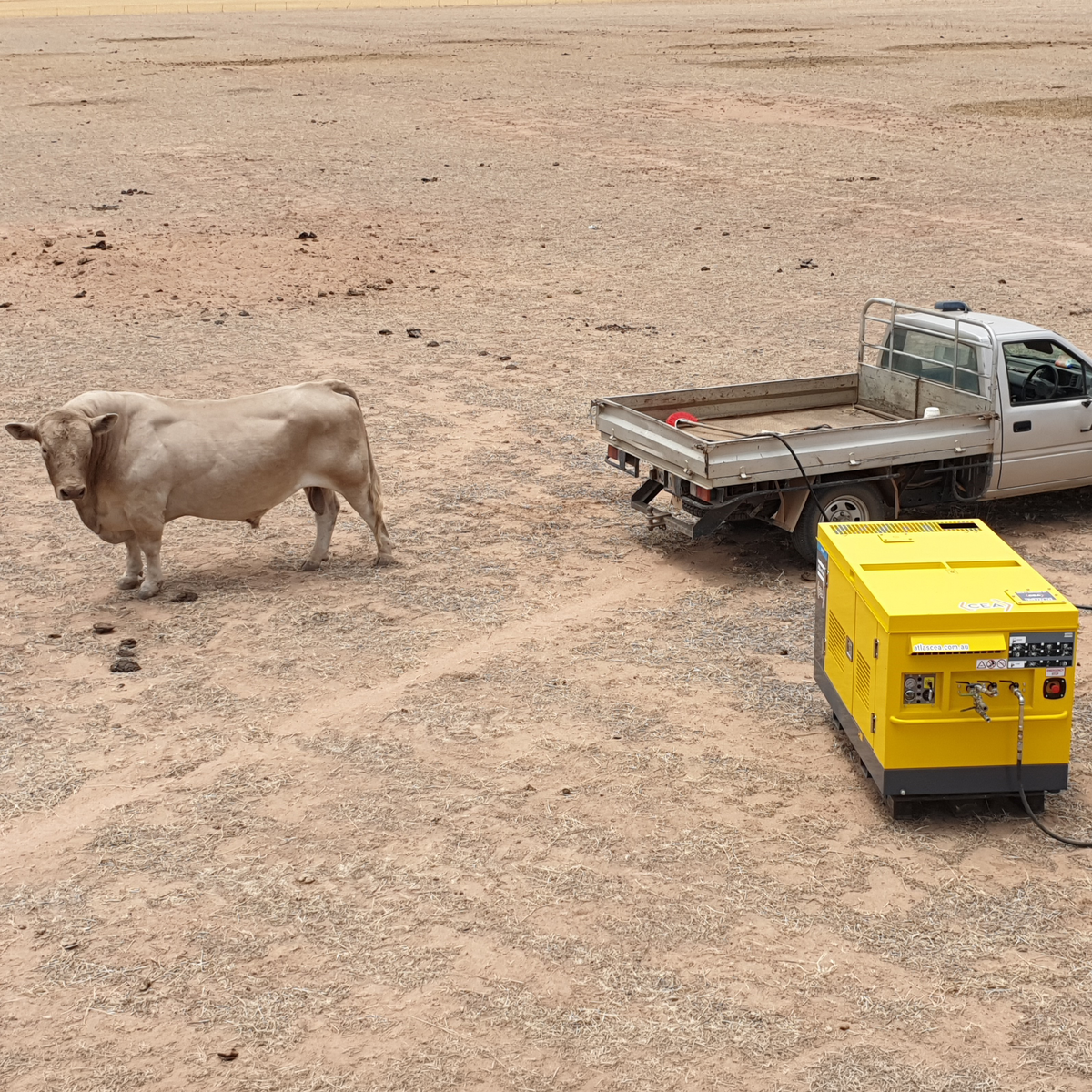
A gas or engine-driven unit on the service truck. The real answer if you break down in the field regularly and need to actually turn a nut out there. Look at output at 90 PSI and remember that a 1 in impact wants 10 CFM or better. Our truck-mounted compressor guide covers underhood, deck mount and hydraulic drive.
A tow-behind. Overkill for most farms unless you are also running air tools for construction or doing a lot of blowing out of tile and irrigation line. If you need one twice a year, rent it.
Mistakes We See on Farms Specifically
Buying on horsepower off a box store shelf. A 5 HP badge on a 120V machine and a 5 HP two-stage industrial unit are not the same compressor and not within 8 CFM of each other. Read delivered CFM at 90 or 100 PSI and ignore the number on the sticker.
Running 3/4 inch garden-hose-grade air line to the far end of the shop. A long run of small line eats your pressure before it gets to the tool. If the shop is 60 feet long, size the header for the distance. Pipe sizing is the cheapest CFM you will ever find.
PVC for the shop header. Common on farms, still a bad idea. It goes brittle and it shatters rather than splitting. OSHA is clear on this and so is physics.
Putting the compressor where the dust is. A shop that sees grain dust, chaff and dirt will plug an intake filter fast. Get the intake up off the floor, out of the traffic lane, and check the intake filter on a real schedule, not when the machine starts sounding tired.
Blow guns with the tip drilled out. Somebody always does it to get more force for cleaning a screen. Dead-end pressure for cleaning is limited to 30 PSI for a reason, and the modified gun is both a violation and a chunk of your compressor's output going out the nozzle.
Where to Start
Pick the biggest tool you own, add the tire work honestly, and buy a two-stage machine with real delivered CFM at that number plus about 30 percent. Put it on the biggest tank you have room for, drain it weekly, and size the shop header for the length of the building. Browse air compressors when you have that number in hand.
Done right, compressed air for farms is the single most useful utility in the shop and the one you stop thinking about. Done wrong, it is an eleven minute wait on an April morning while the planter sits.
Frequently Asked Questions
What size air compressor do I need for a farm shop?
A 5 HP two-stage piston on a 60 to 80 gallon tank is the honest minimum for a shop that does real equipment repair. Step to 7.5 or 10 HP if you run 3/4 inch impacts, paint implements, or do regular tire work. Size on delivered CFM at 90 to 100 PSI, not on the horsepower badge.
Can my shop compressor run a grain bin aeration fan?
No, and it is not meant to. Bin aeration uses centrifugal or axial fans moving large volumes of air at very low pressure. That is a completely different machine from a compressor, and sizing a compressor for it would not work at any price.
Why does my compressor struggle so much with tractor tires?
Because ag tires are a volume problem, not a pressure problem. A large rear tractor tire can hold 40 to 50 cubic feet of air, roughly twenty times a pickup tire. The compressor runs continuously for a long stretch, which is also why undersized single-stage machines burn up doing tire work.
Do I need an air dryer in a farm shop?
If you paint or run air tools hard, yes. A refrigerated dryer at a 38 to 50 F pressure dew point pays for itself in tool life and finish quality. If you only inflate tires and blow off chaff, a good water separator and weekly draining will get you by.
My shop is single phase. How big can I go?
Roughly 7.5 HP before starting current becomes a problem on a typical rural service. Past that, price a rotary phase converter and also ask the utility what three phase to the yard would cost. The answer varies wildly, and it is worth knowing before you commit to a compressor.


