


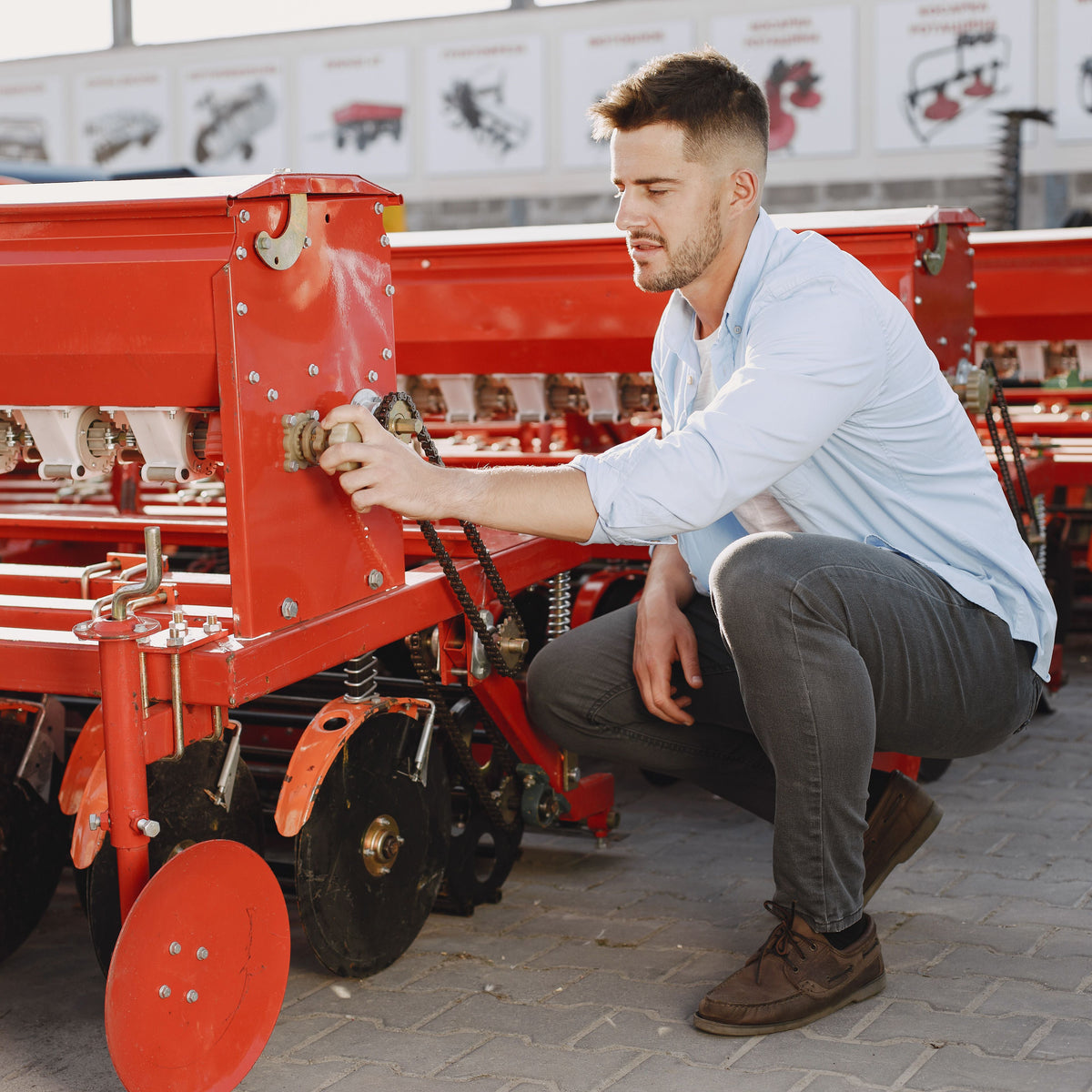
A combine comes in on a lowboy with a bad final drive, and the service manager has two techs, one open bay and a customer calling every hour. The first thing that happens is somebody grabs a 1 inch impact to pull the wheel. If that wrench stalls halfway through the first lug nut because the compressor is chasing the tank, you just lost twenty minutes, and you will lose them again on the next lug.
That is the reality of compressed air for equipment dealerships: ag, construction and compact equipment dealers run heavy tools on shop air, and heavy tools are hungry. This guide walks through what a dealership service department actually uses, what air it takes, and how to build a system that keeps up. We will also say where we stop. We sell the air system and the air tools. We do not sell hydraulic presses, A/C recovery machines or tire changers that handle the biggest ag rubber.
How a Dealer Shop Is Different From a Garage
A car shop lives on 1/2 inch impacts and tire machines. A dealership service bay lives on fasteners that need real torque. One ag publication notes it often takes more than 1,000 foot pounds to break loose the wheel fasteners on a semi or a tractor, which is why 1 inch drive air impacts are standard equipment in these shops. Pair that with grease guns, die grinders, cut-off tools, air hammers for stuck pins and bushings, parts washers and paint touch-up, and the demand adds up fast.
If you also run a trucking or fleet-style shop, our fleet shop article covers the road-vehicle side. This one is about the iron that stays on a farm or a jobsite.
What the Tools Actually Draw
These are average figures from a common compressed air consumption chart, and you should always confirm against the tool plate on what you buy. Our air tool CFM chart has more.
| Tool | Typical air use | Notes |
|---|---|---|
| 1 inch impact wrench | About 12 CFM | The big one. Wants a 1/2 inch hose and fittings |
| 3/4 inch impact wrench | About 6 CFM | Common on implements and compact equipment |
| 1/2 inch impact wrench | About 4 CFM | Brackets, covers, light work |
| Die grinder | About 5 CFM | Often runs for long stretches |
| Air hammer | About 4 CFM | Stuck pins, bushings, rust |
| Orbital body sander | About 10 CFM | Continuous duty, not bursts |
| Paint gun, production | About 8 CFM | Undercoat guns run closer to 19 CFM |
| Grease gun | About 3 CFM | Runs at higher pressure, 120 to 150 psi |
Sizing the Compressor
Add up what runs at the same time, not everything in the building. Two techs, each running a 1 inch impact for short bursts, plus a die grinder in the third bay, plus an air hammer, can touch 30 CFM briefly. Add a paint touch-up at the end of the day and you want headroom.
A practical way to think about it:
- Count the techs and bays. Two to four bays with two to four techs is a typical dealer shop.
- Pick the heaviest tool each tech uses most. For most that is the 1 inch impact, so budget 12 CFM each for bursts.
- Apply a duty factor. Impacts run in bursts, grinders and sanders run longer. Our diversity factor guide explains how to do this without buying too much compressor.
- Add 25 percent for the next tool you did not plan to buy.
For many small and mid-size dealer shops, a two-stage 7.5 to 15 HP machine is the sweet spot. Our 175 psi two-stage compressors give you the pressure for high-torque tools and the recovery to feed them. Bigger shops with five or more techs should go to a rotary screw and a pair of receivers.
Hose and Piping: Where Dealers Lose Torque
The most common complaint we hear is a brand new 1 inch impact that feels weak. The wrench is fine. The air is not reaching it. Heavy impacts need a 1/2 inch supply line and fittings, as one ag tool review points out, and a 3/8 inch whip hose or a cheap quick coupler can strangle the tool. Match the hose to the tool:
- Use 1/2 inch hose, or larger, for 1 inch impacts and sanders.
- Use full-flow couplers, not the tiny automotive style.
- Keep whip hoses short, and put a hose reel in each bay so hose does not get driven over by a tractor.
- Run the main line in 1 inch or larger pipe and loop the shop if you have more than two bays. Aluminum pipe installs fast and does not rust.
Air Quality: Dry Air for Paint and Tools
Dealerships do not fall under any food or pharma audit. But touch-up paint is the place wet, oily air costs you the most, because fisheyes mean a repaint of a fender on a customer's machine. A refrigerated dryer and a coalescing filter at the paint station are cheap insurance, and a drain that works at the tank keeps rust out of your tool motors. Read our water separator guide or go straight to our air dryers if you have not dried your shop air yet.
Mistakes We See in Dealer Shops
- Buying the biggest wrench first. A 1 inch impact on an undersized compressor feels worse than a good 3/4 inch on a proper system.
- A single skinny line. One 1/2 inch pipe feeding four bays gives you pressure drop at the far end.
- No receiver near the far bays. Extra storage near the heavy users takes the sting out of bursts.
- Forgetting the field truck. Few breakdowns happen close to an air compressor, as one ag writer put it, so many dealers keep a portable unit or battery impacts on the service truck for field calls.
- Ignoring tire safety. Large tractor and combine tires are heavy and dangerous to move. Use wheel dollies or tire lifts and follow the inflation rules for your wheel type. We do not sell large-ag tire machines.
What We Can't Do for You
We will not pretend to be a one-stop equipment shop. For hydraulic presses, A/C recovery machines, welders, diagnostic tools and tire changers, you will go to another supplier. For air tools, hose, couplers, compressors, tanks, dryers and piping, we have the range and we will tell you what to buy. Call if you want help sizing for your specific shop.
Shop the Right Tools
Start with our air tools, then size the compressor and hose to match. A tool that is starved of air is the most expensive tool in the shop.
Frequently Asked Questions
What size air compressor do I need for a tractor dealership service shop?
Most two to four bay shops land in the 7.5 to 15 HP two-stage range, depending on how many 1 inch impacts and grinders run at once. Add up the heaviest tools, apply a duty factor, and add headroom.
How much air does a 1 inch impact wrench use?
About 12 CFM on a typical consumption chart, but check the tool's own rating. It also needs a 1/2 inch hose and full-flow fittings to deliver that.
Is a 1 inch air impact better than a battery impact for equipment work?
Air still wins for shop use because it does not run out of charge mid-job and it costs less per tool. Battery models make sense on the service truck, away from the compressor.
Do I need an air dryer in a dealership shop?
Yes, at least at the paint station. Water in the line causes paint defects and shortens the life of air tools, and a refrigerated dryer solves most of it.
Can I run my whole shop on one compressor?
You can, but a single machine means one failure stops every bay. Many dealers add a second smaller unit as backup.


