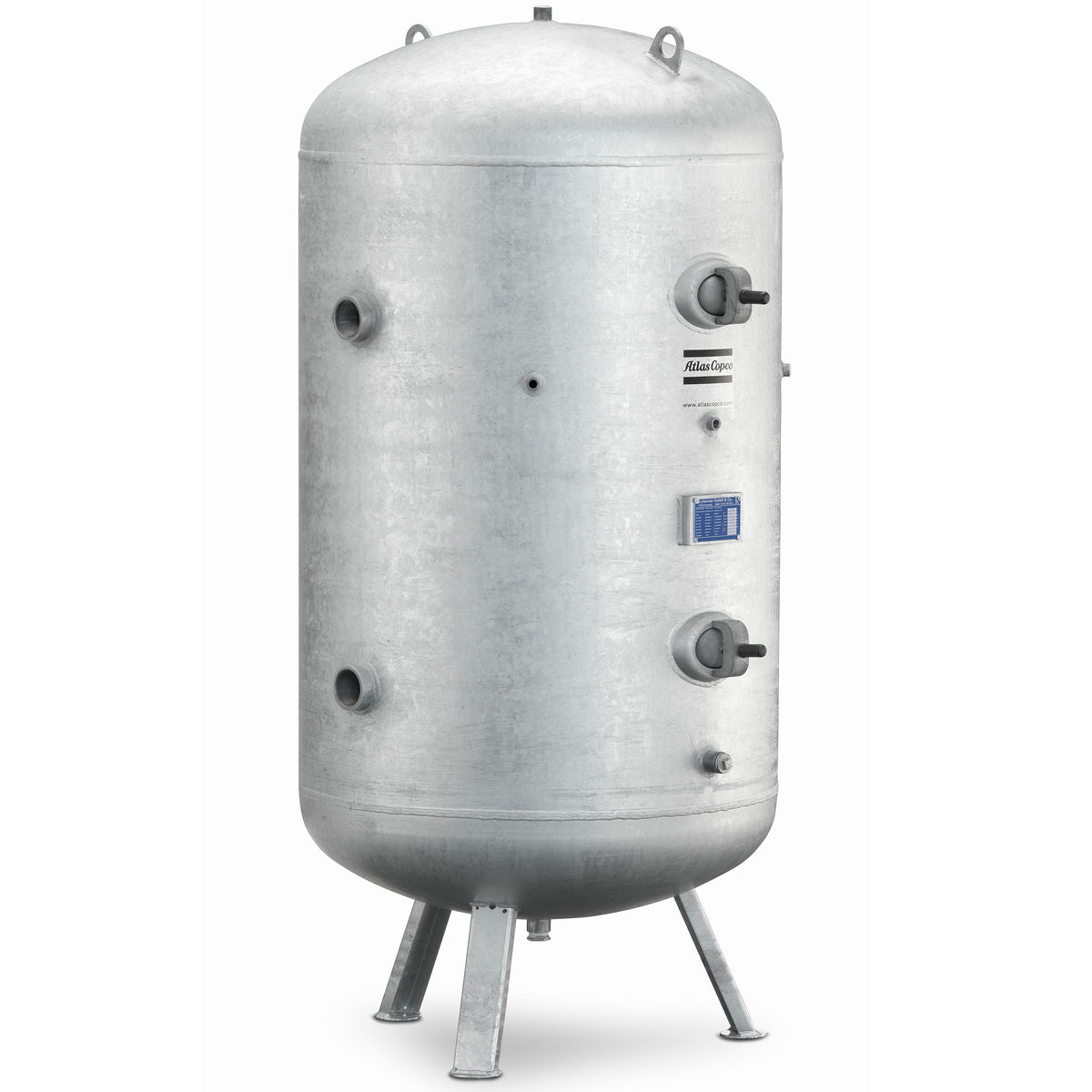
"Can I just use my old 120 gallon air tank as a vacuum tank?" We get that question every few weeks, usually from somebody who just bought a CNC router or a vacuum pump for a pick-and-place line and has a perfectly good receiver sitting in the corner. Short answer: maybe, but probably not, and the reason has nothing to do with how much pressure the tank is rated for.
A vacuum receiver tank does for a vacuum system what an air receiver does for a compressor. It stores capacity so the pump doesn't have to chase every spike, it keeps the vacuum level from crashing when a big load opens up, and it cuts down on pump starts. But the tank sees its load from the outside instead of the inside, and that changes what it has to be built to handle. Here's how to size one, how to tell whether a tank is actually rated for vacuum, and how to plumb it so it helps instead of hurts.
Why an Air Tank Isn't Automatically a Vacuum Tank
A compressed air receiver is designed to hold pressure pushing outward. A cylinder under internal pressure wants to get rounder, and the steel is in tension. Thin steel handles that well. That's why a 150 psi tank can have surprisingly thin walls.
Put that same tank under vacuum and the atmosphere is pushing in on it with up to 14.7 psi over every square inch. Now the shell is in compression, and a thin cylinder under compression doesn't fail by stretching. It buckles. Any slight out-of-roundness gets worse until the shell folds in on itself. ASME Section VIII handles this as a completely separate design case, external pressure, with its own charts and rules. A tank that's perfectly safe at 150 psi internal may not be designed for external pressure at all.
If you've ever seen the video of a railroad tank car crumpling after steam was trapped inside and cooled, that's the same physics at a bigger scale. A shop receiver won't usually fold that dramatically, but a buckled tank is a scrapped tank, and a sudden collapse can tear fittings out of the shell.
How to tell if a tank is rated for vacuum
- Look at the nameplate. A vacuum rated vessel will show an external pressure rating, sometimes stamped as full vacuum, and newer nameplates may show external rating as its own MAWP figure. If the plate only shows an internal MAWP, don't assume.
- Check the listing or data sheet. Manufacturers that build for vacuum say so plainly. Every tank in our vacuum rated air tanks collection is a Samuel vertical receiver marked "Vacuum Rated" in its listing, from 30 gallons up to 1,060.
- Ask the manufacturer with the serial number. If the paperwork is gone, the manufacturer can usually tell you what the vessel was designed for.
- If nobody can confirm it, don't use it. Engineers who've looked at this question generally land in the same place: no vacuum designation means it wasn't designed or certified for vacuum.
Some vacuum rated tanks, like the Samuels we carry, are also rated for 150 psi internal. That's handy if you ever repurpose the tank, but the vacuum rating is the one that matters here.
Sizing a Vacuum Receiver
The basic pump-down relationship that vacuum pump makers like Leybold publish is:
t = (V / S) × ln(P1 / P2)
Where t is the time to pull down, V is the volume being evacuated, S is pump speed, and P1 and P2 are the starting and ending absolute pressures. Rearranged, it tells you how big a volume a given pump can recover in a given time. Two cautions from the pump makers themselves: it assumes pump speed stays constant, which it doesn't as vacuum deepens, and it ignores leaks and pipe restriction. So real times run longer than the math says. Use it to get in the right neighborhood, then add margin.
Absolute pressure, not gauge
The formula uses absolute pressure. Vacuum gauges in the US read inches of mercury below atmosphere, so convert first. At sea level, atmosphere is about 29.92 inHg. A gauge reading of 22 inHg vacuum is 29.92 minus 22, or 7.92 inHg absolute.
A worked example
Say you're running a CNC router at 22 inHg on a pump that moves about 100 CFM at that level. You lift a sheet off and the system drops to 15 inHg (14.92 absolute). How long to get back to 22 inHg with a 120 gallon receiver, which is about 16 cubic feet?
t = (16 / 100) × ln(14.92 / 7.92) = 0.16 × 0.633 = about 0.10 minutes, or roughly six seconds, before leaks and pipe losses.
Now flip it around and look at what the receiver does when a load opens up. Imagine a fixture or a vacuum bag with 2 cubic feet of air at atmosphere suddenly connecting to the system at 22 inHg. Mix the two volumes and the system settles at a pressure in between:
| Setup | Volume under vacuum | Vacuum right after the 2 cu ft load opens |
|---|---|---|
| Pump and piping only | about 1 cu ft | about 7 inHg |
| With a 120 gallon receiver | about 17 cu ft | about 19.5 inHg |
That's the whole case for a receiver in one table. Without storage, the hold-down on every other part on the table collapses to about a third of what it was the instant that load opens. With the tank, the system barely flinches while the pump catches up. Thermoforming shops use the same mixing math to size their receivers, because the form needs that quick initial pull-down that only stored vacuum can give.
Rules of thumb
You'll hear rules like "one gallon of tank per CFM of pump." We couldn't find a pump manufacturer who publishes that as a rule, so treat it as a rough starting point at best. The better approach is to identify your biggest sudden load, decide how far you can let the vacuum level drop when it opens, and size the receiver with the mixing math above. If your system piping is more than about 10 percent of the tank volume, count it, since big diameter pipe is storage too.
Typical Vacuum Levels by Application
| Application | Typical vacuum level | Notes |
|---|---|---|
| CNC router hold-down | 18 to 24 inHg | Going to 26 inHg adds very little holding force but needs a lot more pump |
| Regenerative blower systems | about 13 to 14 inHg max | High flow, lower vacuum |
| Rotary vane and liquid ring pumps | about 22 to 29 inHg | Common for hold-down and process vacuum |
| Dairy milking systems | about 13 to 14.8 inHg | Per FAO guidance, with an interceptor of at least 15 liters near the pump |
One number from the CNC world is worth taping to the pump: chasing 26 inHg instead of 24 takes at least 50 percent more pump capacity for about one more psi of holding force. And a dirty inlet filter dropping 2 inHg at 24 inHg can cut your effective pump capacity by a third. Deeper isn't automatically better. Steadier is. We go into the router side more in compressed air for CNC router and sign shops.
A note on medical and dental vacuum: those systems are governed by NFPA 99 and are sold as certified packages with specific receiver, pump and alarm requirements. We don't sell certified medical vacuum systems, and you shouldn't build one out of shop parts.
Plumbing a Vacuum Receiver the Right Way
Vacuum plumbing has a few habits that run opposite to compressed air, so they catch people.
- Put the receiver between the pump and the process. The process pulls from the tank, the pump pulls from the tank. That lets the tank buffer the load and also act as a separator for anything the process sucks in.
- Check valve between pump and receiver. When the pump stops, the check valve keeps the system from bleeding back through the pump. A pump with a check valve that has reached its set point holds that vacuum without spending more energy. Our check valves cover the common pipe sizes, but confirm the one you pick is suitable for vacuum service.
- Isolation valves on each pump. So you can service one without dropping the whole system.
- Inlet filtration ahead of the pump. Dust and chips kill rotary vane pumps. Size the filter generously, because pressure drop on the vacuum side costs you capacity fast.
- Plan for liquid. Here's the one that surprises people: liquid under vacuum won't drain on its own. Opening a drain valve on a tank under vacuum just pulls air in. Use a drain you can isolate, or a three-valve bypass that lets you drain the tank without stopping the system. Slope lines toward the receiver or a drop leg and away from the pumps.
- Don't neck down. Keep receiver ports and the main line at least as large as the pump inlet. Run the flow straight through the tank instead of teeing off the side.
- Put a vacuum gauge on the receiver. A gauge that reads vacuum, at the tank, tells you more than any setting on the pump control. Add a gauge port so you can watch leak-up rate with the pump off.
Receivers and Pump Cycling
A vacuum pump that starts and stops every few seconds is wearing out its motor, its starter and its vanes. A properly sized receiver stretches those cycles out, the same way an air receiver does for a compressor. On systems with a backup pump, the receiver also has to carry the load while the standby comes online. One large system written up by a vacuum specialist needed two full minutes of storage to ride through a pump switchover. That's a big tank, but it's a lot cheaper than scrapping a production run.
If you already think in compressed air terms, the logic is identical to what we covered in our air receiver tank guide. The only differences are that the pressures are absolute, the gains are smaller, and the tank has to be built for the squeeze.
Frequently Asked Questions
Can I use a regular air compressor tank as a vacuum tank?
Only if it's rated for external pressure or full vacuum. Internal pressure ratings don't tell you anything about how the tank behaves under vacuum. If the nameplate or the manufacturer can't confirm a vacuum rating, buy a vacuum rated tank.
How big should my vacuum receiver be?
Size it to your biggest sudden load. Figure the volume that opens up at atmosphere, decide how much vacuum drop you can live with, and use the mixing math in this article. Then check recovery time with the pump-down formula and add margin for leaks.
Where does the vacuum receiver go?
Between the pump and the process, with a check valve and isolation valve on the pump side, inlet filtration ahead of the pump, and a way to drain liquid without breaking vacuum.
Does a vacuum tank need a drain?
Yes, if there's any chance of liquid getting in, which there usually is. But a plain drain valve won't work under vacuum. Use a drain you can isolate from the system, or a bypass arrangement that lets you drain while the process keeps running.
Will a bigger receiver let me use a smaller vacuum pump?
It can cover short peaks, so a pump sized for average demand plus a good receiver often beats a bigger pump alone. But if your average demand exceeds what the pump moves, no tank will fix that.
The Short Version
A vacuum receiver tank is cheap insurance for a vacuum system, but only if it's actually built for vacuum. Confirm the rating, size it for your biggest sudden load, put it between the pump and the process, and give it a way to shed liquid. Our vacuum rated tanks run from 30 gallons for a small router table to 1,060 gallons for plant systems.