


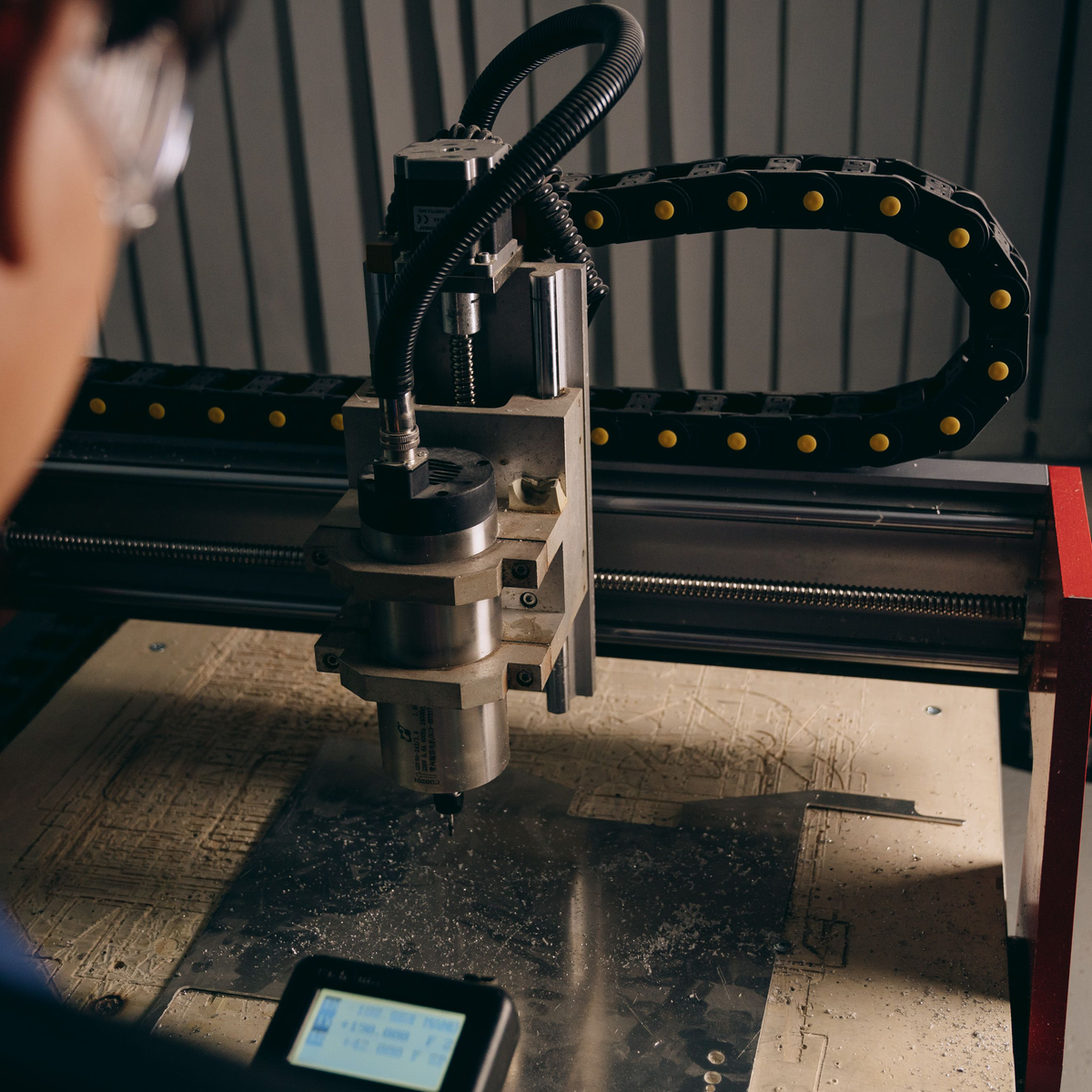
The most common mistake we see in a new sign shop is a compressor that is too big and an air line that is too wet. The owner just bought a 5 by 10 router, somebody told him it needs "good air," and he walks into the shop with a 120 gallon, 7.5 horsepower rig in mind. The router's tool changer will use less air in a day than that machine moves in a minute. What it needs is air that arrives at the right pressure, clean and dry, every single time the spindle asks for it.
Compressed air for CNC router and sign shops is a small-flow, high-consequence job. The volume is tiny. The cost of getting it wrong is a rusted tool holder, a stuck drawbar or a cut that stops halfway through a $400 sheet.
What a router, a laser and a spray booth actually use
A sign and graphics shop usually has some mix of a CNC router, a laser or engraver, a paint or finishing area, and a few pneumatic hand tools. Most of the air demand in that list is surprisingly small. Here are real numbers from one router controller maker's published requirements. Treat them as a starting point and check your own machine's manual.
| Use | Published requirement |
|---|---|
| Supply pressure at the controller | 95 to 105 PSI |
| Automatic tool changer (ATC), per tool change | About 0.23 cubic feet of air, at least 95 PSI to actuate the drawbar |
| ATC case pressure while the spindle runs | About 0.5 CFM |
| Laser air assist, cutting | 5 to 20 liters per minute at the nozzle (about 0.18 to 0.71 CFM) |
| Laser air assist, engraving | 1 to 5 liters per minute (about 0.04 to 0.18 CFM) |
| Recommended compressor for ATC or laser | 3 SCFM at 90 PSI, 6 gallon tank, 110 PSI minimum tank pressure |
| Minimum compressor | 2 SCFM at 90 PSI, 3 gallon tank |
Read that again. The recommended compressor for a tool-changing router is 3 SCFM and 6 gallons. That is a small quiet unit. The same maker says the air must be filtered to at least 40 microns, dried, regulated, and not connected directly from shop air to the machine. In humid climates they suggest adding a higher-capacity dryer.
Pressure matters more than flow
The part that catches people is pressure, not volume. The drawbar needs at least 95 PSI at the moment of the tool change. If your compressor cuts in at 90 and cuts out at 105, or your regulator is set to 80 because that's what the paint gun likes, the tool changer will fail on a random Tuesday. It will look like a machine fault. It is an air supply fault.
That's why the manufacturer says to set the regulator as high as practical without hurting other equipment, and why it recommends a tank that holds 110 PSI or more. Stored air carries the machine through the 0.23 cubic foot gulp. Give the router its own regulated drop and keep the paint gun on a different regulator.
The real enemy is water
A router spindle with a tool taper in it is a precision fit. Water in the air line gets into the tool changer and the spindle case, and the first symptom is flash rust on tool holders. A dusty cut makes it worse. The case pressure air (that 0.5 CFM that keeps dust out of the spindle) also carries whatever water and oil your compressor makes into the bearing area.
Piston compressors push some oil vapor and a lot of moisture. Here is what a clean setup looks like for a router:
- A compressor with a real tank, so it isn't cycling every few seconds.
- An aftercooler or a refrigerated dryer to pull the water out. A small point-of-use dryer works well here. Read our dew point explainer if you're not sure what you're buying.
- A coalescing filter, plus a particulate filter at the machine, rated down to or below that 40 micron minimum.
- A drain that actually drains. A manual one you forget about doesn't count. See the condensate drain options.
- A regulator at the machine set to the controller's rated range, with a gauge you can see.
Choosing the compressor
Here's where quiet matters. Sign shops often sit in a small commercial bay next to a front office or a showroom. A piston compressor rattling at 90 decibels is a bad neighbor to a customer in the next room. Scroll compressors are quieter, oil-free and don't throw liquid oil into your lines. They also tend to cost more per CFM, but a router doesn't need many CFM, so that isn't the number that hurts. You can look at the options in our scroll air compressors collection. Our write-up on scroll compressors explains where they fit and where they don't.
If budget is the issue, a quiet oil-free piston unit with a decent tank will run an ATC and a laser air assist for years. Make sure it hits the 110 PSI tank pressure and stores more than the minimum 3 gallons. Ours in the California Air Tools line fit that description, and bigger ones keep the quiet.
One more point. If you've bought a router that holds sheets down with a vacuum table, the vacuum comes from a separate vacuum pump, not from your compressor. Don't size the compressor for the table. And if you add a laser later, look at its air assist spec separately.
The rest of the shop
Sign shops do more than route. Once the router is covered, here's how to think about the other air users.
- Spray finishing and paint. A spray gun uses far more air than the router does and it is the one that decides whether you need a bigger compressor. Check the CFM on your gun's data plate. Water and oil in paint air show up as fisheyes and blushing. Our air tool CFM chart gives a place to start.
- Blow-off and cleanup. A blow gun is a convenient way to waste air. Use it, but know that it can pull as much as a spray gun.
- Hand tools. Staplers, nailers and small sanders on frames and cabinets run short bursts and are easy on the compressor.
If the paint area is the biggest air user, size the compressor for the paint area and give the router its own filtered and regulated branch. A regulator and a small filter at each machine costs far less than one scrapped sheet.
Mistakes sign shops make
- Buying too much compressor. A big one cools and loads less often and builds more condensate.
- Running shop air straight into the router. The manufacturer says do not.
- One regulator for everything. The router wants 95 PSI or more, the spray gun wants less.
- Skipping the drain. A tank full of water is a rust factory pointed at your spindle.
- Treating the laser's air assist as free. It's small, but it also needs clean air, or the lens fogs.
Frequently Asked Questions
What size air compressor do I need for a CNC router?
For a router with an automatic tool changer, one controller maker recommends about 3 SCFM at 90 PSI with a 6 gallon tank and 110 PSI or more of stored pressure. Your machine's manual has the final word.
Does a CNC router need dry air?
Yes. Water in the line causes rust in tool holders and the spindle case. The same maker says shop air must be filtered, dried and regulated before it reaches the machine.
How much air does a laser engraver use?
Air assist is small, about 1 to 5 liters per minute when engraving and 5 to 20 liters per minute when cutting, according to one controller maker. That is under 1 CFM.
Does the vacuum table use compressed air?
Most vacuum hold-down tables use a separate vacuum pump. Check your machine, since a few systems use venturi vacuum generators that do consume compressed air.
Can I use my paint compressor for the router?
Sometimes, if it holds 110 PSI or more, has a dryer and filter, and the router gets its own regulator. Keep the router at 95 PSI or more and the gun at its own lower setting.
Shop scroll air compressors for quiet, oil-free air at the machine.


