


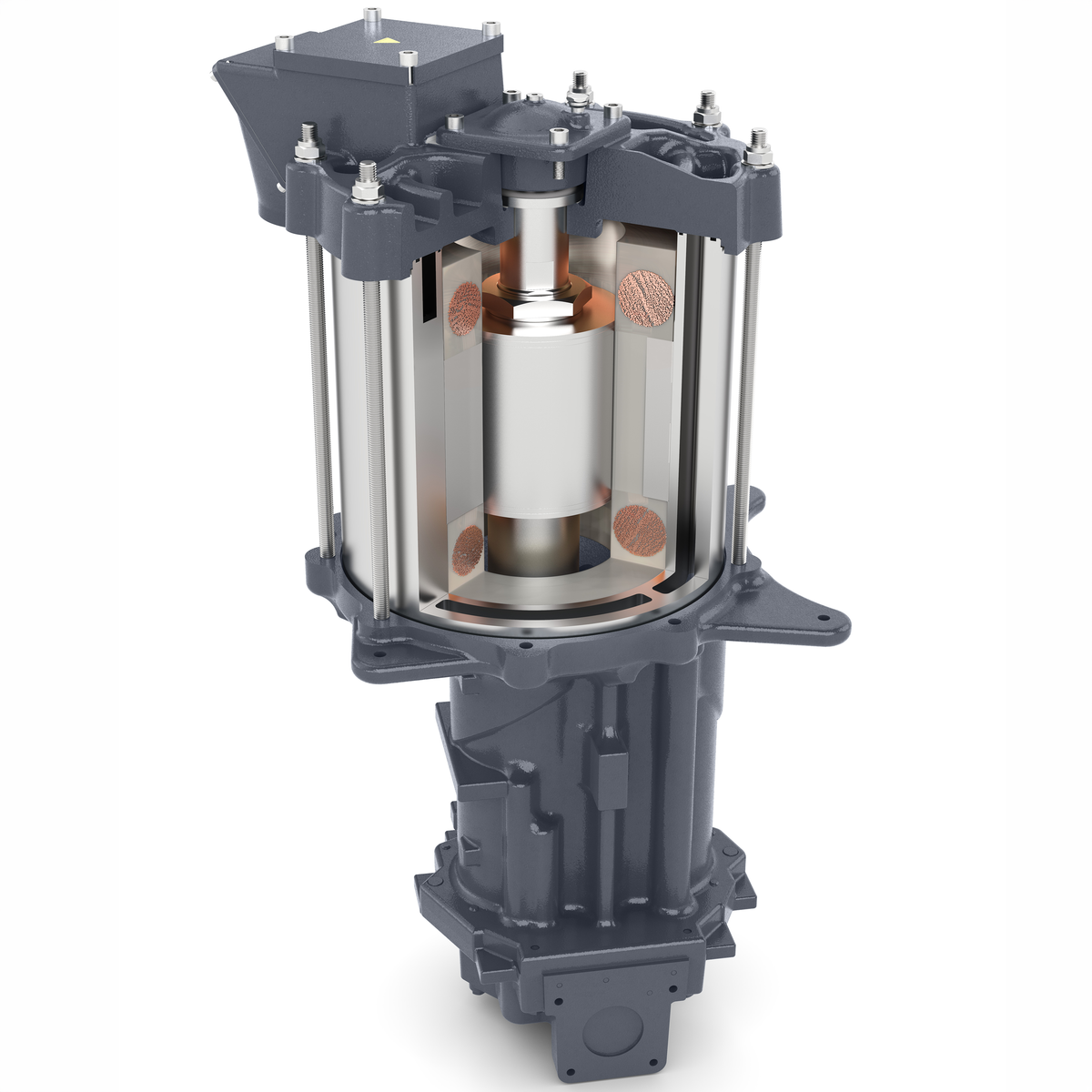
Pull the data sheet on a variable speed compressor built in the last few years and there is a good chance the motor is not an induction motor at all. It will say permanent magnet, or PM, or sometimes synchronous reluctance. The horsepower looks the same, the package looks the same, and the price does not.
Motor technology is the quietest change in compressor packages over the past decade, and most buyers never ask about it. Understanding what a permanent magnet motor air compressor is actually doing differently tells you whether the premium is buying you something and what you are signing up for in twenty years.
Three Motors, Three Rotors
The stator is similar across all three. What changes is the rotor, and that is where the efficiency comes from.
Induction, the traditional machine
The rotor carries conductive bars shorted together. The rotating stator field induces current in those bars, and that induced current creates the rotor's own field, which is what produces torque. The catch is in the word induced: the rotor has to turn slightly slower than the stator field for induction to happen at all. That difference is slip, and every amp of induced rotor current turns into heat in the rotor bars. Rotor losses are built into how the machine works.
Permanent magnet, PM
Magnets are mounted on or buried in the rotor. The rotor field exists on its own with no current needed to create it, so the rotor turns in step with the stator field and there is no slip and essentially no rotor current. Delete the rotor losses and you delete a meaningful slice of total loss. PM is what made IE4 and IE5 efficiency levels practical in compressor packages.
Synchronous reluctance, SynRM
The clever one. The rotor is a shaped steel lamination stack with flux barriers cut into it, giving it directions where magnetic flux passes easily and directions where it does not. The rotor aligns itself with the stator field because that is the lowest reluctance position, and torque comes from that alignment tendency.
No magnets. No windings. No bars. The rotor has neither magnets nor windings and suffers virtually essentially no losses of its own. ABB pushed this into mainstream industrial use with IE5 SynRM machines, and the pitch is that it delivers performance near a PM motor with the simplicity and serviceability of an induction motor.
What the Efficiency Gain Actually Is
Be careful with headline percentages, because a few points at the motor is not a few points on your air bill.
Comparative work puts induction machines around 91.8 percent efficient against roughly 94 to 95 percent for synchronous reluctance designs, about 2.5 points better. On a 50 HP machine that is real money over fifteen years, but it is not the transformation that marketing sometimes implies.
The bigger story is part load. A motor's nameplate efficiency is a full load number, and induction motor efficiency falls off as load drops, because the fixed losses stay while the useful output shrinks. PM and SynRM machines hold their efficiency much flatter down the speed range.
That matters enormously in a compressor specifically, because the entire reason you bought a variable speed machine is that it spends its life at part speed. A motor that is 2.5 points better at full load and considerably better at 50 percent speed is contributing exactly where the machine actually operates. There is also a regulatory push toward manufacturers stating losses at specified load points, which finally lets you compare motors on VSD duty rather than only at full load.
| Induction | Permanent magnet | SynRM | |
|---|---|---|---|
| Rotor losses | Inherent, from induced current | Essentially none | Essentially none |
| Slip | Yes | No, synchronous | No, synchronous |
| Typical efficiency class | IE3, IE4 with effort | IE4 to IE5 | IE5 |
| Part load efficiency | Falls off | Stays flat | Stays flat |
| Rare earth content | None | Yes, neodymium magnets | None |
| Can run across the line | Yes | No, needs a drive | No, needs a drive |
| Rewind and repair | Any motor shop | Specialist, often factory | Closer to induction |
| Power factor | Moderate | High | Lower than PM, drive compensates |
The Things Nobody Mentions at Quote Time
Four practical consequences worth knowing before you sign.
It cannot run without the drive. An induction motor can be wired direct to line as a limp home measure. A PM or SynRM motor cannot. The drive is not an accessory on these machines, it is part of the motor system, and a drive failure is a machine down event with no workaround.
Service is narrower. Any competent motor shop can rewind an induction motor. PM motors are a different conversation, often a factory exchange, and a PM rotor is a strong magnet that is genuinely hazardous to handle. SynRM sits closer to induction here, which is part of its appeal.
Rare earths are a supply chain question. PM motors use neodymium magnets. Pricing and availability of rare earth materials have been volatile, and SynRM exists partly as an answer to that exposure. If you are specifying a fleet of machines over years rather than buying one, it is a fair question to ask a supplier.
The drive still makes harmonics. None of this changes the power quality side. A variable speed package is still a nonlinear load on your service regardless of what kind of motor is behind the drive, which we covered in VSD harmonics and IEEE 519.
How to Evaluate It on a Quote
- Ask what the motor is. Induction, PM or SynRM, and what IE class.
- Ask for losses at load points, not just full load efficiency. On a machine you bought to run at part speed, the part speed numbers are the ones that matter.
- Compare at the package level anyway. Motor efficiency is one input to specific power, and specific power is what you actually pay. A superb motor on a mediocre airend is still a mediocre package. We laid out the comparison in specific power.
- Ask who services it and what a replacement costs, with a lead time. This is the question that separates a good ownership experience from a bad one in year eight.
- Ask whether the drive is standard or proprietary and whether a replacement drive has to come from the OEM.
Browse variable speed rotary screw compressors with those five questions, and if you are replacing a motor on an existing machine rather than buying a package, our electric motors category covers the induction side where most retrofits live.
Frequently Asked Questions
What is a permanent magnet motor in an air compressor?
A motor whose rotor carries magnets instead of conductive bars, so the rotor field exists without needing induced current. That removes slip and essentially removes rotor losses, which is what makes IE4 and IE5 efficiency levels practical in compressor packages. It requires a variable frequency drive and cannot be run directly across the line.
What is a synchronous reluctance motor?
A motor with a rotor made of shaped steel laminations with flux barriers, giving it easy and hard directions for magnetic flux. The rotor aligns itself with the stator field because that is the lowest reluctance position, and torque comes from that alignment. There are no magnets, no windings and no bars in the rotor, so rotor losses are essentially eliminated without using rare earth materials.
How much more efficient is a PM or SynRM motor?
At full load, comparative data puts induction around 91.8 percent against roughly 94 to 95 percent for synchronous reluctance designs, about 2.5 points. The larger practical gain is at part load, where induction efficiency falls off and PM and SynRM stay much flatter, which matters because a variable speed compressor spends most of its life at part speed.
Can a permanent magnet compressor motor run without its drive?
No. Both PM and SynRM motors are synchronous machines that require a drive to start and control them, so there is no across the line fallback. On an induction machine a failed drive can sometimes be bypassed as a temporary measure. On these, a drive failure takes the compressor out of service until it is repaired or replaced.
Are rare earth magnets a problem?
They are a supply chain consideration rather than a technical flaw. PM motors use neodymium magnets, and rare earth pricing and availability have been volatile. Synchronous reluctance was developed in part to reach comparable efficiency without them. For a single purchase it rarely changes the decision. For a fleet specified over years, it is a reasonable question to put to a supplier.
The Takeaway
The efficiency gain in modern variable speed compressors is not only better airends and smarter controls. A good part of it is that the rotor stopped generating its own heat. PM gets there with magnets, SynRM gets there with geometry, and both hold efficiency across the speed range in a way induction motors do not. Ask which one is in the package, ask for losses at part load, and ask who fixes it in year eight.


