


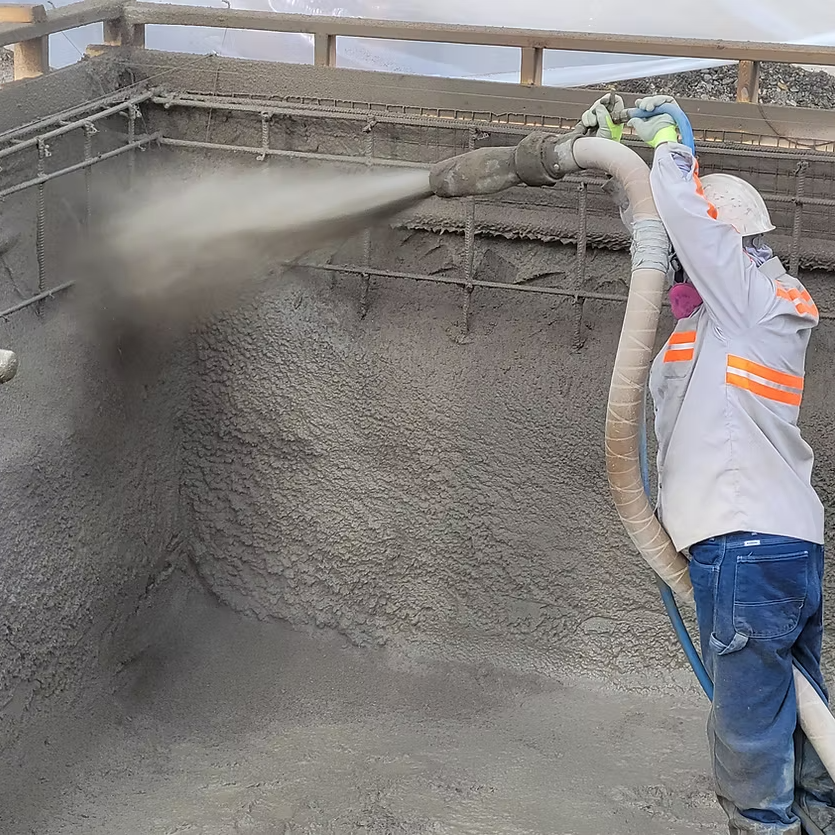
The nozzleman is standing in a half-dug hole with a 2 inch hose in his hands, the crew is waiting on steel to be tied off, and the compressor sitting out by the curb is a 185 that the shop has pulled to a hundred jobs. It will make air. The question is whether it makes enough to throw a wall of concrete at 300 to 400 feet per second, because that speed is what packs the mix around the rebar. This is the heart of compressed air for gunite and shotcrete pool builders: the compressor isn't a support tool on this job, it's the thing that actually places the concrete.
Why a pool crew needs more air than almost any other trade
Plenty of contractors run a compressor for nailers and breakers. Shotcrete is different because the air is the delivery system. In dry-mix work, which most people still call gunite, dry sand and cement ride through the hose on air and water is added at the nozzle. In wet-mix work, a pump moves premixed concrete and air at the nozzle accelerates it onto the surface. Either way, the air supply sets how hard the concrete hits, and how hard it hits drives density, compaction and permeability.
A pool wall that's under-compacted looks fine the day it's shot and shows up later as honeycombing, rebound pockets, or a shell that leaks. Nobody wants to be the builder explaining that to a homeowner with water in the yard.
The numbers
These are published figures, not rules of thumb we made up. Atlas Copco's gunite application guide says the job typically calls for 600 to 950 CFM at 125 to 150 PSI. A pool-industry article from the American Shotcrete Association recommends a minimum of 700 CFM for dry-mix gunite and a minimum of 250 CFM for wet-mix shotcrete. It also calls a 185 CFM compressor, which is a common sight, nowhere near enough for dry-mix and marginal for wet-mix.
| Process | Published air guidance | Source |
|---|---|---|
| Dry-mix (gunite) | 700 CFM minimum; typical range 600 to 950 CFM at 125 to 150 PSI | ASA pool article; Atlas Copco application guide |
| Wet-mix shotcrete | 250 CFM minimum | ASA pool article |
| Typical placement rate for pool work | About 8 to 10 cubic yards per hour on a 2 inch hose | ASA pool article |
The same article makes a point that matters when you're sizing: an oversized compressor is safe, because you can back the output off, while an undersized one costs you velocity. Hose length matters too. Beyond about 100 feet, friction and falling pressure take velocity away, so a 700 CFM machine on a long run can behave like a smaller one.
Dry-mix versus wet-mix, and what each does to your compressor
Dry-mix lets the nozzleman start, stop and adjust consistency at the nozzle, which is why many builders like it for stepped, detailed pools and smaller jobs. It also needs the most air and the driest air, because moisture in the line is how a dry-mix hose plugs. Wet-mix works well on large pools and high-volume jobs, uses less air, and puts the batching at the plant. Plenty of crews run both depending on the job. If that's you, size the compressor for gunite and let wet-mix jobs ride along with headroom.
What we'd put in front of a pool crew
Pool builders don't need a plant air system. They need a towable or skid compressor that shows up, runs all day and doesn't quit in July. Our towable air compressors cover the range:
- Around 250 CFM (a 250 KD8 class unit) is a wet-mix machine on small pools, with the nozzle held close and hose runs kept short.
- 350 to 400 CFM (a 400 KoD class unit, 100 to 200 PSI) is a more comfortable wet-mix machine and the bottom edge of dry-mix territory on short runs.
- Around 650 to 785 CFM (the 650 and 750-200 MP class machines) gets you into real gunite territory.
- About 870 CFM (a 900 class unit) is where a dry-mix crew stops arguing about air and starts arguing about the mix.
Pay attention to the pressure rating as well as the CFM. A compressor that makes its rated CFM at 100 PSI and 750 at 150 PSI, as the Atlas Copco XAS 900 sheet does, delivers less air at the higher pressure. The published gunite range of 125 to 150 PSI means you want the CFM rating at that pressure, not at 100.
Air quality: it's about water, not a standard
No food or pharmaceutical standard hangs over a pool shell. What matters is moisture and oil in the line. Dry cement is hygroscopic, so wet air can start the reaction before the material gets to the nozzle and turn a smooth run into a plugged hose. Portable compressors typically have an aftercooler built in. Ask for it by name when you shop, and check the water separator and drain are working before every job. If your area is humid, an in-line separator close to the machine is cheap insurance, and our aftercooler collection and water separator collection cover the parts. Oil carryover is rarely a problem on a healthy screw, but a unit that's passing oil will foul the mix and the hose, so don't ignore a bad separator element.
Hose, couplers and the last 100 feet
The compressor makes the CFM, but the hose decides how much of it reaches the nozzle. Keep the air line as short and as large as the job allows, use full-flow couplings, and don't daisy-chain adapters that step the bore down. A wall of rebar, a long reach and a kinked line can turn an 850 CFM machine into a 500 CFM experience at the nozzle. We stock hoses and couplers for the air side of the job. The material hose and nozzle on the shotcrete machine itself are a different supplier's department.
Rent or own?
A lot of builders rent for the big days and own a smaller unit for the rest. It's a fair question and the math is straightforward: if you shoot pools more than a handful of times a season, ownership of a machine sized for gunite usually wins. The case for renting is the shop that does three pools a year and doesn't want a diesel engine sitting through a winter. Whichever way you go, write the CFM you need at the pressure you need on the work order, so the unit that arrives isn't the unit that was on the truck.
Mistakes pool crews make
- Bringing the 185 because it always works. It worked on the wet-mix job. Gunite wants a lot more.
- Judging a compressor by its CFM at 100 PSI when the job runs at 125 to 150.
- Skipping the drain check. Water in the line plugs a dry-mix hose.
- Long hose runs on a machine that's sized for short ones.
- Running the engine at the edge of its fuel plan. A pour that stalls midway leaves a cold joint.
What we do and don't sell
We sell the compressor and the air side: towable and portable units, aftercoolers, separators, hose and couplers. We don't sell shotcrete pumps, dry-mix guns, nozzles or material hose, and we won't pretend to tell you how to shoot a wall. If you're matching a compressor to a gun you already own, send us the gun's air requirement and we'll match it.
Frequently Asked Questions
What size air compressor do I need for gunite?
The American Shotcrete Association's pool article recommends at least 700 CFM for dry-mix gunite, and Atlas Copco's application guide gives a typical range of 600 to 950 CFM at 125 to 150 PSI. Check the gun maker's requirement and size above it.
Can a 185 CFM compressor shoot a pool?
The same ASA article calls 185 CFM common but not nearly enough to place wet-mix properly, and it is well under the dry-mix minimum. Wet-mix needs at least 250 CFM.
Does the compressor need an aftercooler for shotcrete?
Dry-mix is sensitive to moisture, so you want the air as dry as you can get it. Most portable screw compressors have an aftercooler built in. Confirm it and the drain are working before each job.
Is dry-mix or wet-mix better for pools?
The ASA article says both can produce quality concrete and treats both as suited to the pool industry. Dry-mix gives the nozzleman more control for detailed work. Wet-mix suits larger, higher-volume jobs and needs less air.
If you're sizing a compressor for pool work, start with the towable compressor collection, and send us the gun, the hose length and your pool schedule.


