


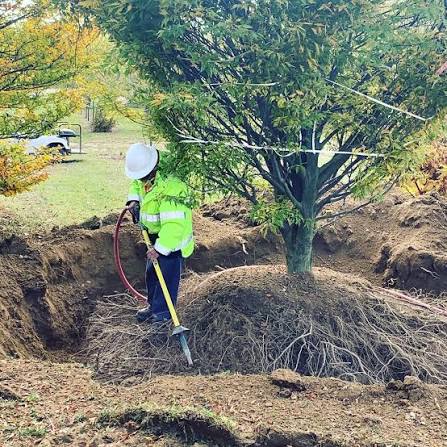
A homeowner wants a mature oak saved, and the new driveway is going in six feet from the trunk. The arborist does not want to cut roots blind. So the crew backs a towable compressor up to the curb, hooks a hose to what looks like a fiberglass wand, and starts peeling soil off the root flare with a supersonic jet of air. No shovel, no bark damage, no snapped feeder roots. It works beautifully, right up until the compressor is a size too small and the tool just fluffs the dirt instead of moving it.
That is the whole story of compressed air for air excavation. The tool is simple. The air behind it is not optional, and it is bigger than most people expect.
Who uses air excavation, and why
Two trades lean on it hardest. Arborists use it for root collar excavation, tree transplanting and bare-rooting, anywhere roots need to be exposed without being cut or bruised. Utility locators and contractors use it to uncover buried lines (water, gas, electric, fiber, phone) when a backhoe bucket is too risky. The same tool also shows up for sensitive archaeological and demining work, but those are not our customers.
The appeal is the same in both: air moves soil and leaves the thing you are looking for alone. Utility work often falls under potholing practices that people reference through ASCE 38, the standard for describing subsurface utility information, and anyone digging near buried lines starts with a 811 locate request. For tree work, root management guidance sits in the ANSI A300 standards. Those are the rules of the road for the job. Your compressor does not have to meet any of them, but it does decide whether the crew can work to them.
The number that surprises everyone: 175 to 185 CFM
Here is the part that catches new crews. A common air excavation tool in the 2000 series is described as a 150 cfm tool, but the compressor behind it is rated for more than that. One manufacturer's kit calls for a compressor delivering 175 cfm at 100 psig. A major arborist supply listing puts the minimum at 175 or 185 CFM and a compressor of at least 33 hp, with a 3/4 inch inlet. Arborists commonly rent a 185 CFM compressor and run it at 100 psi or more.
Two practical rules come out of that:
- Running above the required CFM or pressure is fine. The tool will happily take what you give it.
- Running below it gives poor performance. The soil does not move fast, the crew blames the tool, and the afternoon drags.
The tool family is wider than one size. Smaller nozzles are available that match compressors from about 15 to 250 scfm, a larger model is listed at 330 cfm, and there is a non-conductive version for work near electrical lines. The wider the nozzle and the bigger the tool, the more air it eats. Always check the exact tool you own, and size the compressor to the tool, not to the job.
| What you are doing | Air you should plan for | Notes |
|---|---|---|
| Small nozzle, light root work | Match to the nozzle, as low as roughly 15 scfm | Slow soil removal; fine for small jobs |
| Standard 150 cfm tool | 175 to 185 cfm at 100 psi | The usual rental-compressor target |
| Large tool | Roughly 330 cfm, per the tool listing | Check the maker's current spec |
Soil movement for the standard tool is quoted at about 1.2 to 1.8 cubic feet per minute. That is a useful reality check. If you are moving a fraction of that, the compressor is the first suspect.
Pressure matters as much as volume
The target is 100 psi at the tool, which means the compressor needs to produce more than that at the machine to cover hose losses. A standard 125 psi portable rotary screw has the headroom. A small contractor unit that tops out at 90 does not. The kits typically ship with a 1 inch hose in a short length. Every extra length of hose you add costs pressure at the nozzle, so keep the compressor close to the dig and use the hose size the tool maker specifies, not whatever is on the truck.
Altitude and heat are real
Compressors lose output at elevation, and a unit that makes 185 cfm at sea level makes less in the mountains. Our guide on altitude derating explains how much. Hot days hurt too, because the compressor is running flat out for a long stretch. A tool that works at a continuous 150 cfm needs a machine built for continuous duty, not one rated for short bursts.
Rent, tow or buy
Many tree companies rent a compressor for the odd job. If you air-spade every week, the math flips. We lay out the trade-offs in renting versus buying a tow-behind and in the tow-behind sizing guide. In short, a crew that does this work most weeks usually ends up owning a towable, because you are paying for the rental whether the tool is working or not.
When you shop, look at our towable air compressors and match the rated cfm at 100 psi, not the headline horsepower. A 185 cfm rating at 100 psi is the number you want on the data plate. Our portable air compressors are the better fit for smaller nozzle work and light jobs.
Protect the compressor, the tool and the tree
- Moisture. Cold mornings freeze water in the line and the tool. Drain the receiver before you start and use a water separator at the compressor. Our condensate drains handle this automatically on a shop machine.
- Oil carryover. A worn separator element can pass oil mist. You do not want that blowing across a root zone, so keep the separator and oil service current.
- Dust at the intake. You are making a cloud of soil around a machine that breathes air. Park it upwind and check the intake filter often.
- Sound. One popular tool is listed at 122 dB. That is hearing protection territory, and it falls under OSHA's occupational noise rules. Make ear protection a rule, not a suggestion.
- Wet the soil. Very dry ground does not move well. A good soaking first makes the soil porous and the air does more work.
Mistakes we see
- Buying or renting a 100 cfm machine because the tool is labeled 150.
- Running at 90 psi because the gauge at the compressor says 100.
- Stringing 100 feet of hose to avoid moving the truck.
- Forgetting that a 33 hp machine needs a hitch, a license plate and a truck that can pull it.
- Ignoring the oil service because the compressor is rented, then returning it with a blown separator.
What we sell, and what we do not
We cover the compressor side: towable and portable units, drains, filters and hoses. If you need the excavation tool itself, buy it from a dealer who specializes in arborist or utility equipment, and bring us the spec sheet so we can match the air to it.
Frequently Asked Questions
What size compressor do I need for an air spade?
For the common 150 cfm tool, plan on a compressor delivering 175 to 185 cfm at 100 psi. Smaller nozzles work with smaller compressors but remove soil more slowly.
Can I run an air excavation tool on a small shop compressor?
Not the standard tool. A typical shop piston compressor delivers a small fraction of the cfm required. Smaller nozzles exist for lower-output machines, but expect slow progress.
Is it okay to use a bigger compressor than the tool needs?
Yes. Running above the required cfm or pressure is fine. Running below it is what hurts performance.
Does altitude matter?
Yes. Compressors deliver less air at elevation, so a machine rated at 185 cfm at sea level may fall short in the mountains.
Should I rent or buy a towable?
If you use the tool occasionally, rent. If you air-excavate most weeks, buying a towable with a 185 cfm rating at 100 psi usually pays off.


