


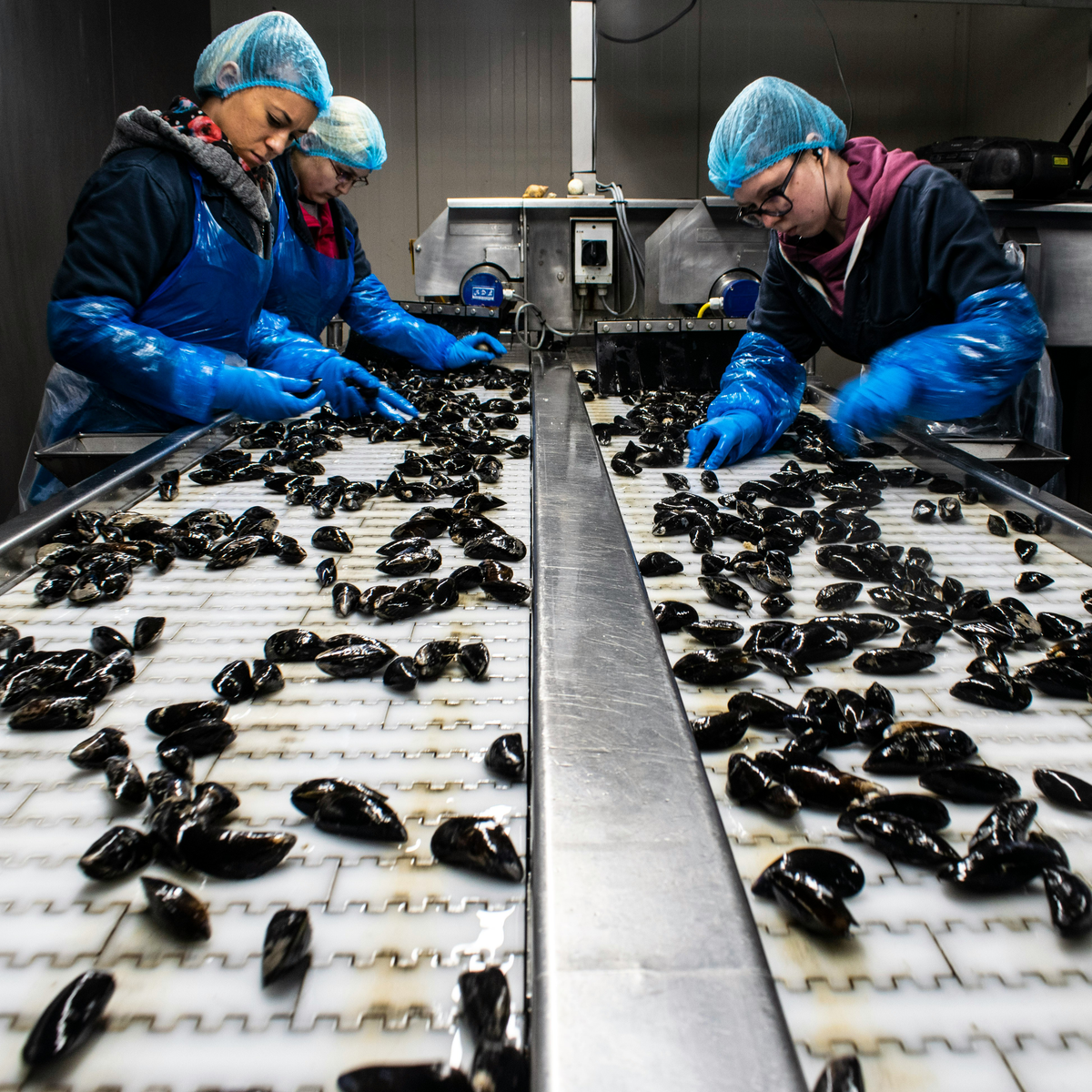
Walk a fillet line at shift change and you understand the problem in about four seconds. Hoses are going, water is sheeting off every stainless surface, the floor drains are running, and somewhere above all of it is a header full of compressed air feeding cylinders on the portioner, the grader gates, and the bagger. The air inside that pipe is supposed to be the one dry thing in the building.
That is the whole job. Compressed air for seafood processing has to stay clean and dry in a plant that is deliberately wet, cold, and salty. Nothing else about the system is exotic. The compressors are the same rotary screws you would put in a machine shop. What changes is the treatment, the piping, and how hard the environment works to undo both.
Three things working against you at once
A seafood plant is harder on an air system than a dry-goods plant for three reasons, and they stack.
First, water on the outside. Daily caustic and sanitizer washdown puts moisture on every exterior surface, and it finds threaded joints, filter bowl seals, drain solenoids, and the inside of any junction box that is not rated for it.
Second, salt in the air. If you are in a coastal plant, or if you run brine chillers or salt glazing indoors, the compressor intake is pulling chloride-laden air. That is what eats aluminum coolers, carbon steel receivers, and the fins on your aftercooler. It is also why a compressor room that shares air with the process floor is a bad idea.
Third, cold. Blast freezers and IQF tunnels run roughly minus 30 to minus 45 degrees F, and anything pneumatic inside them, or on a line that passes through them, will freeze solid if your dew point is above the coldest metal the air touches. A plus 38 degree F refrigerated dryer does nothing for a cylinder sitting in a freezer tunnel.
What air quality do you actually have to hit?
Here is the honest answer that nobody likes. FDA's seafood HACCP rule, 21 CFR Part 123, does not give you a compressed air number. Neither does 21 CFR Part 117. They require you to identify hazards and control them. Compressed air that touches product, or touches a product-contact surface, is a hazard you have to address in your sanitation control procedures or your HACCP plan. The regulation tells you to deal with it. It does not tell you how clean is clean.
The number comes from your audit scheme. BRCGS clause 4.5.3 requires that air in direct product contact be filtered at point of use and monitored. SQF module 11.5.7.1 says compressed air contacting food or food-contact surfaces shall be clean and present no risk. Both point you at ISO 8573-1 as the way to express and verify the target.
The most widely used target comes from the British Compressed Air Society food and beverage code of practice, and most US auditors will accept it:
| Contact type | ISO 8573-1 class | What that means in the plant |
|---|---|---|
| Direct contact (air knives on fillets, blow-off on trays, air that enters a package) | Class 2:2:1 | Particles to 1 micron, pressure dew point of minus 40 degrees F, total oil at 0.01 mg/m3 |
| Indirect contact (cylinders, valves, gates, general plant air near the line) | Class 2:4:2 | Particles to 1 micron, pressure dew point of about plus 37 degrees F, total oil at 0.1 mg/m3 |
Two practical notes. The dew point class is the only one that forces a hardware decision, because minus 40 means a desiccant dryer and plus 37 means a refrigerated one. And the oil number is measured as total oil, which includes vapor, so a coalescing filter alone does not get you there. You need carbon.
Test twice a year at minimum, plus after any work that could affect quality, and test at the point of use rather than at the dryer outlet. Testing at the dryer tells you the dryer works. It tells you nothing about the 300 feet of pipe between the dryer and the air knife.
The treatment train, in order
Order matters more than brand. Build it like this and you will not chase your tail:
- Aftercooler and water separator, to knock out the bulk liquid before anything else sees it
- Wet receiver, which buys you storage and acts as one more place for water to drop out
- General purpose particulate filter ahead of the dryer, to protect the desiccant or the heat exchanger
- Dryer sized for your actual inlet conditions, not the nameplate
- Coalescing filter after the dryer
- Activated carbon for oil vapor and odor, on the branch feeding product-contact points
- Point-of-use sterile or sub-micron filtration at the air knife or blow-off, which is what the auditor will look for
Our air dryers and compressed air filtration cover the middle of that list, and it is the activated carbon stage that trips up most first-time audits, because plants install coalescing filtration, test for oil, and are surprised by the vapor number.
If you want the long version of how the classes are defined, we broke it down in ISO 8573-1 air quality classes, decoded.
Oil-free, or lubricated with treatment?
This is where plants overspend, and where sales people oversell. Both answers are defensible.
An oil-free compressor removes the oil risk at the source. If your direct-contact air is a meaningful share of total flow, or if a customer specification or corporate standard names Class 0 or Class 1 oil, buy oil-free and stop arguing about it. Our oil-free air compressors cover the range most plants need.
A lubricated rotary screw with a good separator, coalescing filtration, and carbon will also meet Class 1 or Class 2 oil at the point of use, and it will cost less up front and less per CFM to run. The catch is that it now depends on maintenance you have to actually perform and document. If your separator element is three years past due, your Class 1 air is a piece of paper, not a fact.
The split most seafood plants land on: one oil-free machine or an oil-free branch for direct-contact air, and standard lubricated machines with full treatment for the utility air that runs gates, conveyors, and the shop.
Piping: the part that gets rebuilt twice
Black iron in a washdown room is a bad trade. It rusts from the outside in a plant that hoses down daily, and it rusts from the inside any time your dryer hiccups. Galvanized is only slightly better and it sheds zinc flakes into your filters.
What works in a wet, salty room:
- Stainless steel for product-contact zones and anywhere the washdown crew points a wand. Expensive, permanent, and the only thing nobody will argue with in an audit.
- Anodized or powder-coated aluminum for main headers and distribution. Light, fast to modify, smooth bore, and it holds up well outside direct spray. See our aluminum compressed air pipe.
- Nothing plastic. PVC is prohibited for compressed air, and in a cold room it gets brittle enough that the question answers itself.
Two details that matter more in seafood than almost anywhere else. Take every drop off the top of the header, not the bottom, so condensate cannot run down into a cylinder. And heat-trace or reroute any line that passes through a freezer, because a plus 37 degree F dew point line entering a minus 35 degree F tunnel will plug with ice at the first fitting.
We went further on the material call, including why 304 stainless pits where 316L holds up and exactly where aluminum belongs, in air piping for seafood plants.
Sizing: rough numbers to argue from
Every plant is different, but these are the loads that show up on nearly every fish and shellfish line. Use them to build a first pass, then verify against your equipment sheets.
| Application | Typical demand | Notes |
|---|---|---|
| Grader and sorter reject gates | 2 to 10 CFM per lane | Short, frequent pulses. Storage matters more than compressor size. |
| Filleting and portioning machine pneumatics | 5 to 20 CFM per machine | Check the OEM sheet. Waterjet portioners add hydraulic load, not air. |
| Vacuum and skin packaging | 10 to 40 CFM per machine | Venturi-generated vacuum is an air hog. Confirm whether yours uses a pump instead. |
| Air knives and blow-off before packing | 15 to 60 CFM per knife | The biggest single swing factor. Engineered nozzles cut this by half or more. |
| Washdown blow-down and cleanup | 10 to 30 CFM | Intermittent, but it lands at shift change when everything else is running. |
| Instrument air for refrigeration valve actuation | 2 to 15 CFM | Small flow, zero tolerance for interruption. Give it dedicated storage. |
Two sizing rules worth following. Add storage before you add horsepower, because almost every seafood plant complaint we hear turns out to be a transient problem rather than a capacity problem. And size the dryer for the hottest day with the aftercooler half fouled by salt, not for the catalog condition.
If you are starting from a blank sheet, our sizing guide walks the math.
What we cannot help you with
Worth saying plainly. If your plant uses modified atmosphere packaging with blended CO2 and nitrogen, we can supply the nitrogen side from a nitrogen generator, but the CO2 supply and the gas blending panel are not ours. Same story with ammonia refrigeration. We will feed clean instrument air to your valve actuators all day long, and the ammonia system itself belongs to your refrigeration contractor.
Mistakes specific to this industry
Putting the compressor room on the wet side. It is convenient, and it kills machines. Salt mist and caustic aerosol go straight into the intake. Put the room on the dry side, duct the intake to clean outside air, and change intake elements more often than the manual says.
Timer drains on a washdown floor. Timer drains either waste air or miss slugs, and in a plant producing this much condensate they miss. Zero-loss condensate drains pay back fast here.
Ignoring the condensate itself. Lubricated compressor condensate carries oil, and in most jurisdictions it cannot go to the floor drain. An oil water separator is cheap compared to a discharge violation.
Testing once and framing the certificate. An ISO 8573-1 test is a snapshot. Plants that pass once and never retest are the ones who find out during an unannounced audit that a failed drain pushed water through the carbon bed eight months ago.
Assuming the freezer line is fine because the dryer is fine. Measure dew point at the coldest point of use, not at the dryer outlet.
Frequently Asked Questions
Do I need an oil-free compressor to pass a seafood audit?
No. Auditors evaluate the air at the point of use, not the compressor type. A lubricated compressor with coalescing and carbon filtration that tests to Class 1 or Class 2 oil passes. Oil-free simply removes a maintenance dependency, which is why larger plants default to it.
What dew point do I need for a freezer tunnel or blast cell?
Below the coldest metal temperature the air will touch, with margin. For a minus 35 degree F tunnel, a minus 40 degree F pressure dew point from a desiccant dryer is the practical answer. A refrigerated dryer cannot get you there.
Can I run stainless only in the product zone and aluminum everywhere else?
Yes, and that is what most plants do. Keep stainless where washdown wands point and where the audit scope sits, and run aluminum headers through the dry side and overhead. Just use proper transition fittings, and do not join dissimilar metals without isolating them.
How often should I test compressed air quality?
Twice a year at minimum, and again after any change to the compressor, dryer, filtration, or piping. Test at the point of use nearest product. Keep the reports with your HACCP records.
My plant is coastal and I am replacing coolers every two years. What fixes that?
Duct the compressor intake away from the salt-laden side of the building, move the compressor room off the process floor if you can, add a pre-filter at the intake, and rinse the aftercooler fins on a schedule. Salt corrosion is an intake-location problem far more often than it is a compressor-quality problem.
If you are specifying a system now, start with the dryer and filtration decision, because everything else follows from the air quality class you have to hit. Clean, dry compressed air for seafood processing is not expensive. Finding out your air was wet after a recall is.


